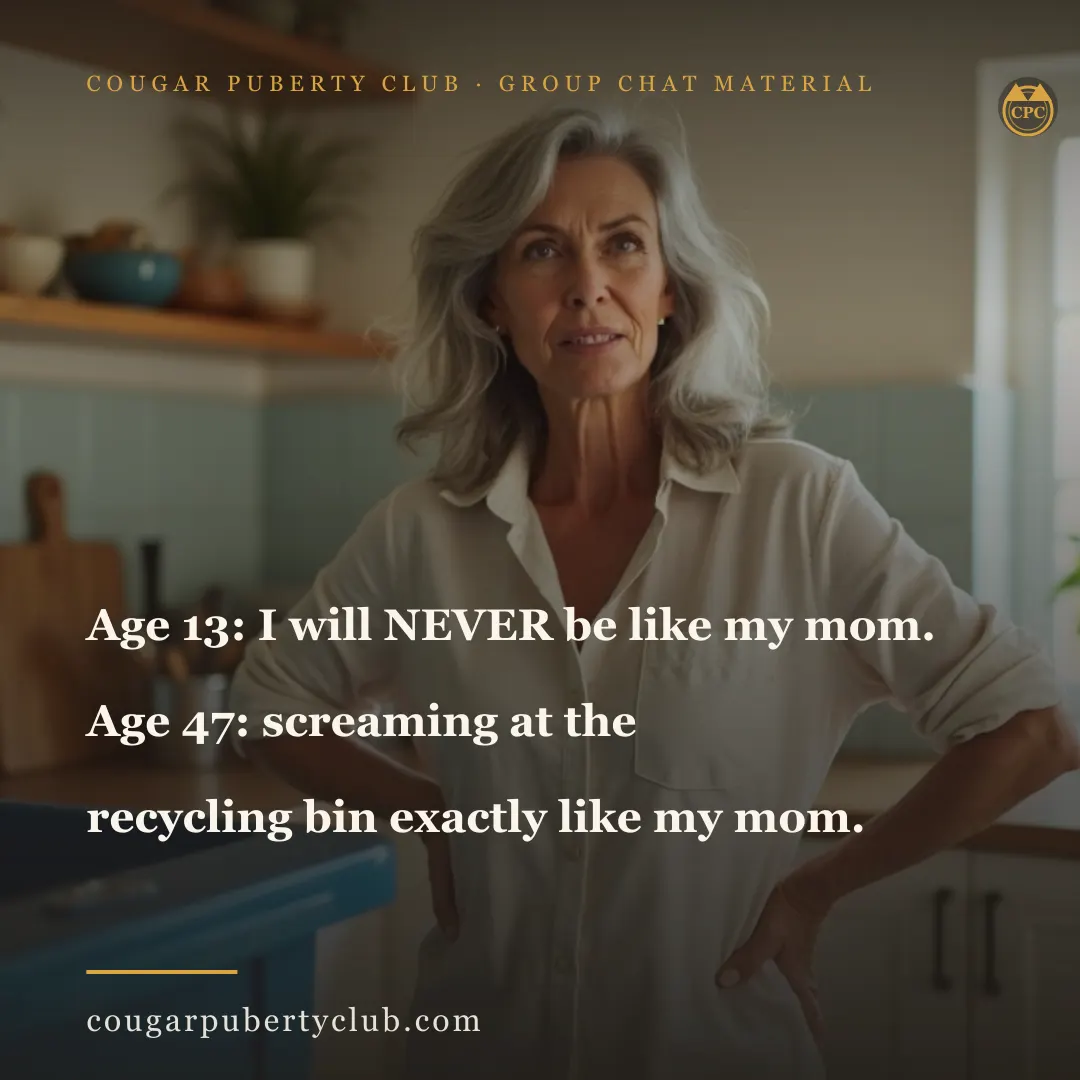
There's a moment in every woman's life when she catches herself doing the exact thing she swore she would never do. Not the big thing. Not the lecture, not the passive-aggressive kitchen comment. The face. The one your mother used to make at the recycling bin, at your father, at the world in general. The one you saw through teenaged eyes and filed under "things I will never become."
Then you turn 47 and the recycling bin has a Blue Bin Situation: someone put a pizza box in there, a greasy pizza box, and you are standing over it making the face. The exact face. The one you've seen in every photo of your mother since 1987. You feel the ghost of your 13-year-old self watching from the doorway, and she is horrified.
Welcome to the generational loop. It's the most shared observation we've ever made: the group chat card gets sent more than anything else on the site, because everyone has had the moment, and everyone is equally unable to believe it.
The inventory: how you know it's happened
The becoming doesn't announce itself. It arrives in small, devastating installments:
The bin face. You are having strong feelings about the recycling. The feelings are correct, but the face is your mother's. You know this because you've seen it in the wild, on her, for forty years.
The weather monologue. You open with "I don't know if you saw the forecast" and you are suddenly 1994 and your mother is in the kitchen explaining barometric pressure to a man who just wants dinner. You can't stop. The weather is important.
The guest-room inspection. You are at someone's house and you find yourself evaluating the guest bathroom with the quiet thoroughness of a building inspector. Your mother is in the building. You are the building.
The sigh. Not the regular sigh. The sigh. The one that communicates volumes without saying a word, the one your father used to ask "what's wrong?" to, the one that was always, always answered with "nothing." You just did it at a closed cupboard. Nothing is wrong. The cupboard has simply disappointed you.
The "I'll just do it myself." You're in a meeting, or a queue, or a kitchen, and someone is doing a task inefficiently, and the sentence is out of your mouth before your ego can stop it. Congratulations. You have become the woman who fixes the towels. Your mother is that woman. You swore you wouldn't be. You are.
None of these are failures. They're the proof of something we don't say enough: you were raised by her, and raising leaves a mark. The loop isn't a curse; it's the shape of a life that loved you enough to teach you, whether either of you noticed at the time.
The part we don't say out loud
Here's the thing nobody in the group chat says, because it feels too soft: the reason the card lands so hard is that we spent our teens building an identity out of not being her. "I will NEVER be like my mom" was the founding document of our selfhood. It was also completely wrong, in the best way.
Because the stuff you inherited isn't the stuff you were afraid of. You were afraid of the boring parts: the routines, the fussiness, the worrying. What you actually got was the competence. The ability to run a household, hold a job, keep the guest towels straight, and still show up to every single school thing for thirty years. The face at the recycling bin isn't her nagging you. It's her standards, living on in you, doing her job.
The women we write for, the competent ones, the ones who run teams and households and everyone else's emotional weather, didn't become their mothers by accident. They became them the way anyone becomes anyone: by watching, by absorbing, by loving. The 13-year-old in the doorway is horrified because she can't see that yet. She will. Give her thirty years.
The forgiveness part
The card's punchline is the loop. The article's is the forgiveness, and it runs in both directions.
Forgiving your mother for being human, for sighing at cupboards, for caring about the recycling more than your teenaged self could understand. You get it now. You are her, standing where she stood, doing the face. The things you resented were almost certainly the things she was doing for you, badly but sincerely, with the tools she had and the exhaustion she never admitted.
Forgiving yourself for the face, the sigh, the weather monologue, the towel-fixing. You're not regressing. You're not weak. You're not becoming someone smaller; you're becoming someone with forty years of accumulated standards, and standards are how things get done. The women who don't become their mothers... are usually not running anything.
And the sneakier one: forgiving the 13-year-old who swore she'd never be this. She was right, in a way. You're not "like" your mother. You're a whole separate person who happens to have inherited her bin face, her standards, and her stubborn insistence that things be done properly. The difference between imitation and inheritance is the choice in the middle, and you get to make that choice every single day. You can do the face and decide what it means.
Where the loop actually breaks
It breaks in exactly one place: when you stop treating "like my mother" as an insult and start treating it as a conversation.
The 13-year-old inside you is still narrating. She's still horrified. And she's still wrong about what the loop means. The loop isn't "you become your mother." It's "you finally understand your mother," which is a completely different sentence, with a completely different ending.
So the next time you're standing over the recycling bin making the face, try this: say her name, out loud, in your head. Not in the annoyed way. In the oh way. Oh. I get it now. That's the loop closing, not around you but through you, from her hands to yours, doing its job.
And then put the pizza box in the trash, where it belongs, the way she taught you. She'd be proud. That's the part she never got to see, but you do.
- Things Nobody Warned Us About
- Married to an Old Man: The Tender Comedy of Aging Together
- Mood Changes in Perimenopause: Why the Dog Food Commercial Makes You Cry
- Perimenopause or just Tuesday? The field guide
Want more of this? Join the 3 AM Club, our newsletter for people who are awake at weird hours, remembering every single thing their mothers used to say. One useful thing, one surprising find, one thing that'll make you laugh. No spam, no creepy tracking.