Everyone told you about the hot flashes. The wave of heat, the sweating, the feeling that your personal climate has been set to "tropical" without your consent. You were prepared for hot.
Nobody mentioned you'd also get cold. Suddenly. For no reason. In a 72-degree room.
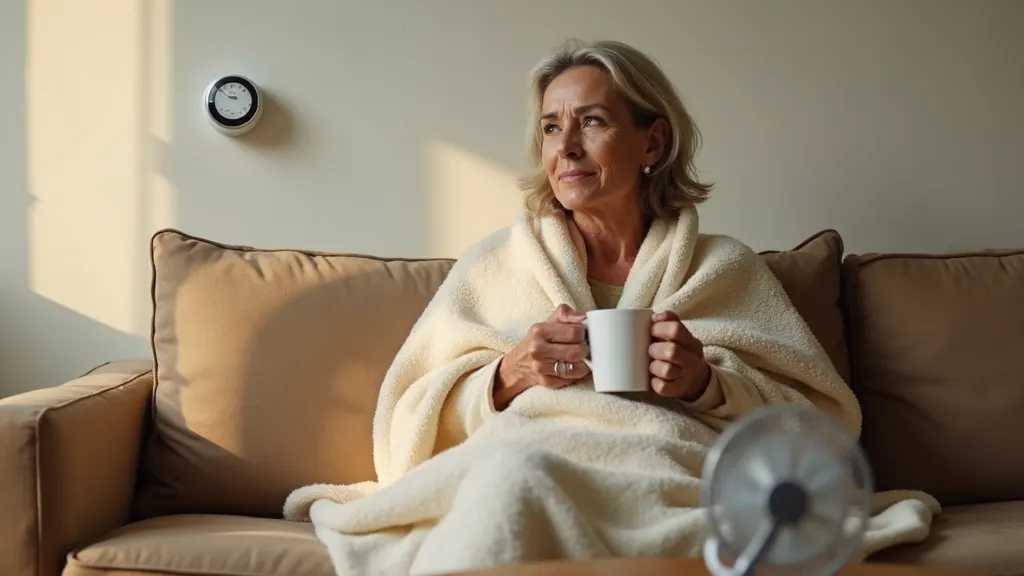
You're sitting on the couch, perfectly comfortable, and then: goosebumps. Shivering. Your hands are cold. You're reaching for a blanket while your partner side-eyes you like you've developed a new personality. Five minutes ago you were kicking off the covers. Now you're underneath three of them.
This is a cold flash. It's real. It's normal. And it's one of the most under-discussed perimenopause symptoms.
What's actually happening
A cold flash is often the other end of a hot flash, quite literally. Here's the sequence:
- A hot flash begins. Your blood vessels dilate rapidly, sending blood to the skin's surface to release heat. You sweat. Your body temperature briefly rises.
- Your body overcorrects. The sweat evaporates, cooling your skin rapidly. Your blood vessels constrict. Your core temperature may temporarily dip below normal.
- You feel cold. Not "it's chilly in here" cold. "I need a blanket immediately" cold. Goosebumps. Shivering. The kind of cold that feels like it came from inside your body, not from the room.
This is the thermoregulatory chaos of perimenopause. Your hypothalamus (the brain region that controls body temperature) is receiving fluctuating estrogen signals and responding erratically Established: The Menopause Society. Sometimes it thinks you're too hot. Sometimes it thinks you're too cold. Sometimes it cycles between both within minutes.
The medical term is "vasomotor instability." The human term is "my thermostat has lost its mind."
What cold flashes feel like
Women describe them as:
- Sudden chills that start internally, not from the room temperature
- Goosebumps and shivering that arrive out of nowhere
- A wave of cold following a hot flash, like your body's thermostat overcorrected
- Cold hands and feet that won't warm up no matter what you do
- The need for a blanket in a room where everyone else is comfortable
- Cycling between hot and cold: sweating one minute, shivering the next
- Worse at night: the hot-flash-then-cold-flash cycle disrupting sleep
The cycle often looks like this: hot flash (2-5 minutes) → sweating → chills (2-10 minutes) → back to baseline. For some women, the cold flash arrives independently, with no hot flash preceding it at all.
When it's not perimenopause
Cold sensitivity can indicate other things. Check with your clinician if:
- Cold intolerance is your primary symptom and it's severe: feeling freezing when others are comfortable in the same room
- You have other symptoms together: fatigue, weight changes, hair thinning, dry skin: could be thyroid (hypothyroidism is common in midlife)
- Your hands and feet change color (white, blue, red) in response to cold: could be Raynaud's phenomenon
- You're experiencing unexplained weight loss, fever, or drenching night sweats that aren't related to hot flashes
- Cold flashes are accompanied by chest pain, shortness of breath, or dizziness
A simple blood test (TSH, T4) can rule out thyroid issues. Most cold flashes are perimenopause. Some aren't. Get the test.
What helps
Cold flashes are harder to treat than hot flashes because they're often the "rebound" from the hot flash. The most effective approach is to reduce the hot flashes themselves.
Reduce hot flash triggers. Caffeine, alcohol, spicy food, stress, and warm environments can all trigger hot flashes. Reducing triggers reduces the subsequent cold flash. What actually changes with alcohol during perimenopause.
Layer your clothing. This is the single most practical intervention. A cardigan over a t-shirt. A scarf you can remove. A blanket within reach. The goal is to add or remove layers quickly, not to find one perfect outfit for a body that changes temperature every 15 minutes.
Keep a small fan AND a blanket nearby. This sounds absurd. It is absurd. It is also correct. The nightstand should have a fan aimed at your face AND a spare blanket folded at the foot of the bed. You will use both in the same night.
Warm your extremities. Cold hands and feet are common because vasoconstriction reduces blood flow to your fingers and toes. A heating pad, warm socks, or a hot water bottle at your feet can help without overheating your core.
Stay hydrated. Both hot and cold flashes increase fluid loss. Dehydration makes the temperature swings more dramatic. Drink water between flashes, not during them.
Consider tracking the pattern. Note when cold flashes happen: after a hot flash? At a specific time? After certain foods or drinks? The pattern helps you predict and prepare, even if you can't prevent every episode.
The psychological weight
There's something uniquely disorienting about cold flashes that hot flashes don't capture. A hot flash is at least well-known: culturally recognized, medically documented, something you can say "I'm having a hot flash" and people understand.
A cold flash is different. You're shivering in July. You're under a blanket while everyone else is in short sleeves. You feel, briefly, like your body is doing something so strange that it must be wrong. It's not wrong. It's perimenopause, just the lesser-known twin of the hot flash that nobody bothered to mention.
That the cold version gets no cultural airtime is the same omission that made cougar puberty a phrase worth inventing in the first place: the symptoms that never make it into the pamphlet are still symptoms.
The bottom line
Cold flashes are real. They're a normal part of the thermoregulatory chaos of perimenopause, usually the rebound from a hot flash and occasionally independent. They're not a sign that something is seriously wrong, but they're worth mentioning to your clinician alongside any other symptoms.
Layer your clothing. Keep a fan and a blanket within reach. Know that the shivering will pass, usually within minutes. And the next time you're sitting under a blanket in a 72-degree room while your partner looks confused, you can say with authority: "It's a cold flash. Look it up."
A hot flash hits right now? The 60-second cool-down protocol. · Full perimenopause symptoms guide. · Why your thermostat has lost its mind.