On Aug. 25, 2026, Dolly Parton died at 80, at a hospital in Nashville, after a brief and private battle with cancer - the kind of private that means the announcement and the grief happened on the same day Press: USA TODAY.
Her nephew, her head of security for more than two decades, delivered the news in a video she had asked him to record years ago. That's the first thing to understand about her: she scripted her own exit, right down to who would say the words.
And the second thing is this: the women my age didn't just lose a singer. We lost the walking, rhinestoned, immaculately-wigged proof that the story we were all told about women and time is a lie.
The expiration date was never real
Here's the script we grew up with: a woman's visible life peaks somewhere in her 40s, and everything after is a quieter, smaller, more apologetic version of the thing. Less work. Less attention. Less being seen. The culture calls it "aging gracefully" when it really means "make yourself smaller on schedule."
Dolly Parton ran the exact opposite play for forty years.
Rock & Roll Hall of Fame at 76. A rock album at 77 - not a legacy cash-in, a real one, with actual rock stars on it, because she decided she wanted to be a rock star and the industry had to get out of her way. A fashion line. A literacy program that has given away more than 300 million books Press: Guardian. She was more visible in her 70s than she'd been in her 40s, which is the exact opposite of the trajectory every woman is promised.
And when someone asked her, at 77, when she was going to stop? She said the sentence that is now going to be carved on our group chats:
"I would never retire. I'll just hopefully drop dead in the middle of a song on stage someday - hopefully one I've written" Press: WhiskeyRiff.
No fade-out. No graceful smaller life. The last thing she did was supposed to be the thing she loved. That's not a celebrity anecdote. That's a blueprint.
The detail that broke everyone
You can find a thousand obituaries of Dolly Parton this week, and they will all mention the records, the songs, the philanthropy. But the detail that went through women's group chats like a current wasn't in any of them - it was in the family's sharing of her final request:
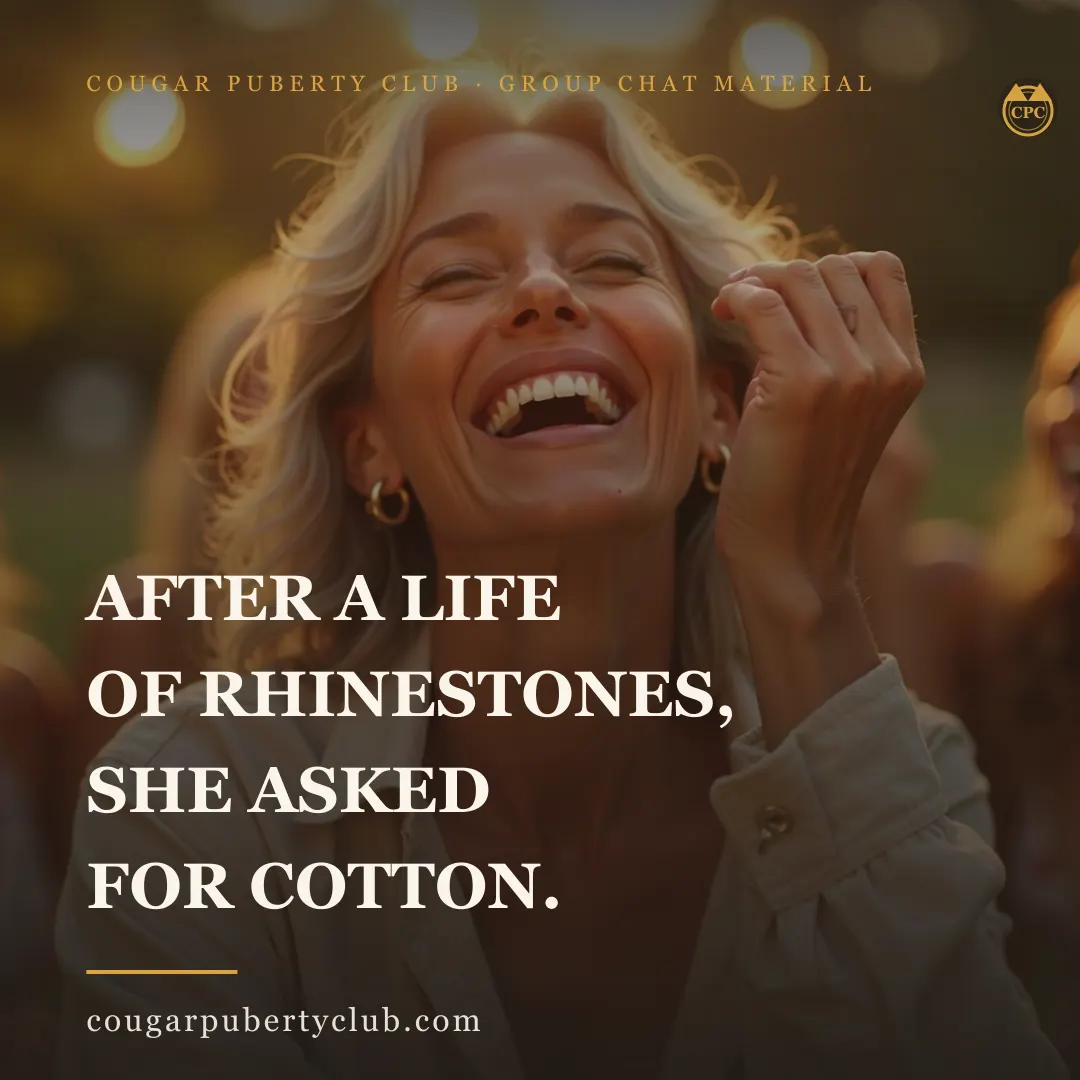
She asked to be laid to rest in a beautiful bed of plush cotton. Because after a life wearing heavy rhinestones, she finally deserved to be comfortable and have some rest.
Rhinestones to cotton.
Read that again, slowly, the way you'd read a text from your best friend at 11 p.m. that makes you put the phone down.
It's the most honest sentence about a life of performance ever written. Decades of being on - the sequins, the wigs, the jokes, the constant work, the 9 to 5 grind, the performing for rooms and cameras and expectations - and then, at the very end, the quiet request for softness. For being allowed to finally, finally be comfortable.
Every woman who has spent thirty years performing at work and at home and in public - the competent one, the one who handles it, the one who looks put-together while her nervous system files complaints - recognized it instantly. Not as a sad detail about a dead celebrity. As a description of their own Tuesday.
The rhinestones-to-cotton arc isn't a tragedy. It's a permission slip: you can be spectacular and exhausted. You can love the show and be done with it. And when you're done, you get to ask for cotton. That's the part nobody tells you - the rest comes after the performance, not instead of it.
The grief is a gift
Here's what the mourning is really about, if you look at it honestly: Dolly Parton was proof that the second half could be the best half. She got more of herself with time - more visible, more successful, more unapologetic, more Dolly - in the exact decades where women are told to expect the opposite.
The women who grew up on 9 to 5, who watched Steel Magnolias with their moms, who knew every word of Jolene before they knew what heartbreak was - they're not just grieving a singer. They're grieving the version of their own future that suddenly feels more possible and less possible at the same time. More possible, because she did it. Less possible, because she's gone, and the proof went with her.
But it didn't. That's the thing. The proof wasn't her fame. It was her choices - the ones she made in her 60s and 70s, when she could have coasted and didn't. Rock album at 77. Hall of Fame at 76. Still working at 80. Those choices are still there, waiting to be copied by every woman who's been told her turn is over.
She didn't peak before you. She peaked after the age you're at now, probably. That's not a eulogy. That's a to-do list.
What her 80s prove about your 50s
So let's say it plainly, the way the group chat would if it weren't busy crying:
- The decline script is optional. She had 25 US country No. 1 singles, wrote two of the 20th century's greatest songs in a single day Press: Guardian - and then did her most interesting work in the decades women are told to step back.
- Being 'on' for decades doesn't mean you're broken. It means you're tired. Rhinestones to cotton isn't a failure of the performance; it's the completion of it.
- You get to ask for softness. The women who recognized the cotton detail were the ones who needed it most. Asking for rest isn't giving up. It's what the rest was for.
- More visible is a choice, not a miracle. She decided visibility was hers to keep. The culture didn't grant it. She never surrendered it.
- The second act is where the interesting work happens. Her 70s were bigger than her 40s. Yours can be too - and you don't have to wait for a comeback narrative. You can just start.
Dolly Parton died in the middle of her life, at 80, which is exactly how she wanted it - in a world where she was still doing the thing, still being seen, still refusing to quietly expire. She didn't retire. She didn't shrink. She went out the way she told us she would: on her own terms, mid-song, after a life of rhinestones.
And then she asked for cotton.
That's the whole lesson in two words. Be spectacular. And when you're done - not before, when you're done - ask for what you need. You've earned it. She proved it.