Sometime in the spring of 2026, a TikTok claimed that your labia disappear in menopause. Not "change." Not "get a little different." Disappear. And then the internet did what the internet does: millions of women went to the bathroom mirror and started checking.
If you were one of them – if you looked, and squinted, and thought wait, is that smaller than it used to be? – here's the thing you need to hear: you weren't imagining it, and you weren't being dramatic. The changes are real. The disappearance is not.
They didn't disappear. They changed. And the change has a name, a mechanism, and treatments that actually work.
The name: Genitourinary Syndrome of Menopause (GSM)
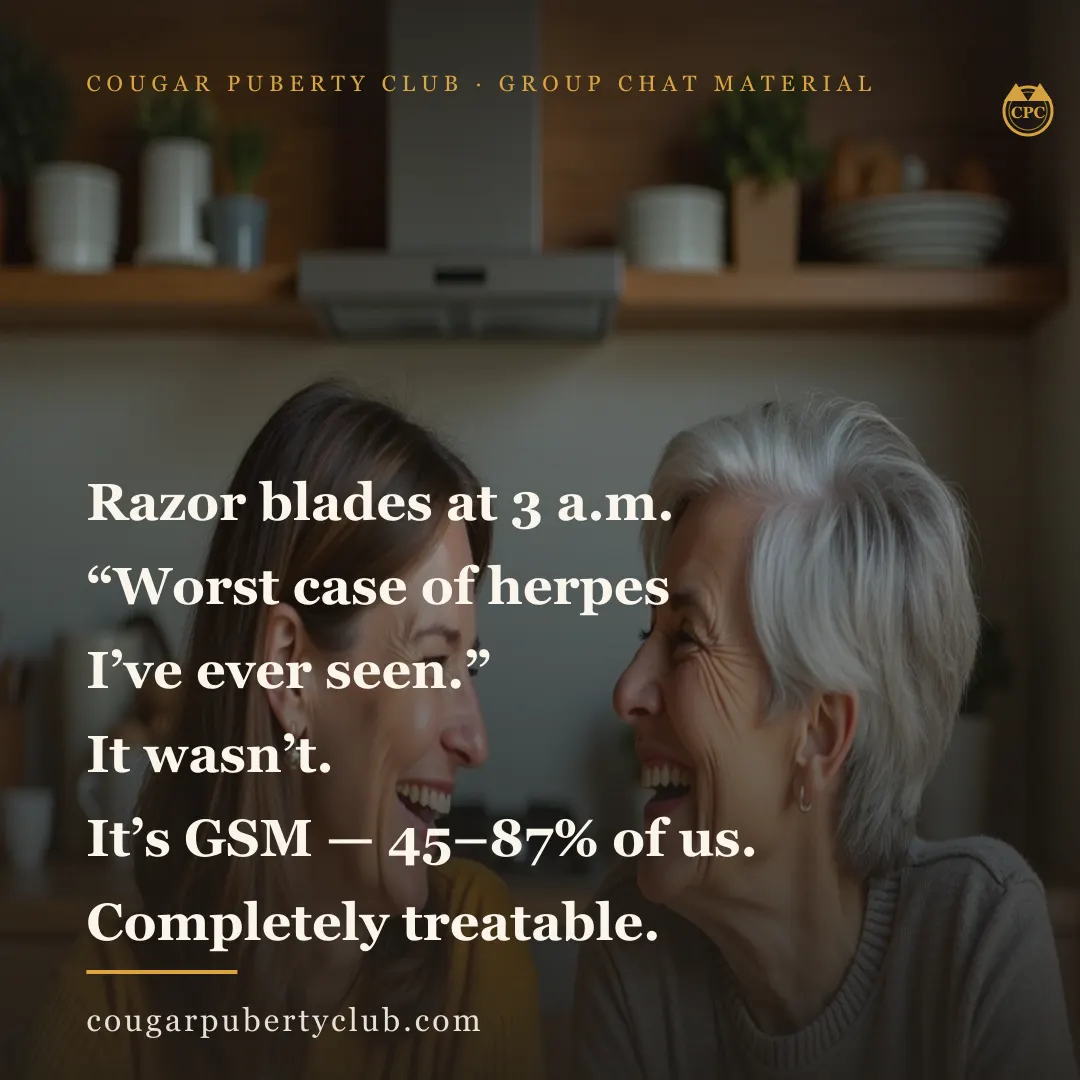
The clinical term for what that TikTok panic was circling is genitourinary syndrome of menopause – GSM for short. It's the updated name for what used to be called "vaginal atrophy," introduced in 2014 to reflect that this isn't just about the vagina looking different; it's a range of vulvovaginal, sexual, and urinary symptoms that happen when estrogen declines Established: SELF.
And it's shockingly common. GSM affects as many as 27% to 84% of menopausal women – while only about 7% of those women are receiving any treatment for it Established: SELF. Up to 85% of women in midlife and beyond experience it in some form, and roughly 70% never mention it to a clinician Established: Harvard Health.
Seven percent treated. That's not a story about women being fine. That's a story about silence.
What's actually happening down there
Here's the short version: your tissues are estrogen-dependent, and perimenopause is an estrogen wind-down.
Estrogen keeps vulvovaginal tissue healthy, lubricated, and moist. When levels drop, the tissue becomes more fragile, thinner, and drier Established: SELF. Under a microscope, postmenopausal vaginal tissue has fewer cell layers than premenopausal tissue – that's the literal, physical source of the "shrinkage" that started the panic Established: SELF.
What that looks like in the mirror:
- The labia minora (inner lips) can diminish in size, become paler, and in some cases start to fuse together Established: SELF
- The clitoral hood can get smaller Established: SELF
- The inner labia can reduce in size or retreat further over time if GSM goes untreated Established: Harvard Health
None of that is "disappearing." It's thinning and shrinking – and unlike the TikTok implied, it's not an irreversible mystery. It's a condition with a treatment ladder.
The part nobody's group chat mentioned: it's not just visual
GSM isn't only about what you see. The same tissue changes drive symptoms that women put up with for years without connecting the dots:
- Vaginal dryness, itching, or irritation Established: SELF
- Pain or discomfort during sex, even bleeding after sexual activity Established: SELF
- Decreased lubrication and lower libido Established: SELF
- Urinary urgency, frequency, or pain urinating – including "UTIs" that don't behave like UTIs Established: SELF
That last one deserves its own paragraph. When labia shrink, they provide less of a protective barrier around the urethra, and the vaginal pH and microbiome shift in ways that let more harmful bacteria thrive Established: SELF. The result: recurrent UTIs – or UTI-like symptoms with no actual infection. (And if peeing has gotten generally weird, the sneeze-prayer problem – leaking when you laugh or cough – is its own perimenopause classic we've covered separately.) But the UTI trap is real: Harvard Health warns that untreated bladder infections can eventually affect the kidneys Established: Harvard Health.
The good news (the part the algorithm skipped)
GSM is treatable, and treatment can reduce symptoms or even reverse the course of the tissue changes Established: SELF.
The ladder, from simplest to most medical:
- Lifestyle. Ditch harsh or highly scented soaps and cleansers around the vulva and vagina Established: Harvard Health.
- Over-the-counter. Vaginal lubricants for sexual activity, and longer-acting vaginal moisturizers used a couple of times a week – the first-line options for milder symptoms Established: Harvard Health.
- Prescription. Vaginal estrogen – creams, rings, tablets that deliver estrogen directly to the tissue – is considered the gold standard, and DHEA can help too. These improve tissue quality, thicken the walls, and restore normal pH so the UTI-causing bacteria crowd back out Established: Harvard Health.
We did the product homework on step 2 so you don't have to guess between fifty identical-looking tubes: our perimenopause intimate care guide breaks down moisturizers vs. lubricants, what reviews actually say, and what to skip.
When it IS something else (the red-flag section)
GSM is a real, common explanation – but it's not the only explanation, and it shouldn't become a shrug for everything. Make an appointment if you notice:
- New or unexplained bleeding – GSM can cause bleeding after sex due to fragile tissue, but bleeding still deserves proper evaluation rather than assumption Established: Harvard Health
- Unusual discharge, lesions, or sores that aren't explained by the dryness picture
- Persistent or worsening pain that isn't responding to the basic fixes
- Recurrent UTI symptoms – worth checking whether it's GSM-related urinary changes before another round of antibiotics Established: Harvard Health
And here's the permission slip you may need: you don't have to wait for your annual exam to bring this up. You can book an appointment specifically to start this conversation Established: Harvard Health. That's what the appointment is for.
How to actually say it out loud
Practice these opening lines – they all work:
- "I've noticed things feel different down there since perimenopause started, and I'd like to understand what's normal."
- "I saw something online about labia changes in menopause and it freaked me out. Can you tell me what's actually going on?"
- "Sex has gotten painful and I've been avoiding it. I want to talk about options."
The clinicians are not going to be shocked. You will be the seventh percent. That's a good thing to be.
The bottom line
The TikTok said your labia disappear in menopause. The real story: perimenopause changes the tissue – thinner, drier, less elastic – and the change is so common and so poorly named-for that a panic went viral before the clinical answer did Established: SELF.
The clinical answer is GSM, it affects up to 85% of women in midlife Established: Harvard Health, and it's treatable – with a $15 moisturizer or a prescription that changes everything.
They didn't disappear. They changed. And now you know what to call it.
If this answered the question you were too embarrassed to type, you're in the right place. Continue with vaginal dryness in perimenopause: the thing nobody talks about, the full perimenopause symptom list, or the intimate care buying guide.