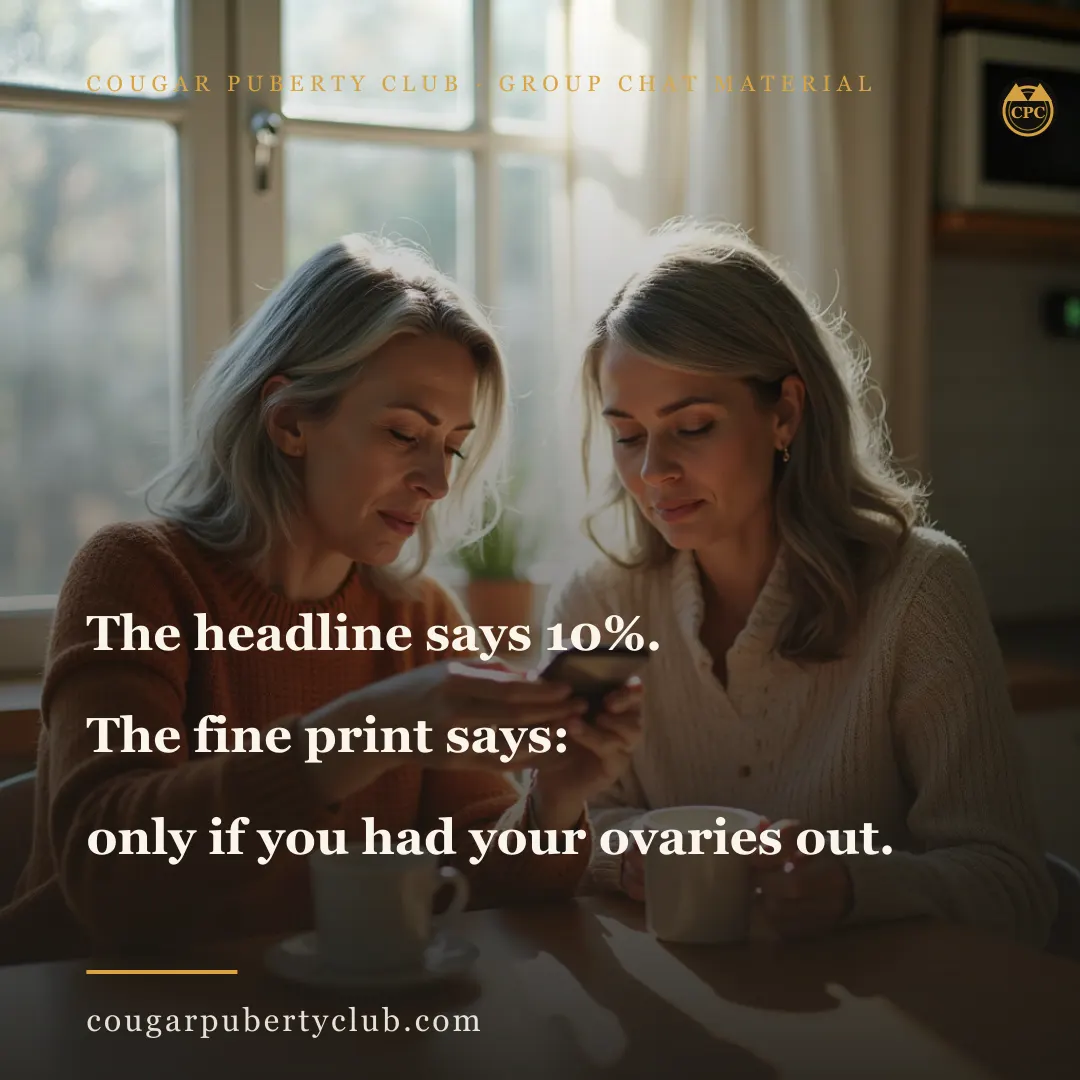
The group chat did its thing this week: the Guardian, the Independent, US News, half of Instagram – "HRT lowers dementia risk." Ten percent. The largest study of its kind. Women everywhere forwarded it with an exclamation point, and the menofluencers added the I-told-you-so face.
Then you read the actual study, and the headline is doing a lot of heavy lifting. Let's decode it – because the fine print isn't the boring part. The fine print is the part that's actually about you.
The study, in one paragraph
Squires et al., published in Alzheimer's & Dementia (the Alzheimer's Association's journal): 183,450 postmenopausal women from the UK Biobank, followed for an average of 13.3 years, about 4,000 dementia cases – the largest analysis of its kind. Women who reported using HRT for at least a year had a 10% lower risk of any dementia and a 16% lower risk of Alzheimer's compared with non-users Established: Alzheimer's & Dementia.
That's the headline, and it's accurate. It's also incomplete, and the missing part is the whole story.
The fine print: who is the 10% actually about?
The 10% is a pooled average. When you break it down, the picture changes shape:
- Natural menopause: no statistically significant benefit. For the group most women will think of – naturally timed menopause – the association didn't reach significance. This is the finding the abstract doesn't mention; it leads with the pooled 10% and the most favorable subgroups Established: The Vajenda.
- Early surgical menopause: 26% lower risk with HRT. The strongest reduction, and it's not close. Women who had their ovaries removed early and used HRT saw a 26% lower dementia risk Established: Alzheimer's & Dementia.
- APOE ε4 carriers: 13%. The gene variant that raises Alzheimer's risk; HRT use was associated with a 13% reduction in that group Established: The Vajenda.
- Lower lifetime estrogen exposure: 16%. Defined as fewer than 37 years between first period and menopause – a category that, as Gunter notes, partly overlaps with surgical menopause Established: The Vajenda.
Read it that way and the pattern is unmistakable: the benefit concentrates in women who lost their estrogen early or abruptly. That's not "HRT protects everyone's brain." That's "HRT restores the baseline that surgery or premature menopause took away." The women who benefited most were getting back to normal – not getting ahead of it.
Why the abstract buried the null
Here's the part that should annoy you, because it's an editorial choice, not a statistical one. The paper's own results show no significant benefit for naturally menopausal women – yet the abstract leads with the pooled number and the flattering subgroups, and never states the null. Dr. Jen Gunter, the OB/GYN behind The Vajenda, spells it out: that changes what an abstract-only reader takes away. And most people – including the people posting "SEE?! I TOLD you" – are abstract-only readers Established: The Vajenda.
Then there's the subgroup rabbit hole: starting HRT at 51-56 was associated with an 18% lower dementia risk, but starting at 46-50 wasn't significant. Gunter's verdict: a subgroup of a subgroup, one significant finding flanked by non-significant ones – exactly the pattern chance produces. A hypothesis to test in a trial, not a finding to act on Established: The Vajenda.
The honest version: why "10% lower risk" can't be a prescription
Three reasons this study can't tell anyone what to do:
- It's observational. Healthier, wealthier women are more likely to use HRT – the healthy-user effect. And women in the early stages of cognitive decline are less likely to start HRT – reverse causation. Both make non-users look higher-risk than they are Established: The Vajenda.
- The Biobank's HRT data is a snapshot. One question at enrollment (2006-2010): "Have you ever used HRT?" Plus age first used and age last used. No dose. No formulation. No route. No full duration – "at least a year" lumps three years with ten, and never-users are grouped with women who quit after two months because of a complication Established: The Vajenda.
- The authors say so themselves. They conclude the findings "rationalize the need for confirmation in an RCT setting" – randomized trials, the gold standard. A study whose authors call for trials to confirm it cannot, in the same breath, guide prescribing Established: Alzheimer's & Dementia.
What this actually means for you
If you went through natural menopause – the majority of us – this study is not a reason to start HRT, and it's not a reason to panic. The headline applied a 10% average to a group where the signal didn't hold up. Your brain-fog conversation with your doctor stays exactly the same conversation it was last week.
If you had early surgical menopause – this is genuinely good news, and it's also not news: it lines up with what every major menopause society already recommends, which is estrogen until roughly the average age of menopause (about 51), then a re-decision point Established: The Vajenda. If that describes you and you're not on estrogen, that's the doctor conversation worth having this week.
And the next time a headline lands in the group chat – before the forwarding finger fires, ask the one question this study's abstract didn't want asked: for who? The answer to "does HRT prevent dementia?" turns out to be "for whom," and the difference between those two questions is the difference between a headline and a study.
The fear is real. The data is better than the fear – and the fine print is where the data actually lives.
When to see a doctor
Forgetting words is usually brain fog, not dementia – but if memory changes are getting worse, happening at home and at work, or coming with confusion about familiar places or tasks, that's a conversation for your clinician, not the group chat. HRT decisions – starting, stopping, dosing, duration – belong in that same conversation. This article is a decoder ring for headlines, not a prescription.