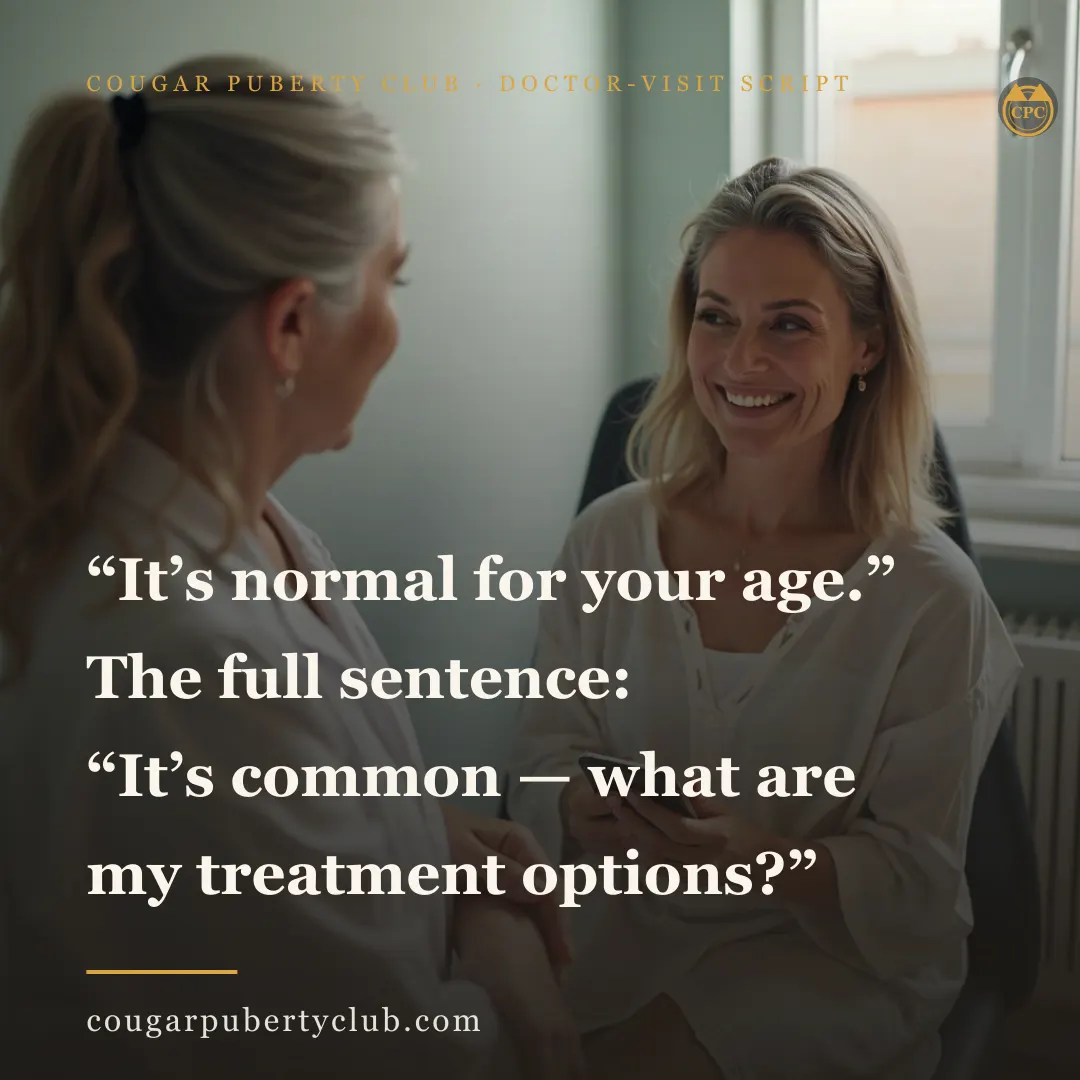
The sentence that ends more midlife appointments than any other: "It's just normal for your age."
Say it out loud and you can hear both halves. The first half is comfort - you're not broken, this happens, you're not alone. The second half is a door closing - nothing to see here, no referrals, no options, see you next year.
A woman sits on the exam table hearing both at once. She's supposed to feel grateful for the comfort. Instead she walks out with the symptom, minus the permission to mention it again.
Here's what the research finally caught up with: that sentence doesn't just feel like a dead end. It is one.
The study that named the double edge
In August 2026, Nature Human Behaviour published the finding women have been describing in community threads for years: reassurance through normalization suppresses treatment Established: Nature Human Behaviour.
The researchers ran 14 studies with 9,371 participants. When clinicians reassured people by telling them their symptoms were typical or expected, people became less likely to seek or continue treatment. The effect held across a wide range of conditions - including menopause.
Not because the patients were lazy. Because the sentence did its job. "Normal" is a period at the end of a conversation. The clinician said everything was fine; the patient's brain filed the symptom under handled. Nobody is rude enough to bring up the thing the doctor just closed.
But here's the part that matters for you: the study isn't an indictment of comfort. It's a finding about stopping at comfort. The reassurance isn't the problem. The full stop is.
Normal ≠ acceptable. Normal ≠ untreatable.
Let's untangle the word that's doing all the work.
When your doctor says a symptom is "normal for your age," they mean it's common. That's usually true - perimenopause symptoms are common, and they're common because estrogen is doing its documented thing across your sleep, mood, temperature and bleeding systems Established: Cleveland Clinic.
But "common" has somehow been smuggled into meaning "acceptable" and "untreatable," and neither of those follows.
Hot flashes are common. They're also treatable. Insomnia at 2:47 a.m. is common. It's also treatable. Rage that arrives with zero warning is common - and it's treatable, and it's worth treating, because the people who love you would like their eyebrows back. Hormone therapy, non-hormonal options, sleep work, and lifestyle levers all exist for symptoms like these Established: ACOG, Established: NHS.
Common and fixable are not opposites. They're the same sentence. That's the reframe. That's the unlock.
The comfort-vs-dismissal test
So how do you tell the difference between a doctor comforting you and a doctor dismissing you? Both start with the same five words.
The test is what comes after.
Comfort comes with a plan. "This is common. It's also very treatable - here are your options, let's talk about which fits your history, and let's check thyroid and iron while we're at it." The sentence opens a door.
Dismissal comes with a full stop. "This is normal for your age." No options. No questions invited. No follow-up scheduled. The chart closes.
You've been trained to hear "it's normal" as the end of the conversation. That training is the problem - and the new research says the training runs both directions. The clinician says it to close the visit. You hear it and close the door on your own symptoms. Two people, one sentence, zero treatment.
The script: three sentences that reopen the door
You don't need to argue with the diagnosis. You don't need to be the most assertive woman in the building. You need one turn.
"I hear that it's common - what are my treatment options?"
That's the whole move. You're not disputing "normal." You're doing what the study says gets lost: you're refusing the full stop and asking for the next step.
Then add the thing that makes it impossible to wave away - your evidence:
"I've been tracking for two months. My sleep, mood and hot flashes come in waves that track my cycle, and I have a genuinely good week each month. Can we talk about what's treatable - and rule out thyroid and iron while we're at it?"
You are not a hypochondriac with a clipboard. You are a patient with data, asking for the part of medicine that actually helps. If the answer is still a full stop - no plan, no tests, no referral - that's a data point about the doctor, not about you. Take the log to someone who reads it.
When "normal" is a red flag no matter what
Some symptoms deserve a workup even if they're common, because common and concerning overlap more than anyone likes to admit Established: Cleveland Clinic:
- Bleeding between periods, after sex, or flooding through protection - this gets investigated, full stop, regardless of age
- New, severe, or changing symptoms - the change is the signal
- Chest pain or shortness of breath that's new - not a "wait and see"
- Thoughts of self-harm or despair that feel bigger than you - that's not a hormone lecture, that's a phone call: in the US, 988 (Suicide & Crisis Lifeline); in the UK, NHS 111, or 999 in an emergency
"Normal for your age" is a statement about the population. It is not a statement about your body's current status. If a symptom is interfering with your life, that is medical relevance. That's the definition. You don't need to justify it.
The rule we keep on the wall
Cougar Puberty Club's editorial rule came out of this exact finding: normalize the experience, never stop at normalization.
"Your body is not broken" is the comfort. "And this is treatable" is the point. One without the other is either a pep talk or a dismissal - and per the study, the second one is doing measurable harm.
So the next time you hear "it's normal," hear the full sentence: it's normal, and it's treatable, and here's what we can do. If your doctor only said the first half, say the second half yourself. It's one sentence. It's the one that gets you help.
Screenshot this for the group chat - we made it a card, because every woman in your life has heard this sentence and most of them stopped there.
This article is education, not a diagnosis. Symptom lists vary wildly between women - the treatable-versus-normal conversation is exactly what a clinician is for.