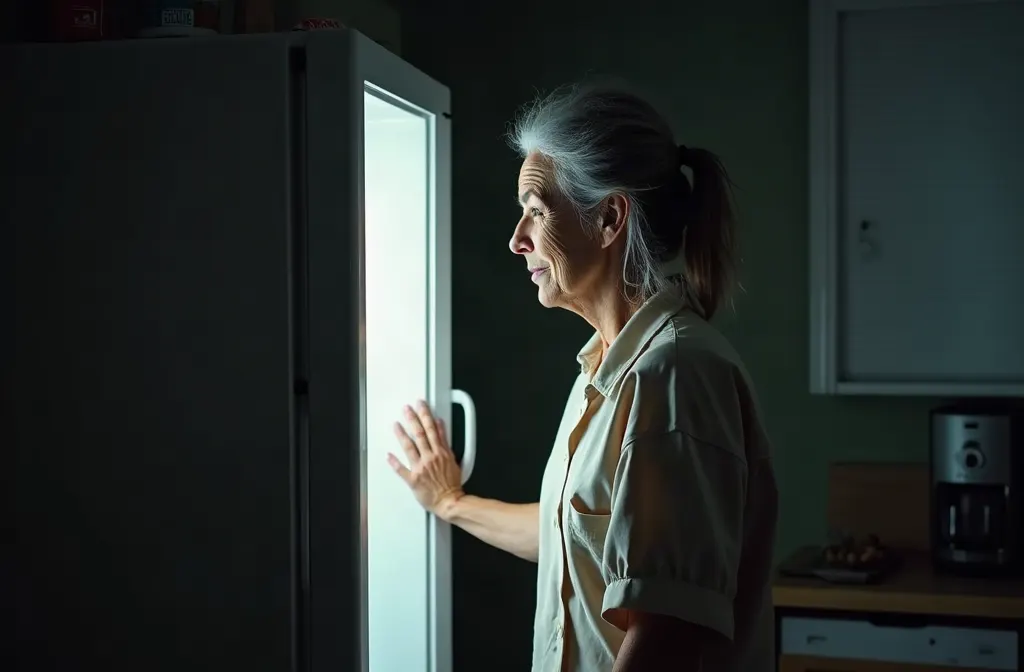
Your friend has never had an eating disorder in her life. She'll tell you that herself, firmly, the way she tells you her marriage is fine. She has also, in the last three years, developed a private set of laws: no bread on weekdays, nothing after 8 p.m., a protein bar instead of lunch if she was 'bad' yesterday. She weighs herself in the morning and does mental math about it in the grocery store. And at 12:47 a.m., she stands in front of the open refrigerator, lit up like a museum exhibit, not eating anything - just standing there, exhausted, staring at the light.
She doesn't know she's a research demographic. Nobody screened her for it. That's the whole problem.
The population nobody screens
In 2026, Florida International University published the story of Maria Bazo Perez's research on eating disorders in midlife women. The headline finding is the kind that makes you re-read it: eating disorders among women between 45 and 65 are not new, but the rate is growing Established: FIU News. Her research, published in the Journal of Eating Disorders, compared disordered-eating patterns across more than 1,000 women in two age groups - emerging adulthood and midlife - and found the emotional machinery is different at 50 Established: Journal of Eating Disorders.
The gap between the research and the reality is the story. Standardized eating-disorder screening barely exists for later life stages. The tools were built for teenagers, and the cultural conversation still pictures a young woman when it pictures this illness at all Established: Journal of Eating Disorders. A BMC Medicine survey of 5,500 women found about 15% met criteria for an eating disorder. A JAMA Network Open study found one in five women has dealt with one by age 40 Press: Flow Space. Penn Medicine's supervising psychologist at the Princeton Center for Eating Disorders told Flow Space that inpatient admissions of women over 40 went from about 5% in the 1990s to about 12% in the early 2000s - and her 2026 estimate is higher Press: Flow Space.
Translation: the women were always there. The screening never arrived.
It looks nothing like the brochure
Here's the part that explains why your friend - and maybe you - never recognized it. The midlife presentation is the mirror image of the stereotype.
Teenagers and young women with eating disorders are often diagnosed with anorexia or bulimia: disorders associated with dramatic weight loss. Middle-aged women are more likely to experience binge eating and night eating - which cause weight gain Established: FIU News. So the illness that was supposed to make you thin is, at midlife, making you heavier, which means the whole thing looks like the opposite of a disorder. It looks like a discipline problem. It looks like the menopause belly. It looks like every 'you really should watch the carbs' conversation she's ever sat through.
And the shame compounds it. Bazo Perez's research found midlife women have trouble accepting help because they believe they should have their act together by midlife, which leads them to hide the behaviors. 'Many women struggle prioritizing themselves and their health, which adds to the barrier of seeking help,' she says Established: FIU News. The woman who runs a household, a career, and three other people's emotional lives cannot admit she lost a fight with a sleeve of Oreos at 1 a.m. So she doesn't. She just adds another rule.
The peri collision
Now add perimenopause, and you get the specific mess that makes this a Cougar Puberty Club conversation instead of a general one.
Your body starts redistributing weight in ways no diet can fully override - that's a documented part of the transition Established: NHS. The old rules stop working. The scale does something that reads, to a woman with 25 years of dieting experience, as personal failure. And here's what the research adds: a woman's experience with menopause can predict her eating-disorder behaviors. Women who find menopausal symptoms debilitating are more likely to develop disordered eating Established: FIU News.
It's a perfect trap. The transition changes your body and raises your risk of developing disordered patterns and gives you a culturally approved excuse to double down on restriction - because now you're not dieting, you're 'managing your menopause weight.' Every diet-culture instinct you've spent decades training gets to dress up as self-care.
And the trigger isn't even what the old model says it is. Midlife women with eating disorders are less likely than younger women to say body image triggered it. They're more likely to cite divorce, loss, health problems, caregiving, or becoming an empty nester Press: Flow Space. The Journal of Eating Disorders study found emotional-regulation difficulties were more strongly tied to disordered eating in middle-aged women than in younger women Established: Journal of Eating Disorders. In other words: when your life hands you a crisis and nobody taught you a coping skill that isn't food-related, the food rules are how you feel in control. That's not weakness. That's a system doing its job - coping - with the only tool it was given.
The Ozempic footnote
Bazo Perez adds a warning that belongs in this conversation: the current GLP-1 era has exacerbated these issues Established: FIU News. The drug that finally 'fixes' the menopause weight becomes the most socially sanctioned restriction in history - and the food rules don't go away when the prescription does. If the pattern underneath was never addressed, it finds a new costume. The weight comes back, the shame comes back, and now there's a second layer: the fear that you're failing at a medication.
The help-seeking checklist
This is not a diagnosis. This is the list to read at the kitchen counter, alone, honestly. You don't need to hit all of these for something to be worth a conversation with a clinician - one or two is enough.
Notice the patterns:
- Eating rules that have gotten stricter, more secret, or more punishing over the last few years
- 'Good' and 'bad' food categories you enforce privately and would be embarrassed to say out loud
- Eating when you're not hungry - especially at night, especially in secret
- Feeling out of control around food, then 'compensating' with restriction or exercise
- Weighing yourself more than once a day, or letting the number decide whether you're allowed to eat normally
- Avoiding eating with other people, or eating differently in front of them
- Using food rules to feel in control when life is falling apart
Notice the shame:
- Hiding what you eat (or don't eat) from your partner, your friends, your doctor
- Feeling like you should have this handled by now, which is why you haven't mentioned it
- Believing this is just what 25 years of dieting does to a person
Say it out loud: If you're in crisis - thoughts of harming yourself, or feeling out of control in a way that scares you - that's urgent: call 988 (Suicide & Crisis Lifeline) or your local emergency number, now. For the eating patterns themselves, the next step is a conversation with a clinician, and you can use the exact sentences: 'I have a complicated relationship with food and I'd like to talk about it' or 'I eat more than I mean to at night and I'm ashamed of it.' You don't need to have it sorted out first. That's their job.
And if you're not sure whether this applies to you - bring this article to your clinician and ask the questions at the top. Bazo Perez's ask is simple and it's the whole point: doctors should be asking patients about their eating habits at every life stage, not just the ones the brochures cover. Screening at the primary care doctor 'needs to be done ASAP' Established: FIU News. You can be the patient who makes that happen by asking first.
What this article is not
It's not a warning that every woman with a diet has a disorder. A 25-year diet is normal for our generation - it's the air we grew up breathing. The question is what's underneath the rules: choice or compulsion, flexibility or fear, self-care or self-punishment.
It's also not 'everything is peri.' The menopause transition explains a lot about your changing body, and it doesn't excuse or explain away disordered eating - they can absolutely coexist, and treating one doesn't require ignoring the other. That both/and is the honest position, and it's the one that gets you taken seriously instead of waved off.
The body truce is real and it's available. But a truce requires knowing you're in a war - and the war nobody screened for is the one your friend is standing in, at 12:47 a.m., staring into the refrigerator light, calling it discipline.