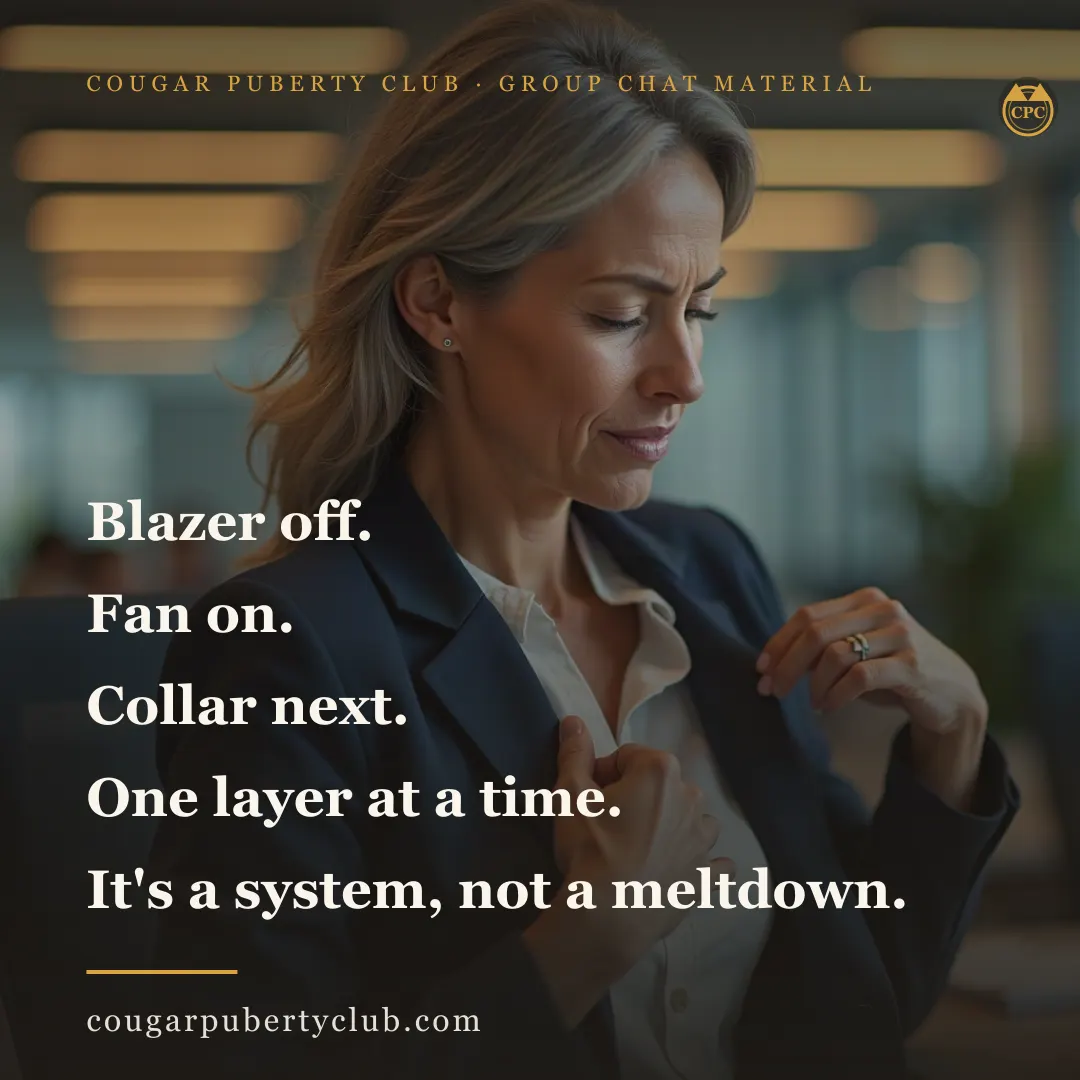
The meeting starts at 9. You're wearing the blazer the dress code requires, over the silk shell that was a lie the moment you bought it, and somewhere around minute six the heat starts behind your ears and moves down your collar like a slow, personal apocalypse. You can't take the blazer off - last time you did, someone asked if you were feeling okay, and you said "just warm," and they said "it's 68 degrees in here," and you smiled like that was a reasonable thing to hear.
Here's what the research finally caught up to: it's not you, and it's not just the thermostat. In August 2026, researcher Zoe Shaughnessy announced a fashion-psychology study - with Henpicked's Menopause Friendly membership, of all the unlikely allies - looking at how workplace dress codes, uniforms, and "professional appearance" expectations interact with perimenopause and menopause HR Press. Hot flushes, changing body temperatures, restrictive clothing, fabric that doesn't breathe. The hypothesis is basically what every woman who has ever worn a mandated blazer in July already knows: the dress code is the thermostat you cannot fight.
This is the protocol. Not "dress for the job you want." Dress for the job you have, at the temperature your body is currently running, without getting a meeting with HR about it.
The fabric order: what to actually buy
Before the system, the materials. Fabric is 80% of this problem, and the dress code rarely specifies fabric - it specifies shape. A linen blazer reads as professional the same way a wool one does, if it fits the same way. So here's the order of operations, most breathable first:
- Linen. The gold standard for office hot-flash survival. It breathes, it wicks, and - the part nobody tells you - it looks rumpled five minutes after you sit down, which means your "I'm having a hot flash" blush has cover. A linen blazer in a light color does 90% of the visual work a wool one does. January problem: it reads as summer. That's what the script at the bottom is for.
- Cotton, but the right cotton. Poplin and oxford cloth breathe. Sateen and anything "stretch" are lying to you. If the dress code says "collared shirt," a poplin shirt in a light color is your friend. Avoid anything with a poly blend - that's a plastic bag with a collar.
- Bamboo / modal / viscose knits. These are the under-layer heroes: soft, breathable, and they don't hold heat against your chest the way synthetic knits do. Great for the layer that actually touches your skin.
- Wool, cashmere, poly-blend anything. The enemy. Wool is a winter fabric and your body is currently running a private summer. If the dress code demands wool-weight, this is where you have the accommodation conversation - because "the fabric literally makes my symptoms worse" is now a documented research lane, not a vibe HR Press.
The rule of thumb: if it would make a good tent, it makes a bad blazer. Air needs to move. The fabric order is: linen over cotton over bamboo, and nothing with a plastic content against your skin.
The mandatory layer system
Here's the architecture. You are building a costume with a zipper. Three layers, each of which can come off independently, each of which still reads as "professional" on its own:
- Layer 1: The shell. Sleeveless or short-sleeved, in a breathable knit or poplin. This is what you're left wearing at the peak of the flash. It must look intentional - not like underwear, not like a tank top at a barbecue. A sleeveless poplin shell with a collar reads "professional" all by itself. This is the layer that has to pass the "if I'm caught in only this, am I okay?" test.
- Layer 2: The shirt or cardigan. Button-front, breathable, open at the collar. This is your mid-range: the layer that comes off when the flash starts and goes back on when the air conditioning wins.
- Layer 3: The blazer. The dress-code compliance layer. It goes on when you walk into the room and comes off the second you're seated - or the second the heat starts, whichever comes first.
The choreography matters as much as the layers. Never take off two layers at once. One layer at a time, always replaceable, always with a reason that isn't "I'm having a hot flash": "I'm going to take my jacket off, this room is warm" is a sentence about the room, and the room cannot argue. The three-layer system means there is always a version of you that is dress-code-compliant and not visibly melting.
The desk-fan + cardigan-stripping choreography
Now the performance, minute by minute:
- The tell. You feel the heat start behind your ears. This is your two-minute warning. Do not wait. Waiting is how you end up peeling a damp blazer off in the bathroom.
- Minute one: the fan. If you have a desk fan - and you should; it's the single highest-ROI accommodation in existence, and it costs your employer less than a lunch meeting - turn it on before the flash peaks. A fan running looks like a personal preference. A fan turned on frantically mid-flash looks like a medical event. Timing is everything the fan guide has the full roster.
- Minute two: the first layer. Cardigan or blazer off, one motion, draped on the back of your chair - not on your lap, not in a ball. Draped reads casual. In a ball reads crisis.
- Minute three: the collar. If you're still running hot, loosen the top button or the scarf. The collar adjustment is the most underrated move in the whole protocol: it releases heat, looks like a normal gesture, and costs you nothing.
- The recovery. When the flash passes, you get cold - because of course you do. This is what the third layer is for. You put the cardigan back on, you do not put the blazer back on until you have to leave the room. The blazer is for transit and entrance. The cardigan is for surviving.
The full desk-fan and bedside-fan lineup is in the portable fans guide if you're upgrading your setup.
The "why are you wearing linen in January" HR script
Sooner or later, someone notices that you're dressed for a climate that does not exist in your building. Usually it's a comment, not a confrontation: "Aren't you cold?" or "Linen in January - bold." Here's the thing: you do not owe anyone your medical history, and you also don't need to be mysterious about it. The script that works:
"My temperature regulation has changed - I run warm now. The dress code says blazer, so I wear a blazer; I just buy it in fabrics I can actually work in."
That's it. It's honest, it's specific, it reframes the choice as compliance ("the dress code says blazer, so I wear a blazer") rather than defiance ("I'm wearing linen because your polyester policy is trying to kill me"). If the comment comes from a manager and it has an edge to it, you add one line:
"If the dress code has specific fabric requirements I should know about, happy to look at them together."
This is the polite version of show me where it says wool. In almost every workplace, the dress code specifies the garment - blazer, collared shirt, tailored pants - and not the fabric. Linen in January is a blazer. It complies.
The honest line on dress-code flexibility
Here's the part worth being straight about: some jobs have actual uniform requirements - protective clothing, mandated fabrics, client-facing dress standards - and "linen blazer" is not available as an option. If you're in one of those jobs, this article isn't the answer; the accommodation conversation is. The good news is the conversation got easier in 2026. Washington State's executive order, California's AB 1940 (still proposed, still not law - we don't oversell), and the general policy wave made "menopause accommodations" a phrase HR has heard the full accommodations guide has the list. Layering flexibility under a dress code is one of the cheapest, most invisible accommodations on the list: same uniform, permission to layer, permission to shed. And it's now backed by an actual research project asking whether mandated non-breathable clothing makes symptoms harder to manage - which is HR-speak for "we might need to change the policy" HR Press.
The three-sentence version
- Fabric order: linen, then cotton poplin, then bamboo/modal. Nothing plastic against your skin.
- The system: shell, cardigan, blazer - three layers, one off at a time, the blazer for entrances only.
- The script: "The dress code says blazer, so I wear a blazer - I just buy it in fabrics I can actually work in."
The dress code is the thermostat you cannot fight. But you can dress for the war. The cooling gear that actually survives a workday - breathable layers, a proper desk fan, the small stuff that makes a 9-to-5 survivable - is all in the cooling products guide, and the fans are in the portable fans guide. Buy the layers, learn the choreography, memorize the script. Then go win the meeting.