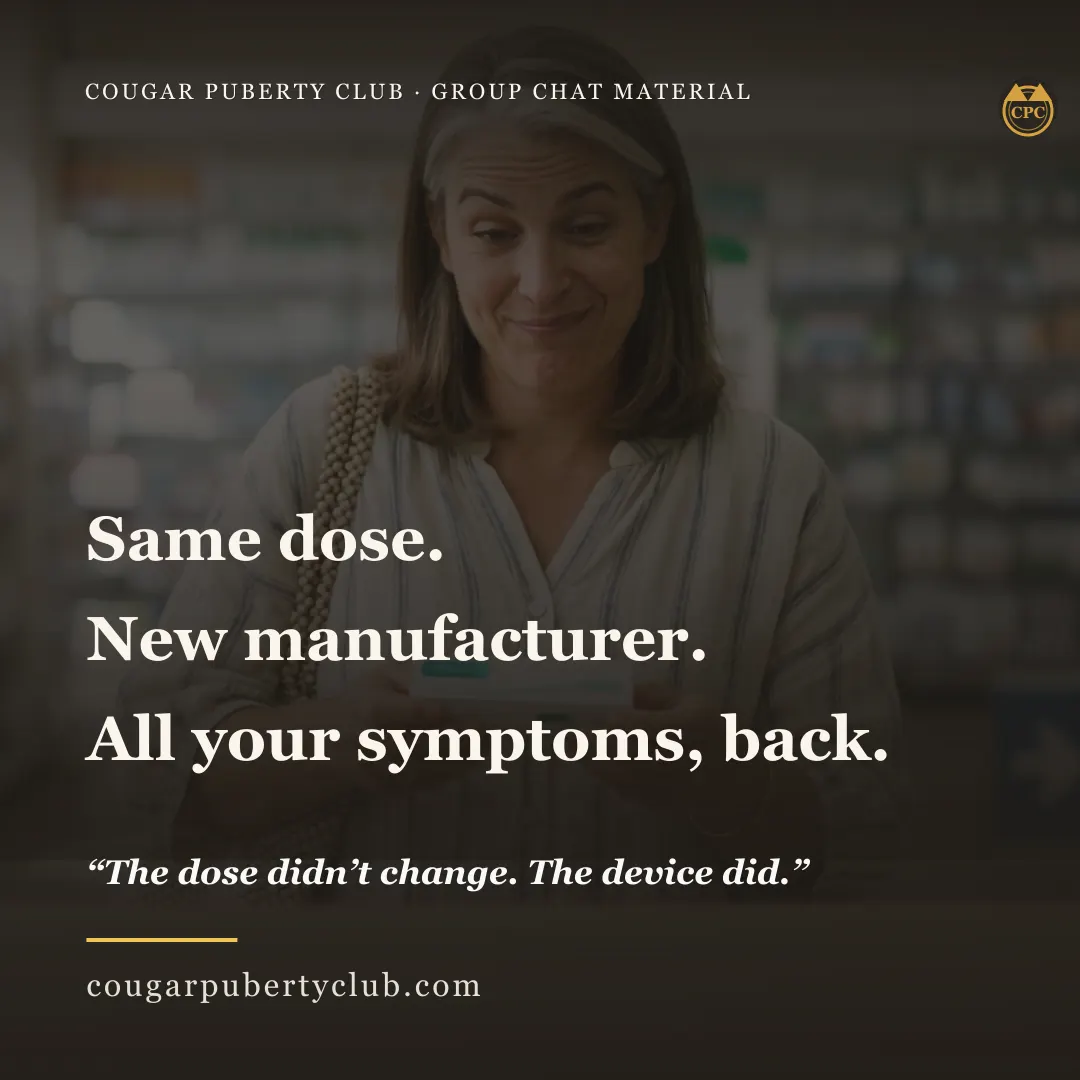
Here is the moment, and if you have a patch prescription in 2026 you already know it. You open the refill bag. The patch inside is a different shape. Sometimes a different size. The box is a different color and the name is a company you have never heard of, and your prescription still says the dose it has said for two years.
And then, a week or two later, the familiar symptoms start creeping back. A flush at your desk. The 3 a.m. wake-up returns. Your patience goes thin for no reason you can name.
You are not imagining it. And you are not the only one in the group chat doing the math on a bag of patches.
The roulette, named
The 2026 estradiol patch shortage turned the monthly refill into a gamble most of us never signed up for. Patch prescriptions jumped 162% in two years and patches became 44% of all estrogen prescriptions Established: CNBC. Supply did not jump with it. So the pharmacy hunts wholesalers, and what comes back is whatever is in the distribution channel that week. Women started hoarding expired patches because the new ones "aren't the same."
The r/Menopause version of this, in one verbatim comment, is the whole story: "I was on Sandoz patches and doing rather well. Then came the shortages and fighting to get my patches. The result was a manufacturer change which caused almost all of my symptoms to come rushing back."
That is not a supply problem. That is a symptom problem that happens to arrive in a pharmacy bag.
What actually differs between brands (it is not the estradiol)
Start with what does not change: the estradiol molecule, and the labeled dose. Your 0.05 mg is 0.05 mg.
Now the part almost nobody explains. A patch is not a pill. It is a drug-device combination, and every manufacturer builds its own device. Four things travel with the brand:
The delivery architecture. Matrix patches dissolve estradiol into an adhesive layer that sits against your skin. Older reservoir designs sandwiched a drug solution between membranes, with different release behavior and different skin-irritation profiles Established: DailyMed. Same hormone, different delivery machine.
The adhesive and the inactive ingredients. The FDA-approved labeling lists the device itself - an acrylate copolymer adhesive, fatty acid esters, a polyethylene backing - and it states the system is "designed to release estradiol continuously upon application to intact skin" Established: DailyMed. Adhesive chemistry is why one brand sticks through a shower and another lifts at the corner by Thursday, and why one leaves you itching.
The size and the wear interval. The labeled dose is tied to system size. In one FDA-approved weekly product, six system sizes - 6.5, 9.375, 12.5, 15, 18.75 and 25 cm² - correspond to 0.025, 0.0375, 0.05, 0.06, 0.075 or 0.1 mg delivered per day Established: DailyMed. A 0.05 mg patch worn weekly and a 0.05 mg patch worn twice weekly are not the same object, even though both say 0.05.
The NDC. The National Drug Code is the specific product identifier - the thing your pharmacy can actually look up, order and note on your file. When someone asks "which patch are you on," the honest answer is the NDC, not the dose.
Put together: the printed dose is a nominal in-vivo delivery rate - what the product is designed to deliver per day - not a measurement of what crosses your particular skin Established: DailyMed. "Safe and effective at the same dose" and "my body noticed the swap" are both true at once. That is the entire roulette.
What the FDA's September statement says - and what it does not
For most of 2026, the FDA's public line was versions of there is no shortage. On September 3, 2026, the agency moved.
\[9/3/2026] The FDA is aware of reports of patients having difficulty readily accessing their usual estradiol transdermal patches due to increased demand and is working with all six manufacturers to increase supply. Although availability of certain products or brands may vary by pharmacy or location, estradiol transdermal patches remain available. - Established: FDA
Read that middle sentence twice, because it is the one your refill lives inside: availability of certain products or brands may vary by pharmacy or location. The FDA is telling you, in official language, that the brand is the variable Established: FDA.
What the statement also does: confirms the supply of FDA-approved patches has nearly doubled over the past year, describes what manufacturers are doing (added shifts, bigger batches, dedicated lines, prioritized production), and correctly tells patients to contact their pharmacist, talk to their provider, and not stop or change medication on their own Established: FDA.
What it does not do: it does not declare a shortage, does not add estradiol patches to the FDA's shortage list, and does not once address the brand-switch relapse that women have been reporting for months Established: FDA.
The numbers keep the pressure on. ASHP - the database built from what pharmacists and patients actually report - now tracks almost 20 estrogen patch formulations in shortage, double the count from earlier in the year Established: USA TODAY. Women and advocates wanted a formal declaration, which could push manufacturers harder, and got an acknowledgment instead Established: USA TODAY. In the group chat, "the FDA finally said something" and "the FDA said the minimum" are both accurate.
Why the switch happens without anyone asking you
This is not your pharmacy being careless. State generic-substitution rules let a pharmacist dispense an equivalent product, often without calling your prescriber, unless the prescription is written dispense-as-written. Add wholesaler allocation on top: your pharmacy may order your brand and receive a different one, then hand it to you as the same drug.
You get a new manufacturer and no notification, because from the system's point of view nothing happened. From your body's point of view, the device changed.
The three-step refill protocol
Written for the version of you who has already called four pharmacies in one morning. Do this instead.
1. Call ahead, before you run out. A few days ahead of your refill, ask: "Can you fill my \[brand] patch, and if not, what NDC can you get?" Lead time turns a scramble into a plan. It also gives you a chance to line up an independent pharmacy or mail-order option while you still have patches in the drawer Established: FDA.
2. Request the same NDC. If your usual product is gone, ask for the substitute's NDC and check two things: same system size, same wear interval. The NDC is the only identifier that reliably tells one manufacturer's patch from another Established: DailyMed. If it is a different product, you are entitled to know before you pay.
3. Ask for a documented brand-change note. Have the pharmacist record the change on your file, and ask your prescriber to add a "same manufacturer when available" note to the prescription. That single line is what converts an automatic substitution into a phone call. It is also the evidence trail if the change does not work and you need to argue for a covered alternative. Bring the box, quote the NDC.
None of this fixes the shortage. All of it gives you back the thing the shortage took: knowing what is on your skin.
The reporting box: "brand changed and symptoms returned"
If your brand changed and your symptoms came back, you are the data set. This is how you get it on the record - and it takes ten minutes.
- Tell your prescriber first. Name the product you left, the product you got, the date, and the symptoms. Ask them to document it in your chart and to note your preferred manufacturer on the prescription going forward.
- Report the supply/access problem to the FDA. CDER Drug Shortages: drugshortages@fda.hhs.gov or (240) 402-7770 Established: FDA.
- File the shortage with ASHP. The FDA page links the ASHP Drug Product Shortages Report form - and is explicit that this form goes to ASHP, not FDA: "When you use this form, you are reporting a drug shortage to ASHP, not FDA" Established: FDA.
- If it was a reaction (rash, itching, blistering), that is an adverse event - report it to FDA MedWatch, separate from the shortage report.
- Keep the box. The old label and NDC are the receipt for everything above.
One more note on what a report is and is not. Filing a shortage report does not summon a patch to your pharmacy, and one report does not move a federal agency. Hundreds of reports filed at the counter, over months, are exactly how ASHP's list grew to almost 20 formulations Established: USA TODAY. That list is the pressure. Your report is a brick in it.
Red flags: call today, not "wait and see"
Most brand-switch symptom changes are an annoyance to solve at the counter. Some are not. Call your provider the same day - or 911, for the first group - if you have:
- Chest pain, shortness of breath, or a leg that is swollen, red and painful (emergency).
- A severe headache or vision change (emergency).
- A spreading rash, hives, or blistering where the patch sits.
- Symptoms that came back hard after missed doses and are destabilizing your sleep, mood, or daily function.
- An unfillable patch and an insurance denial on the alternative - your prescriber's office is the fastest path through that, not another pharmacy call.
What we are not doing here
We are not linking you to buy patches. Estrogen patches are prescription medication, this is a shortage, and a scarcity moment is not a commerce moment. Our rule on this cluster has not changed: we will not run affiliate commerce on the patch itself [Established: Cougar Puberty Club editorial context]. If a clear, safe comparison between delivery forms ever earns its own page, we will build it in the open, with sources.
What you get instead is the part the bag does not come with: the explanation, the numbers, and a script for the counter.
Your dose did not change. Your device did. Now you know the difference - and what to say about it.