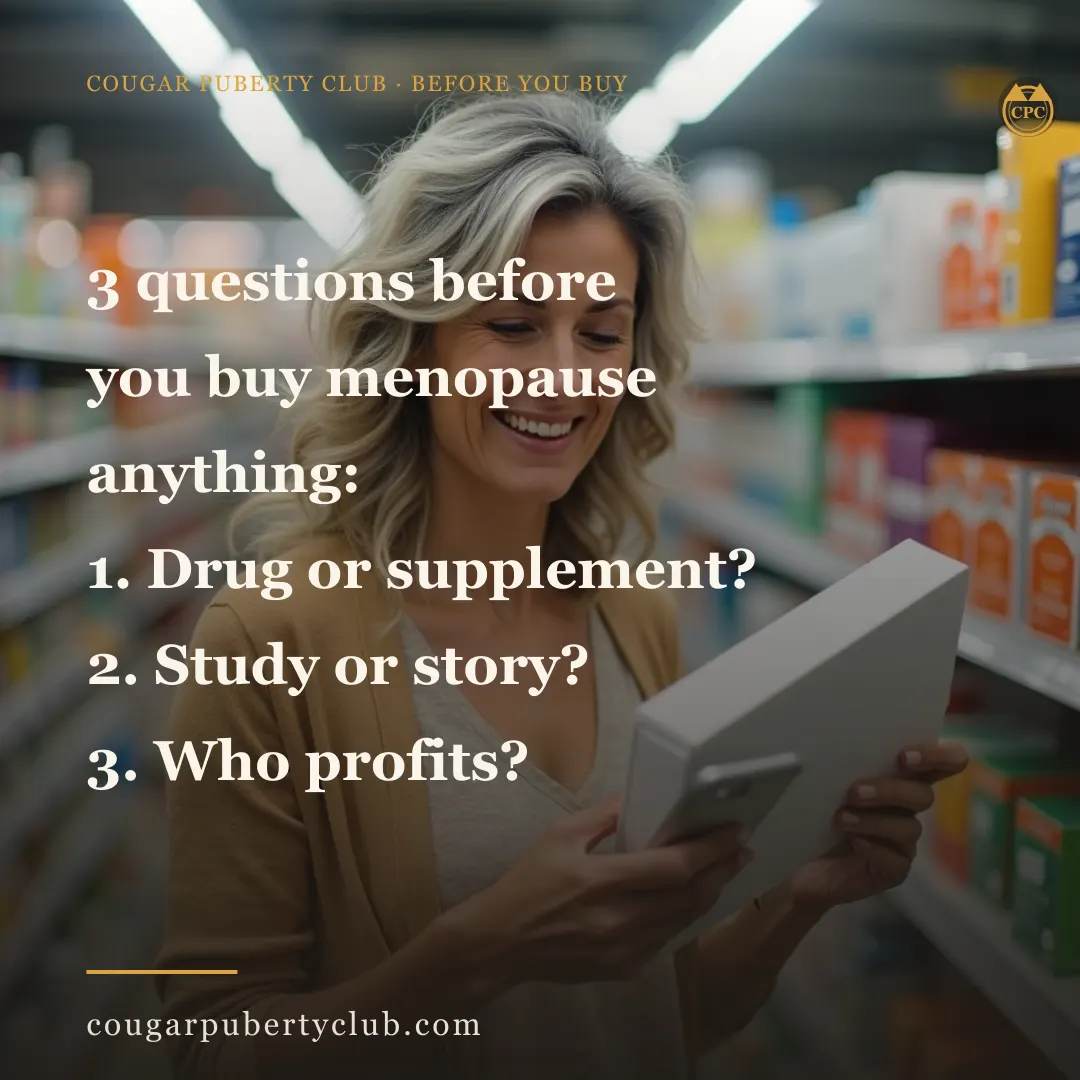
The drugstore aisle is a market now, and so is your phone. One of them has fluorescent lights and a senior discount. The other has a venture-backed clinic, a compounding pharmacy, a supplement brand, and a woman who looks exactly like you telling you that all of it changed her life. They are the same market. Wired finally gave it a name in September 2026: the perimenopause industrial complex Press: WIRED.
Here is the twist nobody puts on the bottle: the boom is real, the need is real, the treatment is often real, and the selling has still gotten completely out of hand. All of those things are true at once. The skill is shopping the gold rush without becoming the gold Press: The Guardian.
The Machinery, Named
Wired's reporting is worth reading in full, but the operating numbers are these. Four leading telehealth startups in the perimenopause space, Midi, Winona, Alloy, and Evernow, saw a 490 percent uptick in web traffic from 2023 to 2026 Press: WIRED. Many of the big virtual clinics are strictly out of pocket, charging subscriptions of up to $200 a month for custom formulations Press: WIRED. The global menopause market is projected at roughly $24bn by 2030 Press: The Guardian. And the symptom list, in the industry's own telling, now runs past 100 entries, a breadth that made Mayo Clinic's Stephanie Faubion, who is basically menopause royalty, say the hype machine 'has gotten completely out of hand' and that clinicians are 'running into a danger zone attributing all these symptoms to perimenopause' Press: WIRED.
None of this makes the perimenopause transition fake. It makes it a target. When the stigma lifted and the money arrived, the same thing happened that happens to every underserved market the moment it becomes profitable: the honest operators and the opportunists moved in on the same block. UCL researchers, writing in the journal Post Reproductive Health, describe a 'rapid expansion in unregulated private companies and individuals providing menopause information and support for profit' Press: The Guardian.
Why This Is Harder Than It Should Be
Three structural facts make perimenopause the perfect selling environment, and you should know them before you buy anything.
There is no lab test that settles it. No test can reveal whether someone is perimenopausal, because unpredictable hormone variation is its hallmark Press: WIRED. Clinicians diagnose from your symptom history and bleeding patterns, and the US Office on Women's Health is explicit that hormone-level blood tests are not usually recommended to gauge status, because levels fluctuate too much for a single reading to mean anything Established: OWH. No test means no objective referee, which means the story gets to do the selling.
The symptom list is wide enough to park a market in. When a company can list more than 100 symptoms and you have had at least nine of them since Tuesday, qualification is not the question. Attribution is. Yale's Mary Jane Minkin put the honest version of this on the record: life stressors are real, and attributing everything in the world to perimenopause is tricky, because nobody can say it isn't for sure Press: WIRED. That uncertainty is the aisle where the selling happens.
The supplement aisle is not regulated like the drug aisle. Under the Dietary Supplement Health and Education Act, supplements do not need FDA approval before they are marketed. The manufacturer is responsible for safety and truthful labeling, and the FDA regulates after products reach the shelf rather than clearing them first Established: FDA. When a product is a drug, the FDA has reviewed whether it works before you can buy it. When a product is a supplement, the label is a promise and the proof is your problem. That is the whole architecture of the industrial complex in one paragraph.
The Checklist: Four Checks Before You Buy Anything
This is the method. It takes ninety seconds per product, which is less time than the podcast episode that sent you to the product.
Check one: is it a drug or a supplement? Look for the FDA-reviewed frame. A drug for hot flashes, like the prescription nonhormonal options, went through clinical trials and FDA review before it could claim anything Read: The Nonhormonal Hot Flash Pills. A 'menopause support' blend is a supplement, which means nobody reviewed whether it works before it reached the shelf, and the burden of proof is on you Established: FDA. If a product is making a medical promise, ask why it is not a drug. The answer is usually that it could not survive the review.
Check two: where is the study? Not 'a study.' The study: on this ingredient or device, at this dose, in women in your age band, ideally in a randomized controlled trial. The Guardian quotes a menopause specialist who is blunt about the state of the evidence: 'The industry is booming, but there's still a huge lack of randomised controlled trials' Press: The Guardian. When a leading menopause researcher tested women taking testosterone supplements, the blood tests showed the hormone never arrived Press: MIT Technology Review. The label said one thing. The blood said another. If the claim is a hormone or a deficiency fix, it is measurable, and the measurement settles the argument.
Check three: who profits, and how? Follow the money to its business model. Subscriptions up to $200 a month mean the seller's income depends on you never stopping Press: WIRED. Estrogen face cream that Mayo's Faubion flatly calls 'garbage' for lack of data runs $150 out of pocket for three months Press: WIRED. The ob-gyn Jen Gunter has written that selling women inadequately studied products under the guise of closing gaps in health care is 'predatory and misogynistic' Press: WIRED. And the advertising self-regulation system caught a flagship clinic's claim that 91 percent of patients find relief within two months; the claim was dropped before the watchdog acted Press: WIRED. The 490 percent traffic surge is not a health outcome. It is a marketing outcome.
Check four: the refund test. It comes from an unusual place, a cooling-bracelet founder interviewed by the Guardian, who concedes that skepticism about menopause products is often justified and offers the signal he looks for: what is the company willing to reimburse if it does not work? 'That's often the best signal' Press: The Guardian. A product that cannot survive a refund request cannot survive contact with reality. Ask it before checkout.
The Worth-It List
Now the part that makes this a trust piece instead of a rant. A smart shopper knows what is worth buying, not just what to skip, so here is the evidence-checked lane.
Hormone therapy, through a clinician, when it fits. This is the real correction story. The FDA removed the black-box warnings in late 2025, and the Commissioner called the decades of denial 'an American tragedy' Established: FDA / CBS News. For many women in the early years of the transition, more recent studies show the benefits can outweigh the risks, and the clinical conversation has genuinely changed Established: FDA / CBS News Read: HRT Is Back. What Actually Changed?. The worth-it version of the industrial complex is the part that survived FDA review: the patch, the pill, the prescription. The not-worth-it version is the same hormones sold as a $200 subscription with a supplement bundle attached.
FDA-approved nonhormonal options. For women who cannot or should not take hormones, the prescription nonhormonal treatments for hot flashes went through the trials. That is what the FDA review process is for Read: The Nonhormonal Hot Flash Pills.
The four supplements with actual evidence. Iron, conditionally, when a blood test confirms deficiency. Fibre, as a bridge to the 30g target. Magnesium, as a cheap experiment with a journal. Creatine, for the training you are doing, not the fog you are not sure about. Four ingredients, every one single, dosed, and honest about its limits Read: Do Menopause Supplements Actually Work?.
Real cooling, on physics. A fan and breathable sheets work because moving air and evaporating sweat work, not because of a brand story. They are also the answer a menopause specialist gives when asked what to actually buy: a simple handheld fan might be the best cooling solution Press: The Guardian. The evidence-checked versions live in our guides: Best Portable Fans for Hot Flashes and Best Cooling Sheets for Night Sweats. The $229 cooling bracelet is a bet on a startup. The $25 fan is a bet on thermodynamics.
A home blood pressure monitor. The silent changes, blood pressure, cholesterol, bone, are the ones that do not sell supplements, which is why nobody is pushing them at you. They are still the ones worth tracking Read: Home Blood Pressure Monitors.
The Patterns That End the Conversation
Some structures are scams regardless of the ingredients. Walk away from all of them:
- Fear-then-sell funnels. The reel tells you your exhaustion is your ovaries failing you, and the next slide sells the fix. If the content is designed to make you feel broken and the product is one tap away, the content is a funnel.
- Proprietary blends without doses. A supplement that will not tell you how much of what is inside is a supplement that decided the marketing is more important than the data Established: FDA.
- Unproven devices at a premium. Same sensors, different label, double the price. If it cannot produce a trial, it is a gadget with a story.
- Estrogen face cream. The Mayo director of women's health calls it garbage. $150 for three months of no data is a donation with a pump Press: WIRED.
- 'Menopause relief' labels without trials. The Guardian's specialist is wary of anything marketed specifically as menopause relief unless it is backed by solid evidence, because the industry is booming and the trials are not Press: The Guardian.
- Vending-machine prescriptions. Questionnaire-only clinics that prescribe without a visit exist, and the flagship clinic's own chief medical officer coined the phrase Press: WIRED. Hormones are real medicine. Real medicine involves a human who has seen you.
- The everything-is-perimenopause frame. It is the mirror image of the old nothing-is-perimenopause dismissal, and it is equally bad for your wallet and your health. Attribution matters, and 'probably not hormones' is a legitimate clinical answer Press: WIRED. We wrote the whole piece on this: Not Everything Is Perimenopause.
The Three Questions, Framed
For the group chat, the whole method compresses to three questions. The card at the end of this article is the fastest way to end a bad purchase decision in public.
- Drug or supplement? If it is a supplement, nobody checked it before it reached the shelf Established: FDA.
- Study or story? Where is the trial, at this dose, on this product, in women like you? Press: The Guardian
- Who profits? Subscription, proprietary blend, $150 cream, or a refund policy that says the product believes in itself Press: WIRED Press: The Guardian.
The Bottom Line
The perimenopause industrial complex is not a reason to distrust your body's signals. It is a reason to distrust unlabeled selling. The transition is real, the treatment is real, and the correction to decades of medical neglect is real. What is also real is the machinery: the venture capital, the 100-symptom lists, the subscriptions, the creams, the clinics that want to be the one-stop shop for half the population's health Press: WIRED.
You do not have to opt out of the market to shop it well. You have to run the checks. Is it a drug or a supplement? Where is the study? Who profits, and what happens if it does not work? The products that survive those questions are a short list, and this site's job is to keep that list honest: the supplements that survive a blood test, the tests that cannot tell you anything, the viral hacks that are just medicine from another aisle, and the buying guides that only point at evidence-checked lanes. Shop the gold rush with a method, and the gold rush stops being the thing that mines you.
Related: Do Menopause Supplements Actually Work? · Do At-Home Perimenopause Tests Actually Work? · Does Allegra + Pepcid Actually Stop Hot Flashes? · HRT Is Back. What Actually Changed? · Veozah vs Lynkuet: Non-Hormonal Hot-Flash Pills