Affiliate disclosure: some links in this piece go to products and we may earn a commission. The honest answer below costs us money in at least two places. You will be able to tell where.
Your group chat has a new bottle in it. It says hormone-free. Someone has already posted the link with "I'm going to try this instead of HRT," and three people have replied with a heart, and one person has replied with a paragraph about how she read that hormones are actually dangerous, and you are sitting there with a fan in your bag and a bone density you have never once thought about, wondering which of them is right.
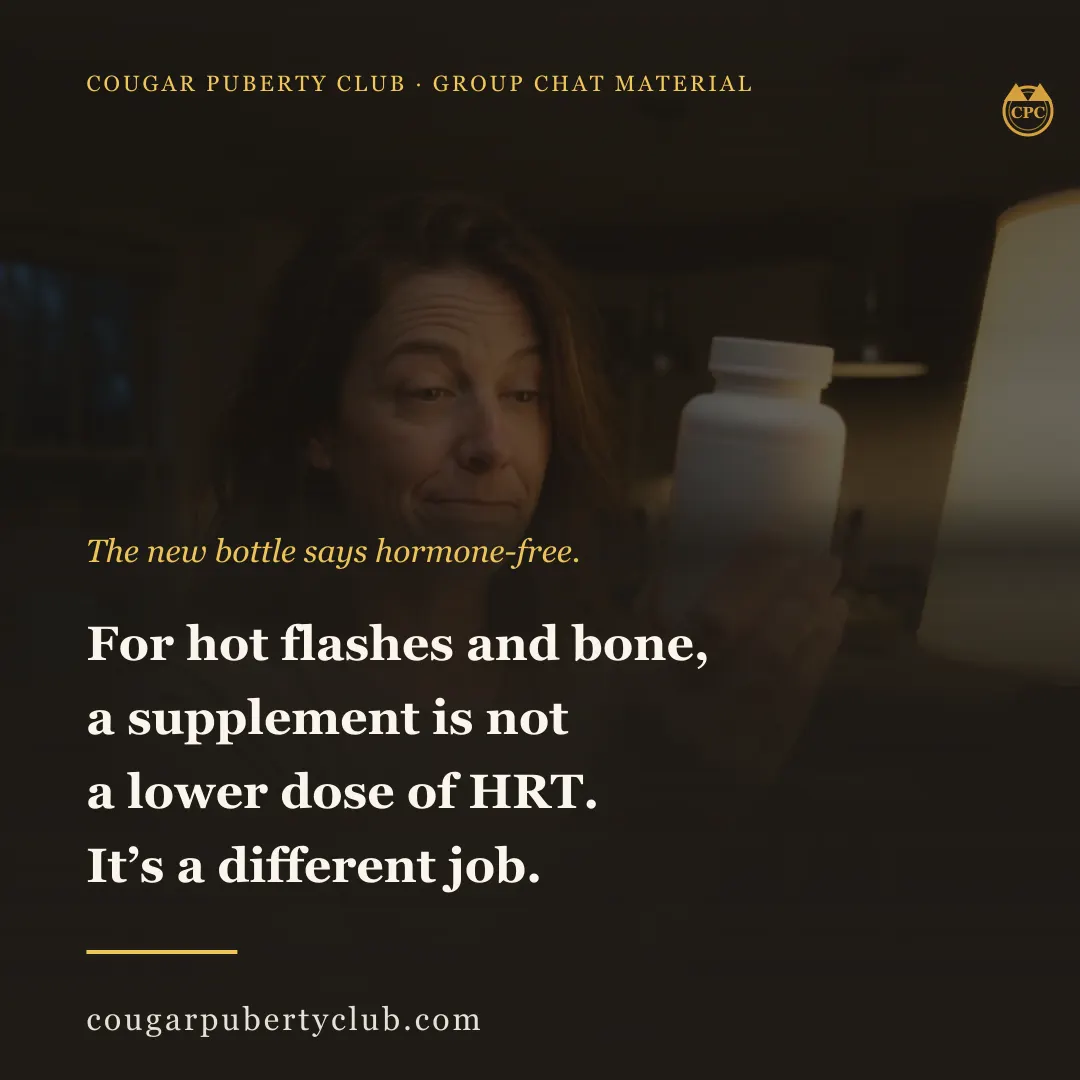
Here is the thing that neither the link nor the paragraph will tell you: a supplement is not a lower dose of hormone therapy. It is a different job entirely. Once you see that, the question stops being "supplement or HRT" and becomes "which symptom am I actually trying to fix, and what does that symptom respond to."
That is the whole decision tree. Three axes: what the symptom is, how bad it is, and what is medically available to you. Let's walk it.
First, the framing correction
There is a move the aisle makes that is almost impossible to unsee once you have seen it. It takes a hormone therapy conversation and slides a bottle into the same sentence, so that "hormone-free" starts to sound like "hormone therapy, but gentler." Gentler. Healthier. More natural. Same job, smaller.
It is not the same job, and the evidence is refreshingly blunt about it.
For hot flashes and night sweats, hormone therapy is the most effective therapy there is, and phytoestrogens, herbs and other dietary supplements have not been clearly shown to relieve menopausal symptoms at all Established: NIH NCCIH. Not "weaker." Not "slower." Not clearly shown to work.
For bone, it is worse than a mismatch, and we will get to why in a moment. That is the branch where the cost of waiting is measured in fractures.
So when someone asks "can I take a supplement instead of HRT," the honest answer depends entirely on what she is treating. And the answer is very different for a woman whose flashes are a mild nuisance in the afternoon than for a woman who has not slept through the night since June.
The three questions hiding inside that one question
When someone says "instead of," she usually means one of three things, and they deserve three different answers.
"I'm scared of HRT." Fair. The fear is decades old, inherited, and worth separating from the actual 2026 risk profile, which is a conversation with a clinician, not a comment thread. See the HRT decision lane for that one.
"I can't take HRT." Then this is not a preference question at all, and the right tree is the non-hormonal prescription lane, not the supplement shelf. We get to that below.
"I'd rather start with something smaller." Legitimate. But understand what you are starting smaller with. If the symptom responds to hormones and not to botanicals, "something smaller" is not a smaller version of the thing. It is a different thing that may do nothing.
The tree, by symptom
Not a ranked listicle. Lists rank products. Trees sequence decisions.
Vasomotor symptoms: hot flashes and night sweats
What actually responds: hormone therapy is the most effective therapy for menopausal hot flashes Established: NIH NCCIH. The UK guideline offers HRT to people with vasomotor symptoms associated with menopause, and separately considers menopause-specific cognitive behavioural therapy as an option, either alongside HRT or for people for whom HRT is contraindicated or who prefer not to take it Established: NICE.
What the supplement aisle offers: soy and red clover isoflavone studies have had inconsistent results, and flaxseed products were found to be no more effective than placebo for hot flashes Established: NIH NCCIH. The one genuinely interesting newcomer is shatavari, which has a single randomized, double-blind, placebo-controlled trial behind it: 80 perimenopausal women, a standardized root extract, eight weeks, and a real result on a self-reported symptom scale, with no hormone-therapy comparison arm Established: International Journal of Women's Health. Promising. Not established. Not HRT. If you want the full read of that study, we did it here: The Shatavari Study: What the New RCT Actually Says.
The new bottle. The September launch is a hormone-free capsule built around a patented standardized shatavari extract, combined with DIM, evening primrose oil and vitamin B6, and the brand reports claimed benefits for mood, hot flashes, night sweats and sleep in as little as four weeks Press: NutraIngredients. That is what the brand says. What the file says is: one positive trial on one ingredient, in one population, plus three other ingredients whose perimenopause evidence is thinner than the bottle's confidence. Nobody has run the trial on this combination.
Honest verdict: if your flashes are mild and occasional, a bottle plus a symptom journal is a low-stakes experiment. If your flashes are moderate or severe, if they are waking you at 3am, if you are carrying a fan to meetings, a supplement is not the substitute. It is an add-on at best, and the thing to do first is have the actual treatment conversation. (A supplement you can read about honestly here.)
Sleep
What actually responds: menopause-specific CBT is considered an option for vasomotor symptoms that are wrecking sleep Established: NICE, and the 3am wake-up is very often the night sweat, not a sleep disorder. Sort the cause before you buy the fix.
What the aisle offers: magnesium is the honest one. It is a real mineral with real roles, the evidence for sleep specifically is mixed, and it is cheap and easy to stop. Treat it as a two-week experiment with a journal, not a protocol. (Magnesium, if you want to run that experiment.)
Honest verdict: if you are waking every night, the bottle is not the first move. The first move is naming why you are waking.
Mood
Mood changes are a recognized menopause-associated symptom, not a character flaw Established: NICE. Where mood symptoms are tied to the hormonal transition, that is a clinical conversation, and where they are moderate or severe, the options that are actually indicated for mood sit in the treatment lane, not the supplement aisle Established: HHS Office on Women's Health.
Honest verdict: never self-treat moderate or severe mood symptoms with a bottle from a feed. That branch has real medicine behind it and deserves a real appointment.
Genitourinary symptoms: vaginal dryness, painful sex
This branch is short, and it is the one where the aisle should just stand down.
Vaginal estrogen is offered for genitourinary symptoms associated with menopause, including for people already using systemic HRT Established: NICE. Over-the-counter water-based lubricants and vaginal moisturizers can help with vaginal discomfort and dryness, and prescription vaginal estrogen creams, tablets or rings are options if those do not Established: HHS Office on Women's Health. A capsule you swallow does not do what a topical estrogen does to that tissue.
Honest verdict: no supplement in the aisle does this job. If someone is selling you one for dryness, they are selling you the gap between knowing and not knowing. (Zero affiliate links in this section, deliberately.)
Bone: the branch where waiting is expensive
This is the branch that should end the "I'll just try a bottle first" plan, and it is the one nobody in the group chat is talking about.
Osteoporosis develops when bone mineral density and bone mass decrease, or when the structure and strength of bone changes, and it is called a silent disease because there are typically no symptoms until something breaks. It is the major cause of fractures in postmenopausal women, and for many women the process begins a year or two before menopause Established: NIH NIAMS. The fractures happen from minor falls, and from normal stresses like bending, lifting, or even coughing Established: NIH NIAMS.
The steps that help protect bone are weight-bearing exercise such as walking, moderating alcohol, not smoking, taking prescribed medications, and eating a diet rich in calcium and vitamin D Established: NIH NIAMS.
Notice what is on that list and what is not. A calcium and vitamin D supplement can be a reasonable top-up for a dietary gap, and it is the one supplement in this whole piece where the ordering is honest and boring. (Calcium plus vitamin D3, if your diet has a gap.) But a supplement is not a substitute for treatment if testing shows real bone loss, and it is definitely not a substitute for the years of protection you would be giving up while you spend six months finding out that a bottle does nothing.
Honest verdict: if you are in the "I'll try a supplement and see" phase and you have risk factors, get the bone question answered by a clinician in parallel. Do not let the experiment run on your skeleton.
Severity is the second axis
Same symptom, different answer, depending on one question: is this disrupting your life?
Mild, occasional, barely notice it. Watching and waiting is legitimate. So is a cheap, low-stakes experiment with a stop date. Sleep, bone protection and time are on your side here.
Moderate or severe: disrupting sleep, work, or relationships. This is the treatment lane. The evidence-backed options here are prescription or structured therapy, and the conversation belongs with a clinician Established: NICE. A bottle purchased at 1am is not a plan.
Red flags. Bleeding after menopause, or bleeding that is new and unusual, is a call to a clinician promptly, not a supplement. That is not a self-treatment branch under any circumstances.
What is available to you is the third axis
If hormone therapy is not suitable for you, that is not the end of the tree. It is a different branch with real medicine on it.
People with certain conditions, including a history of breast cancer, liver disease, or blood clots, should not use hormone therapy Established: NIH NCCIH. In that case "instead of HRT" is not a preference, it is the hand you were dealt, and the honest answer is the non-hormonal prescription lane: FDA-approved options for specific symptoms include a low-dose SSRI for hot flashes, ospemifene for vaginal dryness and painful sex, and fezolinetant for hot flashes, which carries an FDA warning about rare but severe liver injury, alongside over-the-counter lubricants and moisturizers and prescription vaginal estrogen for genitourinary symptoms Established: HHS Office on Women's Health.
If you simply prefer not to take hormones, that is a legitimate choice, and we will not talk you out of it. But it is a choice with trade-offs, not a free upgrade. The honest framing is: I am choosing this path knowing what it will and will not address.
What the label is actually allowed to claim
Here is the part that makes the whole aisle make sense.
Dietary supplements do not need FDA approval before they are marketed. Under DSHEA, the manufacturer, not the FDA, is responsible for ensuring the product is safe and that the label claims are truthful and not misleading before it goes on sale, and the FDA regulates the category after products reach the market Established: FDA.
That single fact explains a lot. It explains why a supplement can say "supports mood" while a drug could not say that without trials. It explains why the honest label checks are the boring ones: a named standardized extract, the dose stated per ingredient, no proprietary blend hiding the amounts, and a third-party testing mark where you can find one. And it explains why "clinically studied" can be technically true and almost meaningless. One small study on one ingredient, stretched over a formula, is a real sentence and a weak proof.
To the September brand's genuine credit, its own science lead names this problem out loud, describing an aisle full of "proprietary blends that hide dose, a single small study stretched into a sweeping claim, traditional use treated like clinical proof" Press: NutraIngredients. The launch also explicitly says hormone therapy is the right choice for some women, and positions the product alongside rather than against it Press: NutraIngredients. That is a real improvement over the us-or-them pitch.
It is also still a marketing position from a company selling a bottle. Both things are true. Hold both.
The interactions nobody flags at checkout
Dietary supplements may have side effects or interact with drugs, and little is known about their long-term safety Established: NIH NCCIH.
Some of those interactions work through the liver enzymes that clear other medications, which means a new bottle can change how your existing medication behaves rather than simply adding to it. We have covered exactly this pattern before: CBD competing with oral progesterone for the same liver enzymes, and the sleep benefit going quiet as a result. Read that one here: The Progesterone Went Quiet.
If you are on hormone therapy, this matters more, not less. Tell your clinician about every supplement you take, including the ones you are sure are harmless, and ask specifically about interactions with what you are already on.
The script for the appointment
Take these in. You are not asking permission, you are asking for a comparison.
- "I'm considering adding a perimenopause supplement. Given my history, my medications and my symptom pattern, is it worth adding alongside what you're recommending, or a reasonable alternative?"
- "If my symptoms are moderate or severe, what are my evidence-backed options, including hormone therapy and non-hormonal prescription options, and how does this supplement compare?"
- "Is there any reason this specific ingredient is a problem for me, including interactions with anything I take?"
- "How would we know it's working, how long should I give it, and when do I stop if nothing changes?"
- And if you are told to just try the supplement first: "What happens to my bone and my sleep in the meantime, and what should we monitor while I wait?"
The honest verdict
Instead of HRT, for moderate or severe vasomotor symptoms or for bone protection: not worth it. This is the place where the aisle's framing does real harm, because the woman who spends six months on a bottle is six months further from the treatment that would have worked, and her bone does not get that time back.
Alongside HRT, or for mild symptoms: maybe. Run it as an experiment with one symptom, a baseline, a stop date, and your clinician told. Expect to stop a lot of them. That is the point.
Sold as "natural HRT": save your money. The word is doing the work that the evidence is not.
This is not medical advice. Whether hormone therapy, a non-hormonal prescription option, or a supplement is right for you is a decision to make with a qualified clinician who knows your history and preferences. We do not give dosing numbers on purpose. Bleeding after menopause, or new and unusual bleeding, should be raised with a clinician promptly.
If you want the broader label-versus-blood-test read on the whole supplement shelf, that is here: Do Menopause Supplements Actually Work?. And if you want to know how to subtract things instead of adding them, start here: The Minimum Effective Dose.