There is a specific moment that happens now, more and more, when you read a menopause headline. You get about three sentences in, and something in your chest tightens and an unimpressed voice in your head asks the only question that matters: who was this studied on?
Not what did they find. Not should I be worried. Just: who was actually in the room for this? And then, half the time, you find out it was men. Or women a decade younger. Or nobody measured at all, and someone just... decided, and it was printed with an author's confidence, and now it lives in a magazine and in your group chat and possibly in your doctor's memory as "the guidance."
This is not paranoia. It is pattern recognition. And it just went viral at the level of an official government document.
The story that made it a public joke
In late August, reports out of Spain landed on a menopause nutrition guide that had reportedly been built on studies conducted on men [media signal, tier-2 reporting: social topic only, not clinical guidance]. A nutrition guide. For menopausal women. Based on data from men. The internet, as you can imagine, did not handle this with restraint, and honestly, the restraint was not deserved.
But here is the part that the outrage cycle skips past. This was not an outlier. It was the absurd, screenshot-able version of a quiet, everyday problem: much of what gets handed to women at midlife was never researched on women at midlife. The Spain story is the loud one. The dull, daily version is the diet advice, the training plan, the sleep rule, the supplement pitch, each one resting on evidence that might not have been gathered on anyone remotely like you.
The useful move is not to get angry at the headline. The useful move is to have a way to read it. So here is the frame. Five questions, portable to anything anyone hands you.
Before the questions, one note on why they are legitimate, because this is not vibes.
The inclusion of women is the law, not a favor
The reason "who was this studied on" is a fair question is that it is the exact question the law is built around. The National Institutes of Health is mandated by the Public Health Service Act (section 492B, 42 U.S.C. sec. 289a-2, added by the NIH Revitalization Act of 1993) to ensure the inclusion of women and members of racial and ethnic minority groups in all NIH-funded clinical research, in a manner appropriate to the scientific question under study. The stated primary goal is blunt: to ensure that research findings can be generalizable to the entire population Established: NIH.
Read that goal again. Generalizable to the entire population. Which means: if the study was not run on women, its findings are, by the government's own framing, not generalizable to women. The question answers itself.
The statute goes further than enrollment. It requires clinical trials to be designed to analyze whether study outcomes differ for women and for members of racial and ethnic minority groups Established: NIH. Translation: it is not enough to let women in the door. You have to look at whether the results came out differently for them.
And the regulator's position is aligned. The FDA states that it requires sponsors to include a fair representation of both sexes as participants in clinical trials so that clinically significant sex-related differences in response can be detected Established: FDA. The FDA's guidance on sex differences recommends increasing enrollment of female participants to help ensure generalizability of results, analyzing and interpreting sex-specific data, and including sex-specific information in regulatory submissions Established: FDA.
So the question is not you being difficult. It is you applying the same standard the agencies that fund and approve things are supposed to apply. Now the frame itself.
The five questions
Use them in this order. Each one is a filter, and each one can end the conversation early.
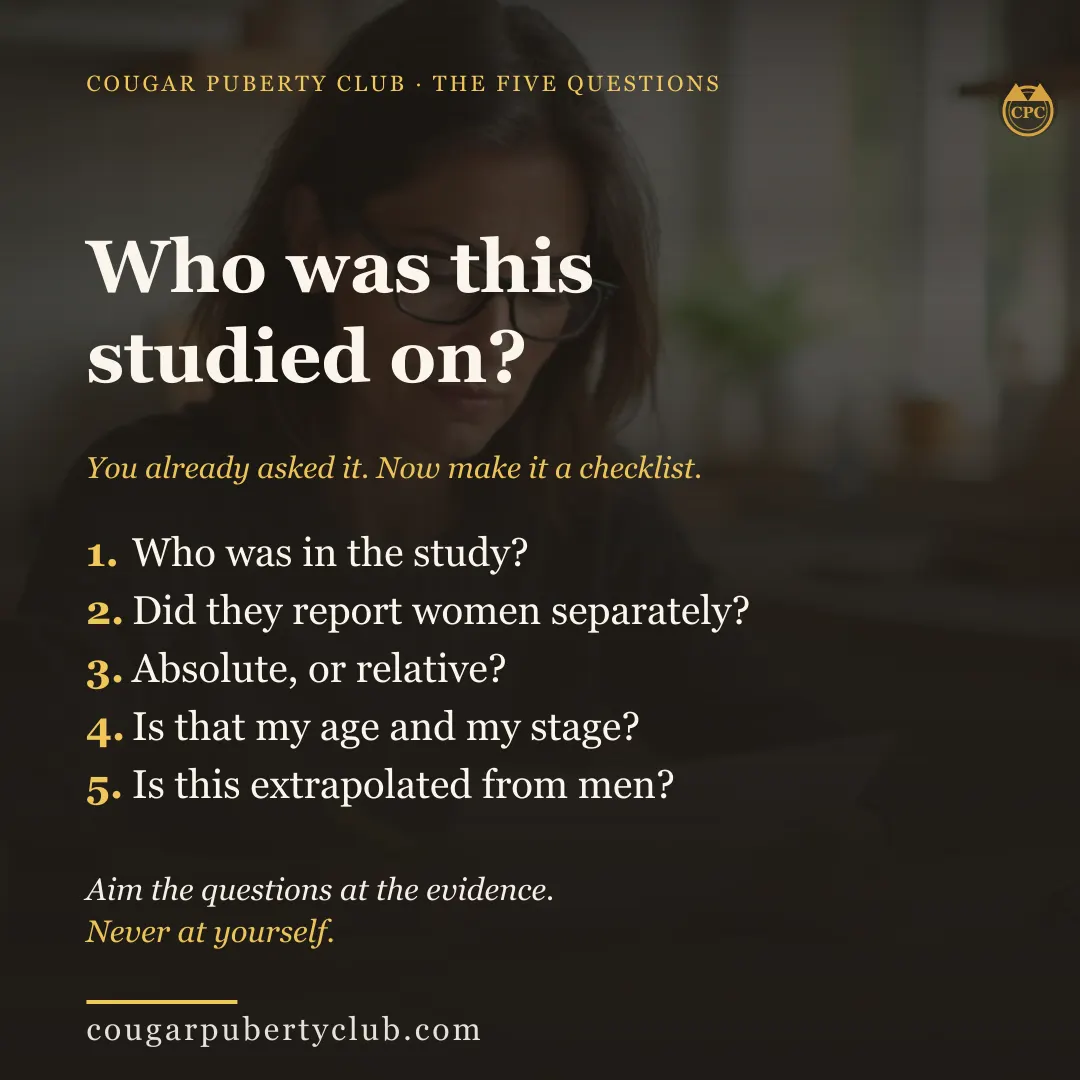
1. Who was in the study? Not "how many people," but "who." Women, men, both, and in what proportion? A study of 40,000 people is not impressive if almost none of them were like you. This is the first and most decisive question, and it is often the one you can answer in the first paragraph of the abstract.
2. Did they report the women separately? A trial can enroll women and still tell you nothing about women if it only publishes the blended average. Sex-stratified reporting means the women's results were shown on their own. If all you have is the everyone's number, you have the number of a person who does not exist Established: NIH.
3. Is that effect absolute or relative? "X% higher risk" is relative. Relative to what, out of how many, over how long, is absolute. This one question has dismantled more scary headlines than any other, in both directions. It can shrink a fear, and it can also quietly reveal that a tiny benefit was dressed up as a triumph.
4. Is this population actually my age and my stage? Perimenopause is not menopause is not postmenopause. A study of 30-year-olds on hormonal contraception is not a study of you at 48 with a heart that has skipped and a sleep that has broken. If the population does not match your age and stage, file the finding under "interesting" and keep going.
5. Is this extrapolated from somewhere it does not belong? This is the Spain question. When men are the default research subject and women's guidance is built on their data, the finding is being borrowed from a body that is not yours. Same applies across the age line: results borrowed from younger women, or from men, and handed to you without a footnote.
Five questions. None of them require a science degree. All of them require a willingness to be slightly annoying, which, let's be honest, has never been a problem.
The frame, applied to the five lanes you actually live in
Abstraction is cheap. Here is what the five questions do when you point them at the areas that generate the most advice, the most spending, and the most guilt.
Protein and nutrition. The lane where everyone has an opinion and the evidence moves by the month. Ask the questions of the diet study before the diet: was it run on women, across which years of the transition, and did the women's outcomes get reported on their own? A diet pattern validated in a cohort that is mostly not you is a hypothesis with a mouth on it.
Strength and bone. Bone is the clearest case for asking, because bone loss is timed, measurable, and sex-specific. Estrogen matters to bone, which means the female body is the relevant body for the question, and research borrowed from male athletes about "bone building" tells you very little about your femoral neck at 51.
Cardio and heart. Heart disease in women has a long, well-documented history of being under-recognized and under-studied, and the presentation can differ from the textbook male version. When heart guidance sounds like it was written for a different patient, sometimes it was. Ask who was studied, and ask whether women's numbers were separated out.
Sleep. Broken sleep is one of the most reported perimenopause experiences and one of the most casually explained away. Ask whether the sleep research the recommendation rests on actually included women in the transition and measured their sleep, rather than extrapolating from general adult sleep studies.
Supplements. The lane where the question earns its keep fastest, because the gap between marketing confidence and actual evidence is at its widest here. Ask: was this studied on women at this stage, was it compared to a placebo, and was the women's result reported separately? If the answer is "not really, but the mechanism sounds plausible," you have just saved yourself a subscription.
The rule that keeps this honest
Here is where a good tool becomes a bad one if you are not careful, and this part matters as much as the questions themselves.
"Who was this studied on" is a tool for claiming better evidence. It is never a tool for telling a woman her symptoms are not real.
Those two things look similar from the outside and are opposites in every way that counts. The evidence gap is real, and it is exactly why women get told their symptoms are stress, or anxiety, or early-onset something-else, and sent away: when a symptom is under-studied, the lazy fallback is to explain it away rather than investigate it. Women describe this pattern directly: being misread, misdiagnosed, and handed a mental-health label when what they needed was curiosity Established: STAT First Opinion.
So the frame has a direction. It points at the evidence. It never points at you. "Absence from the research" is a problem with the research, not evidence that the symptom is invented. If you remember one line from this article, make it that one: the question is who was studied, not whether you are really feeling it.
How to use it without turning into a courtroom
You do not walk into an appointment with five accusations. You walk in with one clean question, aimed at the evidence and not the person.
Try: "For that recommendation, was it based on research that included women my age and stage, or is it extrapolated from somewhere else?"
The answers are all useful, and none of them are a fight. If the evidence is strong and specific to you, great: now you can commit to it with actual confidence, which is worth something. If it is extrapolated, the conversation shifts from "do this" to "do this, and here is what we watch, and here is what we would try if it does not work." That is a better conversation than the one where you nod, take the advice, and privately wonder the whole way home.
And you get to extend the same grace you would want extended to you. A clinician working from thin evidence is not your adversary. Most of them inherited the same thin evidence you just learned to spot. You are not auditing their competence. You are asking, together, whether the foundation is for you or about you.
That is the whole move. Not cynicism. Not dismissal. Just the five questions, asked kindly, on your own behalf, of a research record that owes you a better answer than it has sometimes given.
This article is general information, not medical advice, and it is not a substitute for talking with a qualified clinician about your own symptoms, history and care.
The card, for the group chat
The companion shareable distills the frame into one screenshot: the five questions, plus the line that keeps it honest. If you have a friend who has been reading menopause headlines with a growing sense of "wait, who did they ask," send her the card, then send her this article.