The Three Questions to Ask at Your Next Appointment
You've made the appointment. You've been living with symptoms for - let's be honest - somewhere between eight months and five years. You know the form is only going to ask about hot flashes. And the moment you sit down, your brain will go as blank as the intake sheet.
Here's the thing: the researcher who documented this exact gap also handed us the fix. In the same week his study broke, Yulin Hswen - the University of Maryland epidemiologist who compared women's own conversations about menopause with what actually makes it into the medical chart - published a First Opinion essay in STAT with three questions designed to catch everything the form misses.
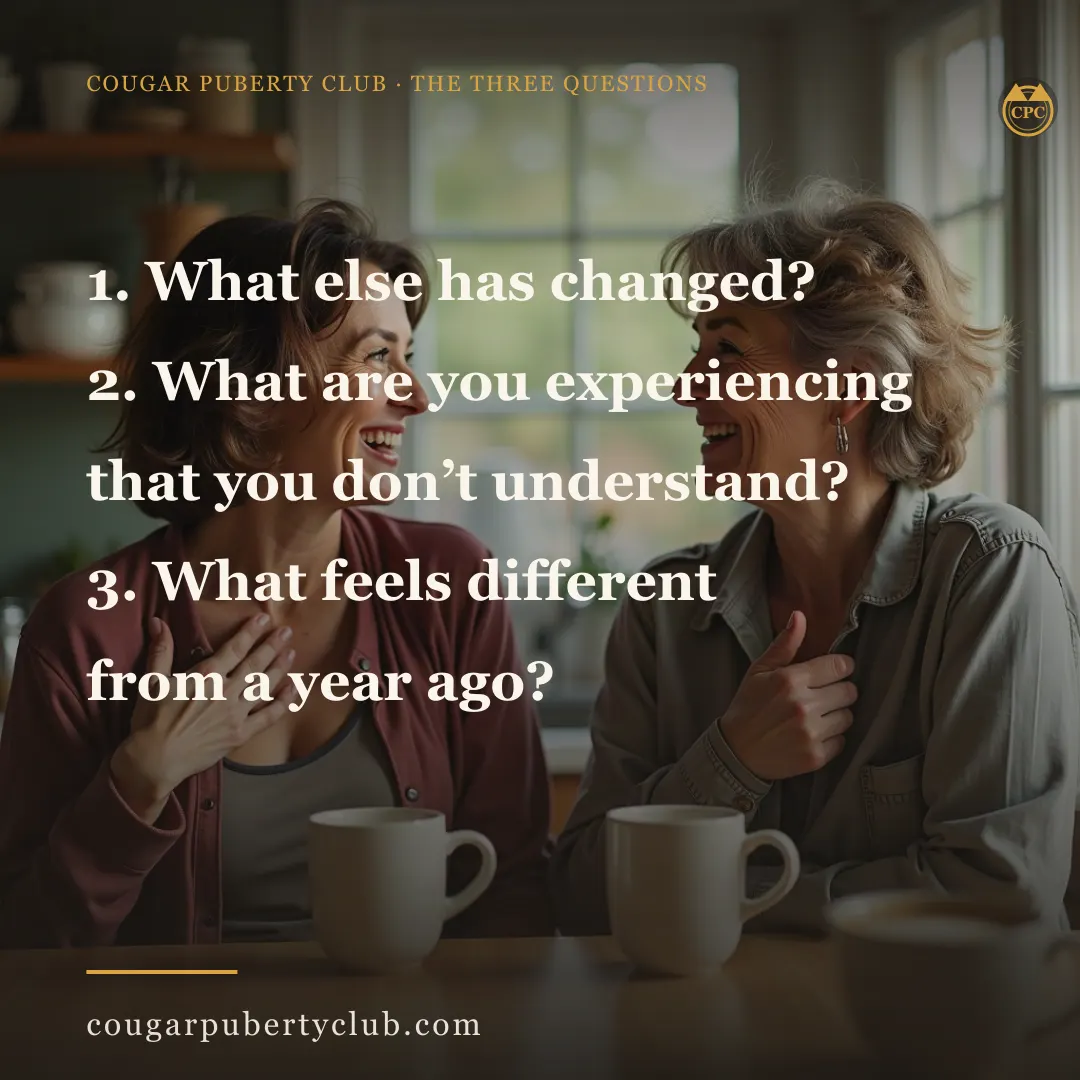
What else has changed? What are you experiencing that you don't understand? What feels different from a year ago?
That's the whole device. It's not a checklist of symptoms - it's a self-audit. You answer them before the visit, on paper, and the answers become your list. Walk in with that and the appointment has a script whether your doctor follows it or not.
Why these three questions work
The study behind them is the numbers version of every group-chat thread you've ever been in. Hswen's team compared 646 clinical notes (screened from 2+ million UCSF records) with 577 of the top r/menopause posts Established: JAMA Network Open. The result:
- Cognitive impairment - the brain fog - came up in ~20% of women's own conversations but only ~5% of clinic visits. A roughly 4x divergence.
- Emotional well-being and weight change showed the same direction: several times more likely to appear in women's own accounts than in the chart.
- Hot flashes, night sweats, and HRT - the classic symptoms - were actually more likely to appear in clinical notes than in women's own conversations.
The chart documents what's easy to document. The group chat documents what's actually happening. And because the form only asks about flashes, the chart never learns about the rest.
Each of the three questions attacks a specific failure mode:
"What else has changed?" - because the symptoms you've normalized ("oh, that's just the word-slip thing, it's fine") are exactly the ones you'll forget to mention. The question forces the full inventory, not the headline.
"What are you experiencing that you don't understand?" - this is the mystery-symptom lane: the phantom smells, the 3 a.m. heart-pounding, the skin crawling, the things you haven't named out loud because you don't have the words yet. Hswen's point: women end up in months or years of unnecessary testing for symptoms that get labeled anxiety, dementia, or autoimmune - because nobody asked the open question.
"What feels different from a year ago?" - the time-based frame. It's the one that catches the slow creep: the sleep that broke, the patience that left, the body that stopped responding to the same workouts, the same food, the same wine. A year ago is a baseline you can actually feel. A checklist of textbook symptoms isn't.
And the rule underneath all three, straight from the author: what isn't documented in the health record shouldn't be mistaken for what doesn't exist. When you describe something that doesn't fit what's known, the right response is to question whether the textbook is incomplete - not to question you Established: STAT First Opinion.
How to use them (the 20-minute pre-visit prep)
One week out (or the night before - we're not grading):
- Answer all three on paper. Not in your head. Paper. For each answer, write it as data: what, when it started, how often, what it stopped you from doing. "Word-finding since spring, several times a day, mid-sentence, in meetings" beats "brain fog, sometimes."
- Read your answers back. The one that makes you go "huh, I forgot that one" is the most important line on the page.
- Put the page in your bag. That's your script. You don't need to memorize anything. You need to not be empty-handed when the room goes quiet.
In the room: name your main symptom in one sentence, the way you'd say it to a friend - then hand over the page. If the conversation goes to hot flashes anyway, redirect with the answers. If it goes to "it's normal," use the turn: "I hear that it's common - what are my treatment options?" See: When Your Doctor Says It's Normal.
This is the calm lane. The other playbooks are still there.
This article is the before - the prep that keeps you from freezing, from forgetting, from leaving the room and realizing you said none of it. It is deliberately not the after.
If you've already been dismissed - twice, five times, nine years' worth - this script isn't enough, and that's not your failure. That's when the full playbook kicks in: the four-week log that reads like data, the witness who's an advocate not a prop, and your second-opinion rights See: Bring the Log. Bring a Witness. Leave with a Plan.. And if you're still wondering why the form only ever asks about flashes, the data story behind all of this is worth the read See: Why Your Doctor Only Asked About Hot Flashes.
Melinda French Gates needed three doctors. The system's blind spot was never your fault - but now you've got the questions that widen it.
What else has changed? What are you experiencing that you don't understand? What feels different from a year ago? Answer them before the visit. Hand the answers to your doctor.
Send this to the friend with an appointment next week. She'll screenshot the card, answer the three questions in her Notes app at 11 p.m., and walk in prepared - which is more than the intake form ever did for her.
Medical disclaimer: This article explains a research finding and a communication strategy; it is not medical advice. Symptom changes, especially sudden or severe ones, deserve a clinician's evaluation. The three questions are a pre-visit prep device from the study's lead author, not a diagnostic tool.