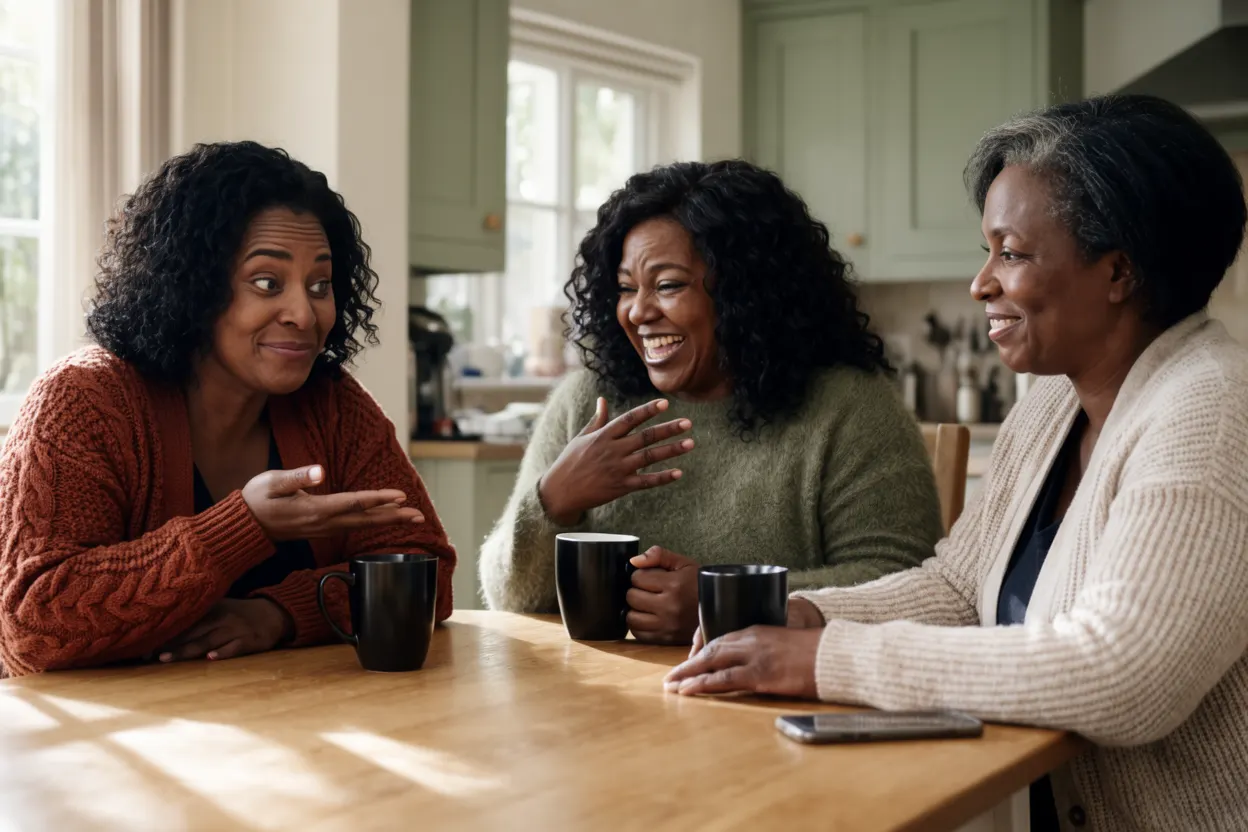
Your mother never said the word. Not once. Not when your aunt went through her "change," not when your grandmother got hot in church and fanned herself through the whole sermon, not when you started asking questions. The word sat in your house like something that wasn't allowed to be real.
It wasn't her fault. She was never handed the word either.
The silence has a mechanism
In March 2026, UCL research landed on something women in the community had been saying for years: the biggest barrier to Black women getting menopause support isn't access to information. It's stigma, transmitted as silence Research: UCL via FemTech World.
Then in August 2026, ITV and FemTech World amplified it. At an event in St Helier, Jersey, hosted by Eve Studios and Liberty Underwear, women said it out loud. Angela Mowanga: "I became dismissive about signs and symptoms. From our parents and our grandparents, they just carried on. I hardly heard the word menopause spoken about in my household." Daisy Ayebale: "We have also been overlooked when it comes to the healthcare system. We need to know this information before it's too late." Research: UCL via FemTech World
And EBONY had already said the other half of it in March: Black women deserve better menopause care.
That's the coverage wave. Here's the mechanism underneath it, because nobody's explaining the machine - just the parts.
The four walls of the silence
1. The mothers who couldn't name it. Your mother didn't withhold information out of cruelty. She repeated the pattern she inherited: don't speak it, don't examine it, don't ask for help with it. "We never had things like hot flushes, itchy skin and tiredness" - not because they didn't happen, but because they weren't discussed Research: UCL via FemTech World. When the vocabulary is absent, the experience still happens - it just happens alone.
2. The strong-Black-woman push-through script. You were raised on it: you endure, you provide, you show up. It's a survival inheritance, and it was necessary. But it has a clinical cost. When a woman is "dismissive about signs and symptoms" - her own words - because the culture trained her to be, she arrives at the doctor's office years later than she should, with a longer, harder road behind her Research: UCL via FemTech World. The same script that protected the community is the one the healthcare system is counting on you to keep running.
3. The church and community taboo. Menopause is treated as women's business, whispered business, the thing you don't announce. The silence gets reinforced every Sunday, every family gathering, every time an older woman fans herself and changes the subject. Taboo thrives on "not being willing to educate ourselves" - Mowanga's exact phrase Research: UCL via FemTech World. The community is where the word should travel fastest, and it's where it travels slowest.
4. The provider dismissiveness that expects the script. Daisy Ayebale named it: overlooked by the healthcare system Research: UCL via FemTech World. When you combine a patient trained to minimize with a provider in a hurry, the appointment goes nowhere - you say "I'm fine, just tired," and the provider writes down "fine, just tired." Neither of you meant harm. Both of you produced the same result: no help.
What the research actually says about your symptoms
The presentation nuance matters, because it changes what "normal" means for you:
- Earlier. Research reported in the 2026 coverage indicates Black women are more likely to experience menopausal symptoms earlier than the average timeline suggests Research: UCL via FemTech World. If you're 38, 40, 44 and the pamphlet says "average age 51," the pamphlet isn't the last word.
- More intensely. Not "the same symptoms, slightly worse." More intense. Which means the interference with your sleep, your work, your patience, is real and it counts.
- For longer. A longer symptom window means more years of the push-through script, more years of being told it's nothing, more years of not naming it.
None of this is a diagnosis. It's context: a reason to take your symptoms seriously instead of assuming you're being dramatic Established: NHS. Perimenopause symptoms are common. That doesn't make them trivial.
The what-to-say-at-the-doctor script
Here's the thing about the dismissive appointment: it's partly yours to structure. Not because you should have to - because you deserve to win it.
Open with dates and interference, not feelings:
"For the past four months I've had night sweats that wake me two to three times a night. My periods went from every 28 days to every 19 days. I'm exhausted by 2pm and it's affecting my work. I know Black women often experience symptoms earlier and more intensely - I want to be evaluated for perimenopause, and if this isn't that, I want to know what else it could be."
Notice what's in there: a timeline, a pattern, an interference statement, the research, and a request for the alternative. The "what else could it be" is the line that forces the workup instead of the wave-off.
If you get waved off:
"What would you like me to track between now and our next visit, and when should I come back if it's not better?"
You're not asking permission. You're assigning homework - theirs.
If the silence is the problem:
"I grew up in a family where menopause was never discussed, so I don't have a reference point for what's normal. Can you help me understand what I should be paying attention to?"
That one's powerful: it converts your cultural inheritance from a weakness into information the clinician can actually use.
Breaking the chain is the treatment
Here's the part nobody put in the research paper: the cure for intergenerational silence is one woman saying the word out loud in front of a younger woman.
You don't need a TED talk. You need one kitchen-table conversation where you say "I'm in perimenopause and it's kicking my ass and here's what I wish I'd known" - and a daughter, a niece, a goddaughter, a younger cousin hears it. That's the moment the silence dies. It's not dramatic. It's how every chain gets broken: somebody goes first.
Your mother never said the word because no one said it to her. Your grandmother pushed through because that was the only option she was given. You have the option they didn't: you can name it, you can research it, you can bring the dates to the appointment, and you can say the word out loud so the next woman doesn't have to spend twenty years not knowing what's happening to her.
The silence was the symptom. Talking is the treatment.
Cougar Puberty Club is a media brand, not a medical practice. This article is education and cultural context, not diagnosis. If your symptoms are interfering with your life, that is a reason to be taken seriously - and a reason to keep asking until you are.