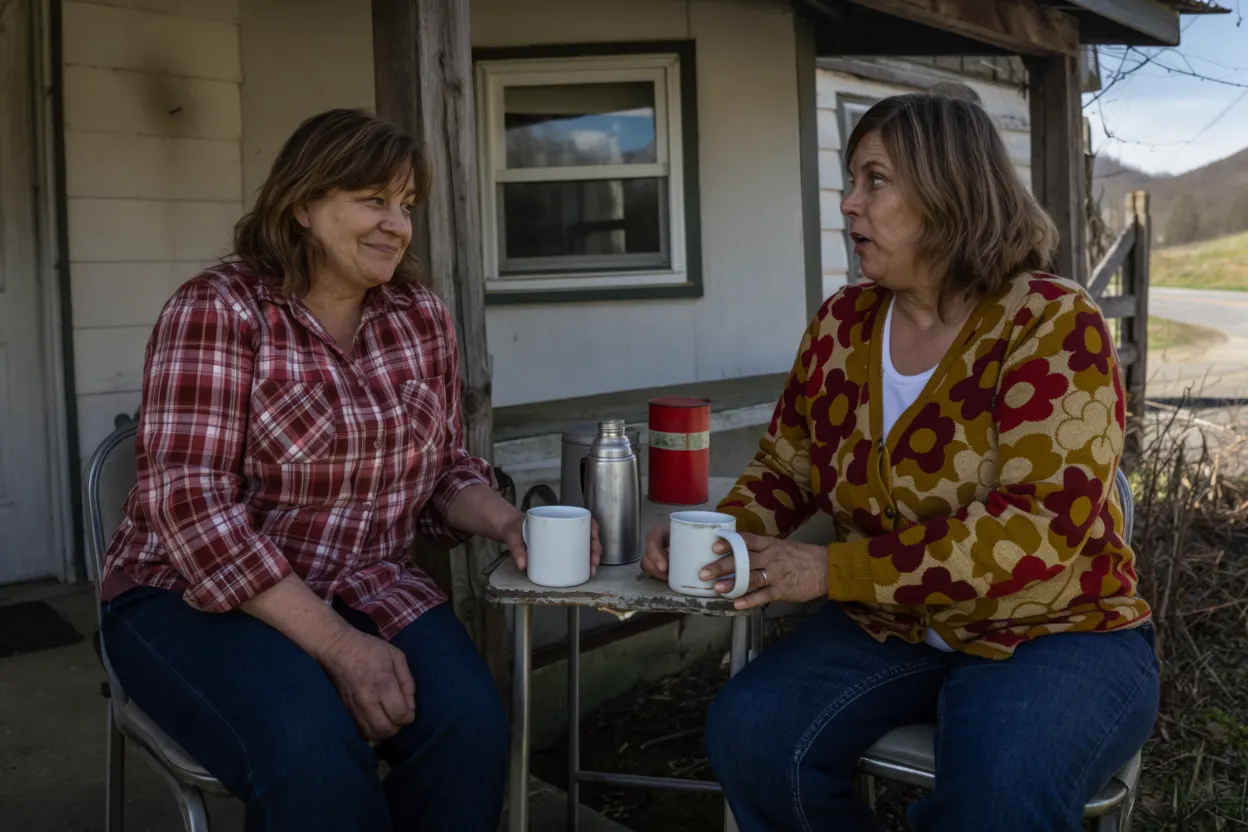
There's a woman in every small town who has been in perimenopause for years and has never said the word out loud.
Not because she's shy. Because no one in her county is paid to ask. The nearest OB-GYN is two counties over. The clinic she does have is booked solid with everything else. And the menopause conversation happening online - the podcasts, the panels, the product launches - is happening somewhere else, in cities, between people with insurance networks and discretionary income and a Sephora on the corner.
The photographer Anna Mullins saw the gap and pointed a camera at it. She turned 55, taught herself black and white photography, and started The Menopause Effect: interviews and portraits of Appalachian women who wanted to tell their stories Cultural: Upworthy. It's a quiet project and it's radical, because it's the first time a lot of these women have seen themselves in the menopause conversation at all.
The three walls
The rural menopause experience isn't a lesser version of the urban one. It's structurally different. Three walls:
1. Geography. In a county where the women's-health infrastructure has collapsed, "go see a specialist" is a four-hour round trip on a workday, or a day you can't take off, or a drive you can't make because you're the one driving your mother to her appointments. Access isn't an inconvenience. It's a filter that decides who gets evaluated at all.
2. Class. The menopause boom is white-collar. It's priced for people who can afford $40 telehealth subscriptions and boutique clinics and supplements with shipping. The women in Mullins' portraits don't have a menopause brand. They have a can of something from the co-op and a friend who swears by it.
3. Stoicism. Rural culture runs on a push-through script that makes the strong-Black-woman problem look familiar: you don't complain, you don't take the day off for "female trouble," you get on with the harvest, the shift, the grandkids. The script keeps the farm and the family running. It also keeps a woman from saying the sentence that would get her help: I think something is wrong with me.
The church-basement silence
In a small town, everyone knows everyone - which means the menopause taboo has a shorter leash and a longer memory. You don't announce it at the diner because the woman two booths over is your son's third-grade teacher. The church basement is where the casseroles happen, not the cervix talk. Privacy is a luxury of being anonymous, and in a town of eight hundred, nobody is.
So the silence compounds: no provider to ask, no peer group to check against, no vocabulary to even form the question. The first woman who says the word out loud in that town is doing something braver than publishing a Substack.
The DIY-remedy culture
Here's the part that deserves respect, not condescension: when the system doesn't come to you, you build your own. Rural women have been managing menopause with herbs, tinctures, black cohosh from the feed store, and advice from the woman who raised them. Some of it works. Some of it is harmless ritual. Some of it interacts with blood-pressure medication and nobody's monitoring.
That's the honest boundary. Herbal remedies can't tell you whether your symptoms are perimenopause or your thyroid or anemia. They can't give you a cardiovascular risk screen before you consider hormone therapy. Perimenopause symptoms are common and real Established: NHS - but "common" and "harmless" are different claims, and the difference is exactly what an evaluation is for. The remedies aren't the problem. The absence of a clinician to check them against is.
The canary is the maternity desert
Here's the data that explains the whole situation. In August 2026, March of Dimes released Nowhere to Go: Maternity Care Deserts Across the U.S.: 34.6% of U.S. counties - more than one in three - are maternity care deserts, affecting more than 5.8 million women, and nearly 58% of rural counties lack obstetric clinicians Established: March of Dimes.
To be precise about it: that's a maternity-care measure, not a menopause statistic. We're using it because it's the best available map of where women's-health providers are - and the trend is the point. When a county's only birthing unit closes, the OB-GYN workforce goes with it. The doctors who did the annual exams and the hormone conversations were the same ones who delivered the babies. Menopause care didn't get its own collapse. It rode in on the same infrastructure and went down with it.
The result: in a growing share of rural America, there is no "menopause appointment" to book. There's whoever is left, and a 90-mile drive if you want the full conversation.
The telehealth reality
The best news in this whole piece: the specialty isn't as far away as the road says.
The Menopause Society (formerly NAMS) maintains a public directory of menopause-competent practitioners, searchable by location and by telehealth availability Established: The Menopause Society. Many of them consult remotely and are used to coordinating with a local primary care provider who does the labs and the follow-up.
The honest limits, because honesty is the brand: you need broadband, or at least a cell signal and patience. Some parts of the workup need an exam and local bloodwork, which means you still need a local clinician willing to be the hands. And telehealth can't fix the underlying desert - it routes around it, which is a different thing and still worth doing.
The working model for rural America: telehealth menopause specialist + local PCP for labs + your pharmacist as the on-the-ground clinical resource. The pharmacist, by the way, is often the most accessible clinician in town, and asking them about interactions costs nothing.
What actually helps in a no-specialist-within-hours town
1. Start with the directory, not the drive. The Menopause Society practitioner finder filters by telehealth Established: The Menopause Society. One remote consult can get you the evaluation, the hormone-therapy conversation, and a letter your local doctor can work from.
2. Give your PCP the script. Dates and interference, not feelings: "For the past four months I've been waking two to three times a night, my periods are closer together, and I'm exhausted by mid-afternoon. I want to be evaluated for perimenopause - and if this isn't that, I want to know what else it could be." Perimenopause typically starts in the mid-to-late 40s and lasts about four years on average; menopause is confirmed after twelve consecutive months without a period Established: OWH. You're giving them a timeline and a request for the alternative. That's a workup, not a wave-off.
3. Know what treatment looks like before you ask for it. Hormone therapy is genuinely effective for bothersome symptoms, especially started within ten years of menopause and before age sixty, and it comes in gels, patches, and pills - not just "the pill your mother took" Established: NHS. Non-hormonal options exist too. The point of knowing this in advance: you can have the conversation with whoever you can get, instead of waiting for the specialist who isn't coming.
4. Use the pharmacist. In towns where the clinic is stretched thin, the pharmacy is the most reliable clinical touchpoint. Interaction questions, OTC options, which supplements are pointless - it's free and it's local.
5. Build the care web. Telehealth specialist for the brain, local PCP for the hands, pharmacist for the daily questions, and one friend who will say the word out loud with you. The web is the workaround for the desert.
The photo essay is the point
Here's what Anna Mullins understood that the whole menopause industry keeps missing: recognition is a form of care. Before the treatment, before the product, before the podcast, a woman needs to see someone like her - same hands, same porch, same county - and realize the thing she's been privately enduring for five years is a named, normal, studyable phase of life. That's what the portrait does. That's what this article is trying to do with words.
The menopause boom was never going to drive 90 miles. So the conversation has to start where the women already are: the church basement, the diner booth, the feed store, the porch. One woman saying "I'm in perimenopause and it's kicking my ass and here's what I wish I'd known" - in a town where no one has said it before - is worth more than a hundred urban panel discussions.
Somebody has to go first. In rural America, the somebody is usually you. Anna took the photograph. The rest of us can say the sentence.
Cougar Puberty Club is a media brand, not a medical practice. This article is education and cultural context, not diagnosis. If your symptoms are interfering with your life, that is a reason to be taken seriously - and a reason to keep asking until you are.