You walked into the kitchen. You were holding a mug. You had a mission: a mission that evaporated somewhere between the hallway and the sink, like it was never real. Now you're standing in front of the refrigerator, opening it anyway, because it feels like something should happen here.
Congratulations. That's brain fog. And if you're in perimenopause, it's not in your head. Well, technically, it is. But it's not your fault.
What brain fog actually is
Brain fog isn't a medical diagnosis. It's the shorthand for a cluster of subjective experiences: forgetting words, losing your keys while holding them, walking into rooms and forgetting why, drawing a blank on a colleague's name you've known for a decade, and the special joy of forgetting the word for colander and describing it as "the thing with the holes you use for the pasta."
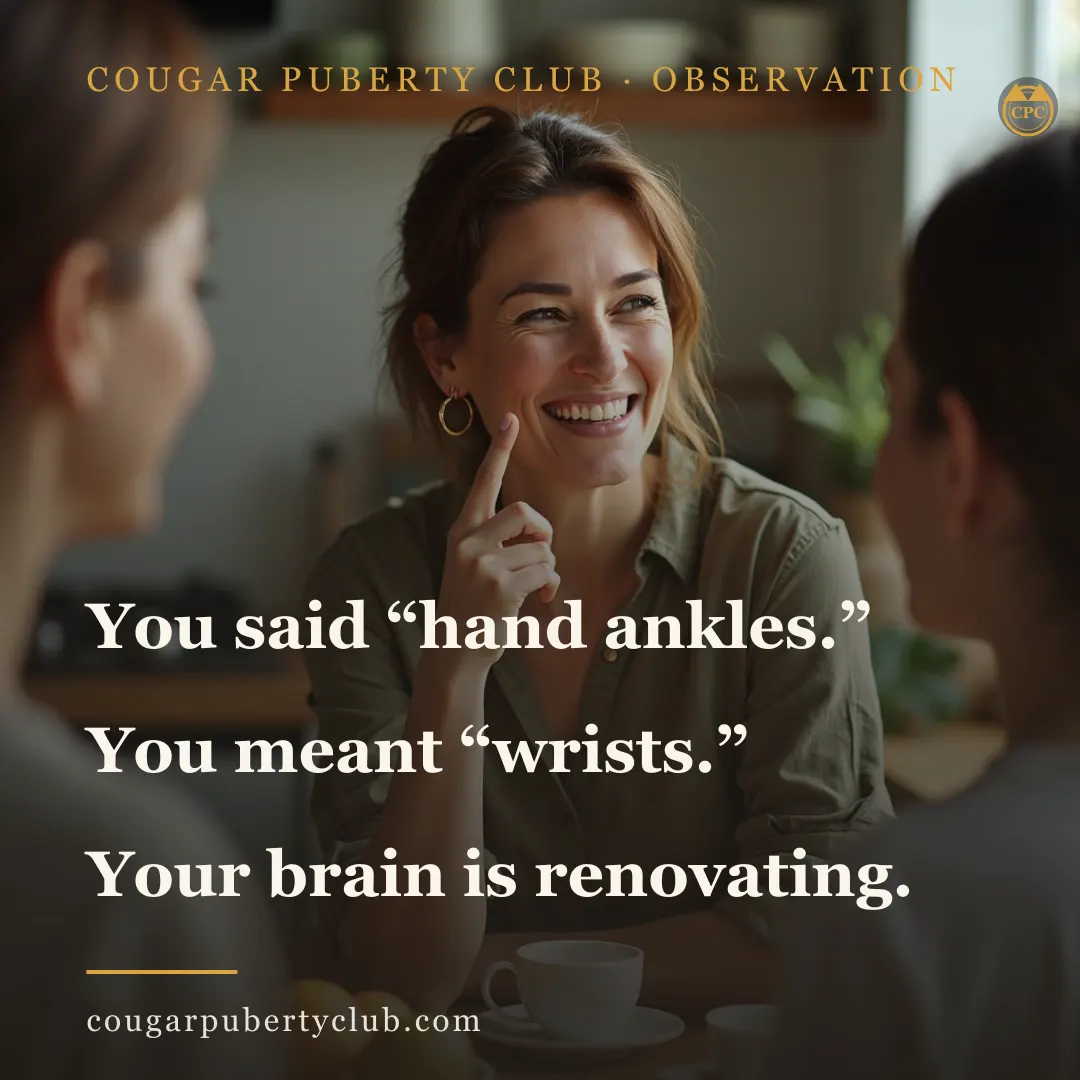
And then there's the advanced move: the wrong-word swap. Not a blank: a substitution. You meant wrists and out came "hand ankles." You meant remote and said "clicker." Or fridge and said "the cold cupboard." It's the brain taking a shortcut to the right neighborhood and then improvising the house number. It sounds insane in the moment. It is, in fact, one of the most universally reported brain-fog experiences in perimenopause, which is why it's one of our most-shared cards.
Here's the number that should make you feel better: as many as two-thirds of women going through perimenopause report problems with memory or trouble focusing Established: OWH. Two out of three. If you're losing the colander word, you are in the statistical majority of women in your exact situation.
The Brain Fog Thesaurus
You know the word. It is right there. It has been right there for three seconds, which is three seconds too long, because what actually came out of your mouth was "space waitress."
The Brain Fog Thesaurus is the unofficial dictionary of words your brain has temporarily replaced with the nearest thing it could find. Same meaning, wrong neighborhood, zero notice. Real submissions so far: space waitress (flight attendant), potato children (tater tots), food tweezers (tongs, submitted by a former chef, which hurts more), hand ankles (wrists), and the classic, the pasta thing with holes (colander).
Every one of these was said out loud, in public, by a woman whose brain was doing renovations without a permit. The group-chat version of the list, with one open question, is the card at the bottom of this article. Send it to the friend who will know exactly what you mean.
The professionals are not exempt, and their entries got their own board. The flight attendant's brain produced "space waitress" (two words, she knew it, and she knew "stewardess" was retired). The chef's brain produced "food tweezers". The casting brain produced "name brand actors" for A-list. When the word that leaves is the vocabulary of your actual job, it stings in a specific way - the work words live on the busiest street in your brain, so they're the first to go quiet. The verified greatest hits, professional edition, are the card below.
What's your translation? Drop it in the comments. The thesaurus is open for submissions. The comment section is the corpus, and the next edition gets built from what you send. (And if you're here because the laugh turned into a 2 a.m. worry spiral: that's exactly what the rest of this article is for. This is a club, not a hospital.)
Why it happens
The short answer: your hormones are doing renovations and the wiring is briefly exposed. Perimenopause involves significant fluctuations in estrogen, and estrogen does not stay in the ovaries' lane; it interacts with brain systems involved in memory and executive function. The Menopause Society summarizes the research this way: brain fog (forgetfulness, trouble concentrating, and mental fatigue) is commonly reported and often attributed to fluctuating hormone levels Established: The Menopause Society.
A 2025 literature review presented by The Menopause Society found menopause is associated with structural brain changes, including reductions in gray matter volume in regions critical for memory and executive function, which correlate with declines in verbal and visuospatial memory performance. The genuinely reassuring part: some evidence suggests partial recovery of gray matter volume after menopause Established: The Menopause Society. In plain language: this is likely a season, not a sentence.
One more thing worth knowing, because the supplement aisle will not tell you: hormone therapy does not treat or prevent memory loss or brain diseases, including dementia and Alzheimer's disease Established: OWH. Menopausal hormone therapy may be an excellent choice for hot flashes and night sweats that are wrecking your life, and sleep disruption absolutely makes cognition worse, but "cures brain fog" is not one of its evidence-based claims. Anyone selling you that is selling you something.
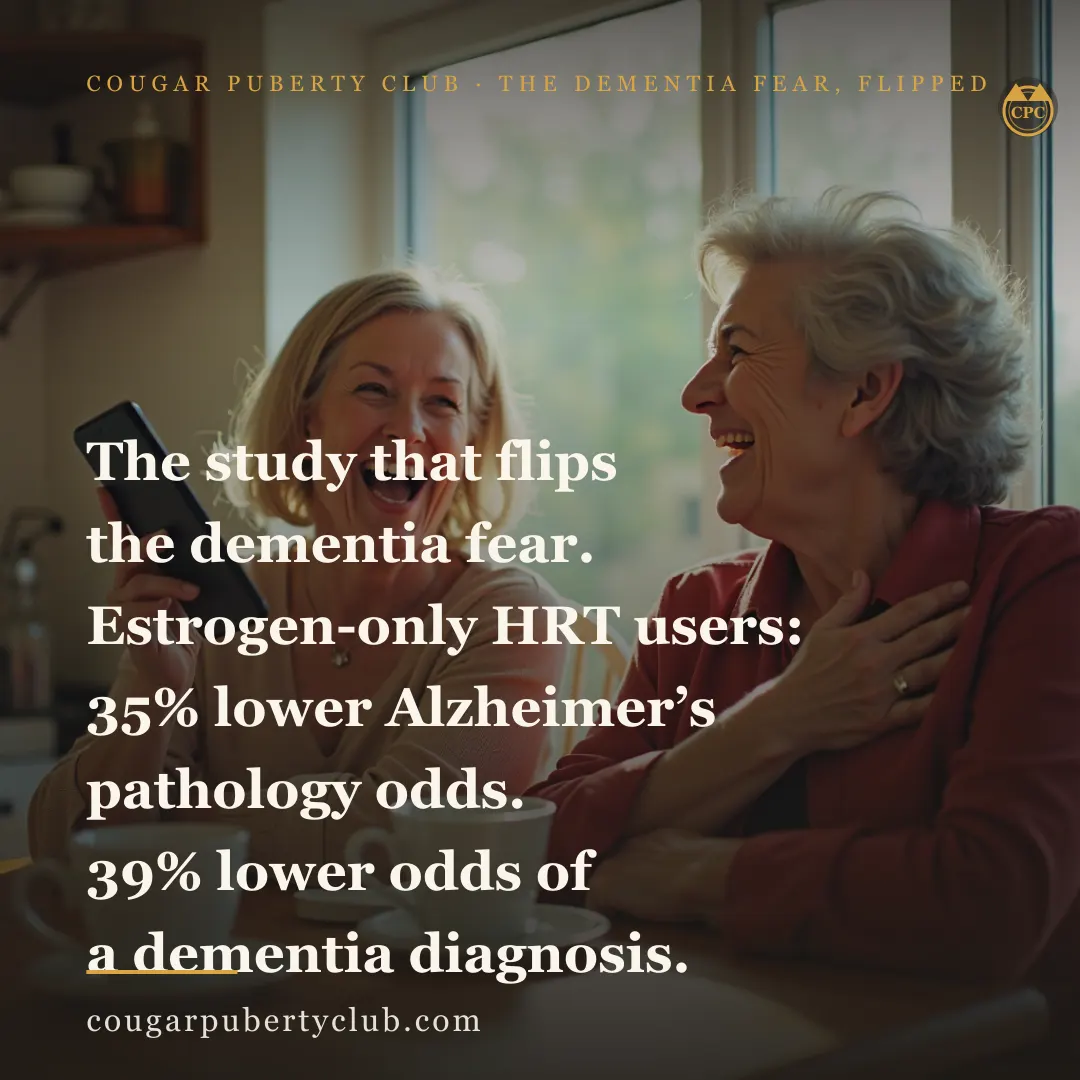
One nuance, because the news cycle will not give it to you: a new observational autopsy study (Aug 2026) found women who had used estrogen-only hormone therapy had lower odds of Alzheimer's pathology and of a dementia diagnosis Established: Stanford Medicine, Neurology. That is an association in a specific group, not evidence that MHT prevents dementia – the guidance above still stands – but if your brain-fog fear has a "what if it's the beginning of something" flavor, it's the kind of finding worth bringing to your clinician conversation. (The card version of this is in the shareables library.)
What it is not
For the overwhelming majority of women, perimenopause brain fog is not early dementia. It is a disruption of short-term recall and word-finding under hormonal and sleep pressure, not a loss of who you are. Most women do not experience progressive cognitive decline during this transition; the changes are typically subtle, and many report things leveling out as hormones settle Established: The Menopause Society.
That said, there's a difference between forgetting the colander and forgetting the stove. Bring these to a clinician's attention:
- Confusion that's new, sudden, or scary, like getting lost in familiar places
- Trouble with familiar tasks or conversations you used to handle easily
- Memory problems that are getting worse, not fluctuating
- Forgetfulness that's interfering with work, safety, or daily life
Federal guidance is direct about this: talk to your health care provider if forgetfulness or other mental problems affect your daily life Established: OWH. And while you're there, ask whether any of your medicines could be contributing, because the answer is sometimes yes, and that's a fixable one.
What actually helps
The boring, free, evidence-backed list, courtesy of the federal Office on Women's Health:
- Get enough sleep. Sleep is when your brain files the day's receipts. Perimenopause makes sleep hard; see our sleep topic hub and the troubleshooting guide for the full program.
- Move your body. Regular physical activity is associated with better memory and focus.
- Eat like you mean it and don't smoke. Both are on the federal list.
- Stay socially active. A book club, a hiking group, a standing lunch: social interaction is protective for memory.
- Stay mentally active. Crosswords, a class, a new skill, a language. Use the brain or the brain uses you.
All of the above per OWH guidance Established: OWH.
And the low-tech hack that out-performs most of the supplement aisle: write it down. Notes app, sticky note, a list on the counter. Offloading your memory is not cheating; it's engineering. The competent women we write for run teams and households with a thousand moving parts; the ones who forget the fewest things are the ones who stopped trusting their brains to hold everything.
The bottom line
Brain fog is one of the most common, and most under-discussed, experiences of cougar puberty. Two-thirds of women in perimenopause report it. It is real, it is mostly temporary, and the fixable contributors (sleep, stress, meds, being genuinely overloaded) are worth addressing first.
If your forgetfulness is mild and fluctuating, you are normal, and you are in excellent company. If it's interfering with your life or getting worse, that's not a character flaw either; that's a conversation to have with a clinician, armed with the questions above.
- Perimenopause or just Tuesday? The field guide
- What is perimenopause, anyway?
- Perimenopause 101
- Every source behind this article
Heard the estriol-for-brain-fog headlines? The first named study behind that search (a UCLA pilot in Scientific Reports, September 2026) is real, early, and - here's the catch - the estrogen it tested isn't FDA-approved in the US. We unpacked the whole thing: The Estriol Experiment: The Brain-Fog Study, and Why You Can't Get It in the US.
Want more of this? Join the 3 AM Club, our newsletter for people who are awake at weird hours, forgetting what they came in here for. One useful thing, one surprising find, one thing that'll make you laugh. No spam, no creepy tracking.