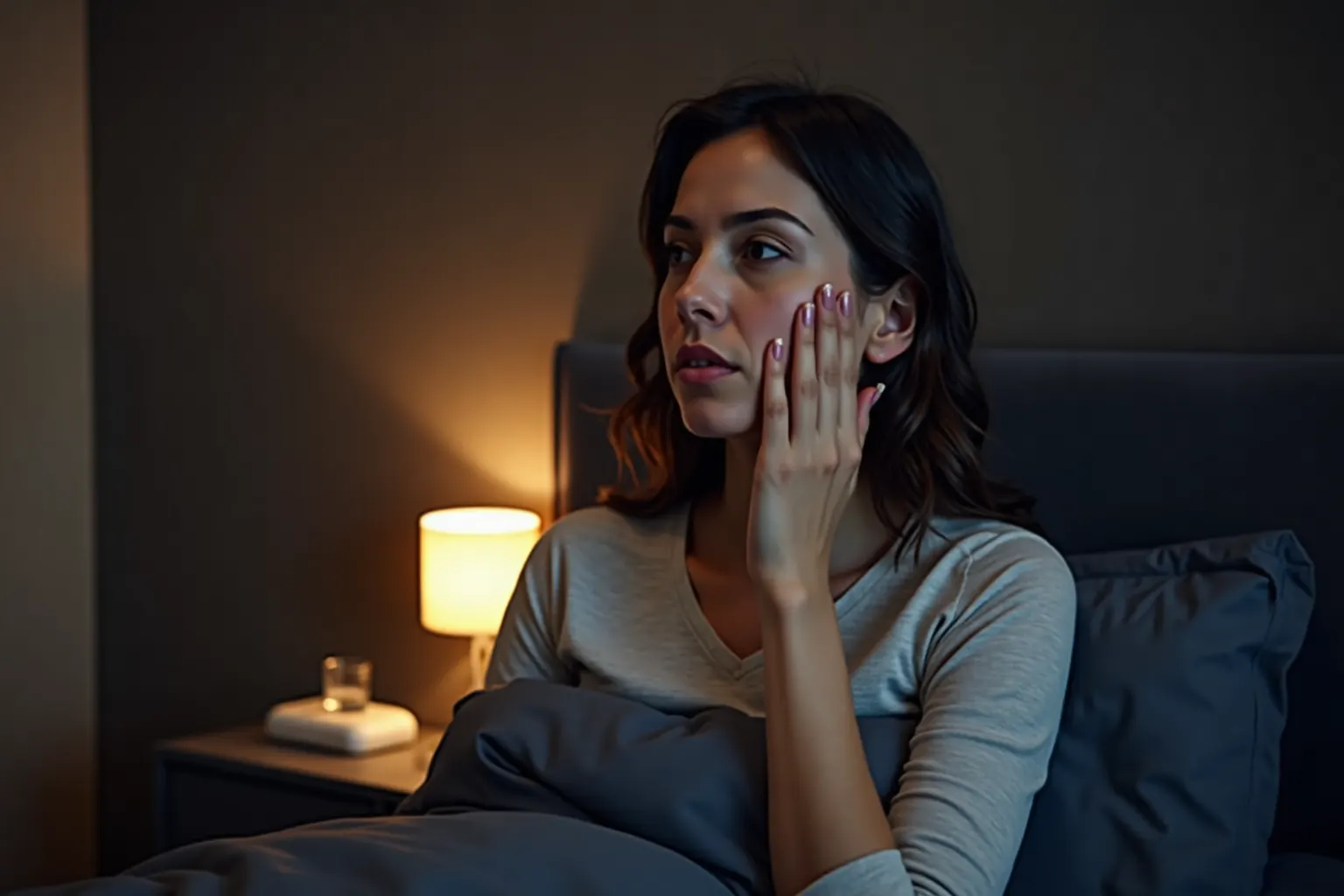
You wake up with a jaw that feels like you spent the night chewing gravel. Your head hurts in that specific way, behind the ears, around the temples. Your partner, who loves you, reports that you made a sound like someone tightening a winch. And when you finally pry your mouth open for coffee, you notice your teeth feel… shorter? Flatter? Wrong?
Welcome to the peri jaw.
Teeth grinding, bruxism, if you want the word for it, is one of those things that "everyone does a little." Cleveland Clinic's line: many people grind now and then, especially during stressful times Established: Cleveland Clinic. But perimenopause has a way of taking background noise and turning it into a lead instrument. Women in our research keep showing up with variations on the same message: I am grinding the crap out of mine. My jaws hurt. And then the follow-up question, always: Is it peri, my SSRI, or am I just angry?
The honest answer is usually: yes.
The two usual suspects (and they can both be guilty)
The classic peri question is "SSRI or estrogen?", and for bruxism specifically, it's a fair question, because the evidence is uneven.
The SSRI side is real and documented. Cleveland Clinic lists certain medications, including SSRIs, the selective serotonin reuptake inhibitors that so many of us end up on during peri, among the risk factors for grinding Established: Cleveland Clinic. NHS says the same in plainer terms: medicines for sleep problems, depression, or anxiety are linked to teeth grinding Established: NHS. If you started an SSRI in the last year and the grinding started or got worse around the same time, that's not a coincidence you're imagining.
The estrogen side is more of a backdoor. There's no clean "estrogen causes bruxism" line in the textbooks. What peri does is stack the risk factors: worse sleep, more stress and anxiety, more depression (and more SSRIs), and, importantly, more sleep apnea, which Cleveland Clinic notes has a confirmed correlation with grinding Established: Cleveland Clinic. Peri doesn't need its own entry in the bruxism chapter. It just needs to quietly make every other cause more likely.
So "is it peri or my SSRI?" is the wrong question. The right one is: what's stacking up, and what can I actually do about it?
The jaw is where the rage goes
Here's the part our community recognizes immediately: grinding isn't just a dental thing. It's a tension valve. The same women who develop sudden sound rage, the misophonia thing, where his chewing becomes a personal attack, are often the same women who wake up with clenched jaws. The jaw is where the day's accumulated irritation goes to sleep and files its protest overnight.
It's not a character flaw. It's a stress response with teeth. Cleveland Clinic notes that anxiety and stress are risk factors Established: Cleveland Clinic, and perimenopause is basically a stress test for your nervous system. When the rage has nowhere else to go, the masseter muscle volunteers.
This is also why the fix isn't just dental. If grinding is your body's way of processing the week, a mouth guard protects your teeth, it doesn't fix your nervous system. Both conversations matter.
Night guards: when $30 is legit and when it isn't
Let's be practical, because the night-guard aisle is confusing and the internet will absolutely sell you a $150 version of the same thing.
The role of any guard: worn at night, it protects your teeth from the damage of grinding Established: NHS. That's it. That's the whole job. A guard is a buffer, not a cure.
OTC boil-and-bite is legitimate when: your grinding is mild, you have no jaw pain worth mentioning, no tooth damage, and you just want to stop wearing your molars down while you sort out the stress/medication/sleep side of things. Millions of people use them. They fit "fine."
Go to the dentist when: your jaw hurts in the morning, you have headaches or earaches, your teeth are visibly worn, cracked, or sensitive, or your partner says you grind in your sleep. NHS is explicit: see a dentist if you grind and have tooth damage, sensitive teeth, or pain in your jaw, face, or ear Established: NHS. A dentist-made guard is fitted precisely to your bite Established: NHS, and, just as important, the dentist checks that grinding hasn't already started damaging things. The bill for a custom guard is annoying. The bill for a crown is worse.
The rule of thumb: OTC is a stopgap, not a diagnosis. If you're waking up in pain, you're past the stopgap stage.
The magnesium thing
You will be told, possibly by a well-meaning group chat, to take magnesium. It's the peri supplement of the year, and it does genuinely help some people sleep. On the bruxism-specific claim, the evidence is thin, and neither of our tier-1 sources lists it as a grinding treatment. If you want to try it for sleep, that's a conversation for your clinician, just don't let a supplement defer the dental checkup that actually protects your teeth.
The actual to-do list
- See a dentist if there's any pain, damage, or a partner who says you grind. Get the bite checked and get a real guard if they recommend one.
- Have the medication conversation, not by stopping anything cold, but by asking your prescriber whether your SSRI might be contributing and whether the timing lines up.
- Rule out sleep apnea if your sleep is bad, because grinding and apnea travel together Established: Cleveland Clinic and apnea is the one with the serious untreated consequences.
- Do the boring stress stuff, NHS's list is unglamorous and it works: relaxation, consistent sleep, regular dental check-ups, less alcohol and caffeine, no smoking Established: NHS.
- Name the rage. If the grinding started alongside the sound rage and the irritability, you're not becoming a horrible person, you're becoming a woman whose jaw is doing the emotional labor. The misophonia explainer is the natural next stop.
Peri jaw is real, it's common, and, unlike so much of this transition, it has a fairly clear action plan. Teeth can be protected. The grinding can be managed. And the rage? That part, at least, you're allowed to keep.