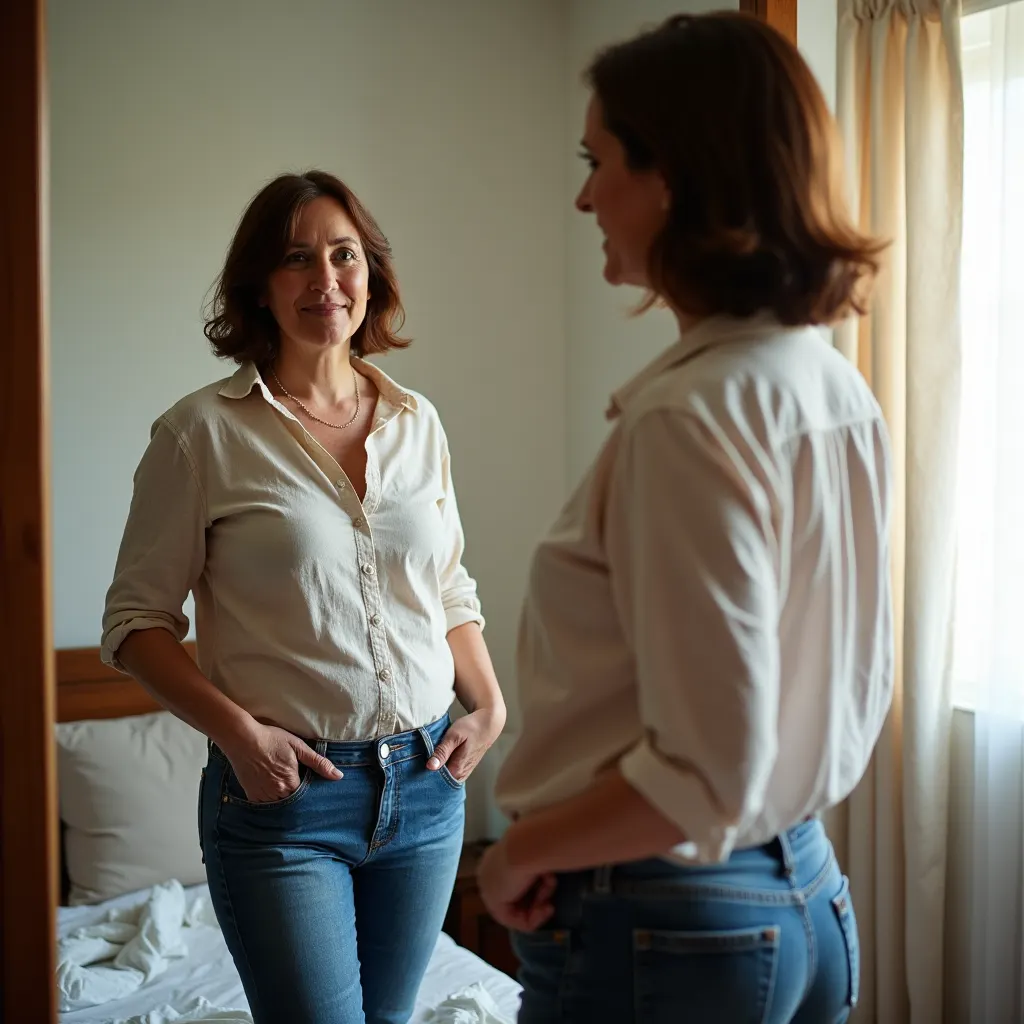
Here's the sentence that changed the conversation. It's not "how do I look younger?" anymore. It's:
"I don't recognize myself anymore."
Aesthetic physicians report hearing it constantly from women in their forties and fifties Women's eNews, Aug 2026. And here's the thing they noticed: when a woman says that sentence, she is almost never talking about her wrinkles.
She's talking about the woman in the mirror not matching the woman inside.
If you've stood in front of the bathroom mirror lately and felt like you were looking at a stranger - not an older version of you, a stranger - this piece is for you. It's not vanity. It's not "getting old." It's two huge things happening at once, and they're both real, and they're both fixable in how you see them.
The camera part: you're the first generation to watch it happen
Here's a fact that should stop you cold: for the first time in human history, women are going through perimenopause while seeing their own faces reflected back at them hundreds of times a day. Zoom. FaceTime. The front camera you accidentally open. The security camera at the door. The selfie you delete. The filtered feed that quietly rewrites what "normal" looks like.
Every one of those is a mirror. And mirrors, it turns out, are not neutral.
When the world moved onto video calls, researchers noticed something: prolonged self-observation was associated with greater appearance dissatisfaction, more self-focused attention, and - wait for it - greater interest in cosmetic procedures. They gave it a name. The Zoom effect. Zoom dysmorphia Women's eNews, Aug 2026.
That's not a joke about your work calls. That's documented: watch your own face for hours a week, and your brain starts treating it like a project with a defect list.
Now take a woman whose face is actually changing - because she's in perimenopause - and put her in front of those cameras. The cameras didn't make you look older. But they did make you watch it, in a way no woman in history has ever had to.
The brain part: the chemistry behind the stranger
The mirror tells only half the story. The other half is happening in your skull.
Here's the nerdy version, because you deserve the real mechanism, not a wellness-blog metaphor. Your brain converts progesterone into allopregnanolone, a neurosteroid that enhances signaling through the GABA-A receptor - your brain's primary inhibitory system. One of its jobs: soften emotional intensity, reduce hypervigilance. It's the reason calm used to come naturally Journal of Neuroendocrinology, 2022.
In perimenopause, progesterone often declines first - and becomes erratic. As allopregnanolone levels wobble, GABAergic signaling gets less stable. Result: you feel more anxious, more emotionally reactive, less able to find the calm that used to be right there Women's eNews, Aug 2026.
Meanwhile, fluctuating estradiol is playing on the other neurotransmitter systems - serotonin, dopamine - which govern mood regulation, reward, motivation, and cognitive confidence. The Menopause Society puts it plainly: women appear to be particularly vulnerable to low mood in the perimenopause years, and mood symptoms may be related to big swings in estrogen The Menopause Society.
Put it together and you get the exact experience women describe: confident and decisive one week, uncertain and deeply self-critical the next. Feeling like a completely different person from one week to the next. Because - here's the part nobody says out loud - your brain is a completely different chemical environment from one week to the next.
Why they amplify each other
Here's the cruel math of midlife:
- Hormonal fluctuation increases emotional sensitivity.
- Constant camera reflection increases self-monitoring.
- Biology and technology start feeding each other.
The result is the feeling: "I'm aging faster than everyone else."
You usually aren't. That's the part the doctors want you to hear. But the feeling is real enough to shape how you see yourself - and that's the part worth taking seriously. Not because you need fixing. Because you deserve to know what's actually happening.
The honest part: when this deserves a conversation
Quick clarity, because we don't do vague here: "I don't recognize myself" is a documented, common, normal perimenopause experience. But if the unfamiliarity has crossed into persistent low mood - if it's been weeks of flat, gray, hopeless, or heavy - that's not "just hormones," and it's not a sign you're weak. It's a sign to have a conversation with a clinician. Depression in the perimenopause years is common, and it's treatable The Menopause Society. The hormone changes and the mood changes can be tangled together; a good clinician will help you untangle them instead of waving you off with "it's your age."
And if you're not there - if you're mostly fine, just unfamiliar - that's also real, and it doesn't need a diagnosis. It needs reframing.
The mirror part: a different question
Here's the shift the doctors have started using, and it works at home too.
Old question: "How do I fix this?" New question: "How do I support you?"
Stand in front of the mirror and ask it out loud, once. "How do I support you?" The first question turns your face into a defect list. The second one treats you like a person going through a documented biological transition - because that's exactly what you are.
Wrinkles start reading as biology rather than failure. The emotional turbulence starts reading as a brain adapting to profound hormonal change rather than as weakness. The stranger in the mirror starts reading as a woman mid-transition - not a woman being erased.
The mirror didn't become a liar. It's just showing you someone you haven't met yet. Same person, different chemistry, different cameras, different era of life. First generation of women to ever have to reconcile all of it in real time - and you're doing it with the self-awareness to actually ask the question.
That's not "aging gracefully." That's aging authentically - and it's the whole game.
The 30-second version: You don't recognize yourself because (1) you're the first generation of women to watch themselves age on camera hundreds of times a day, and (2) perimenopause is rewiring the brain chemistry that governs calm, mood, and confidence. Neither is vanity. Both are real. The fix isn't a product - it's a question swap: "How do I support you?" instead of "How do I fix this?"