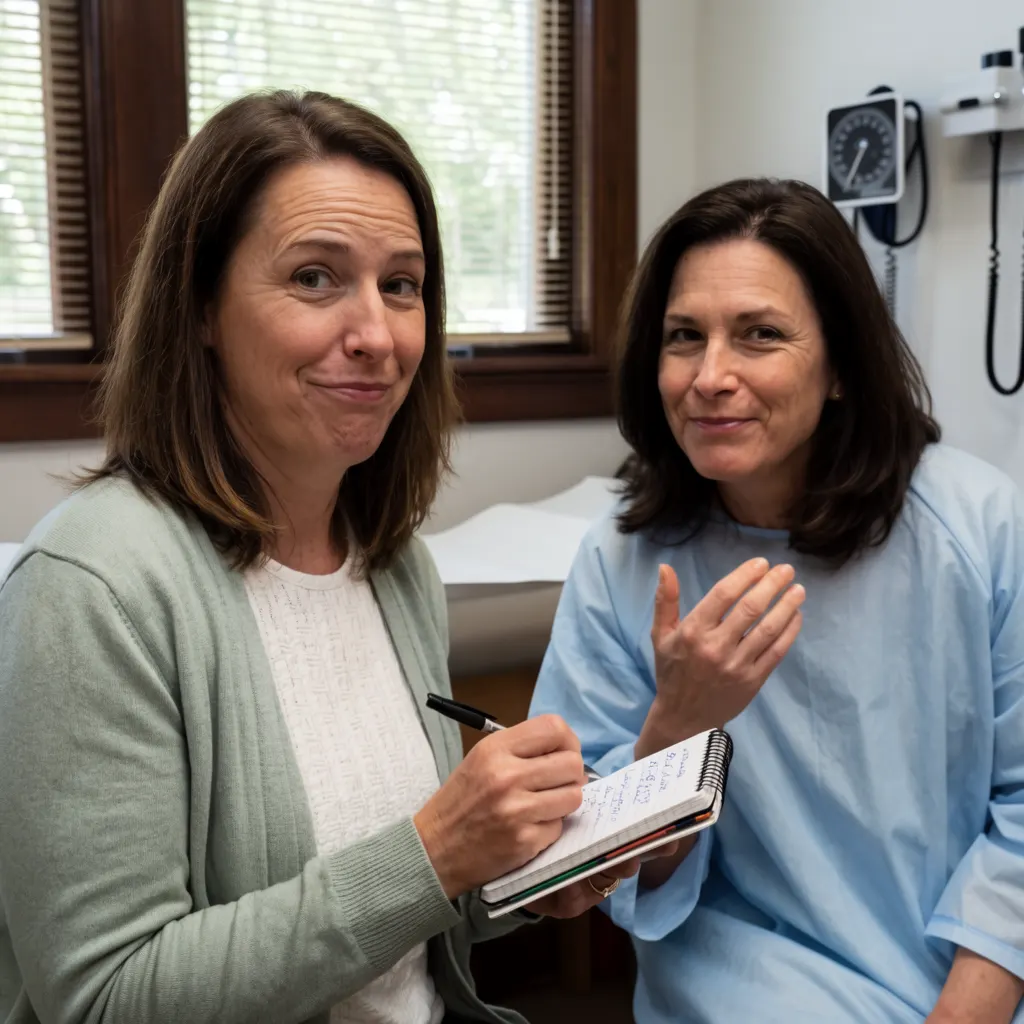
You know the IUD insertion story by now: the wave of women who went in expecting "a little pinch" and got something else entirely - and the wave of articles that followed, finally saying the quiet part: you can ask for pain relief, and it's not weakness to need it.
The endometrial biopsy is that conversation's sequel. Same plot, worse cold open. A woman in r/Menopause went in for a biopsy and ended up describing the doctor throwing a sample pack of ibuprofen at her on the way out the door with "it doesn't hurt that much" Community: r/Menopause. The thread filled with "same" - hundreds of women who'd been sent into a procedure that can spike from zero to ten in seconds with nothing but a suggestion to take Tylenol. One of them put the whole thing in a sentence: pulling a tooth is quick too, and they numb that area to oblivion Community: r/Menopause.
So let's do what we do: name the gap, translate the jargon, and give you the scripts. Because the biopsy itself - the reason for it, the reality of it, and the pain relief you're actually entitled to ask about - is all findable in plain language. Nobody's putting it together for you. We are.
What the biopsy actually is
In an endometrial biopsy, a small sample of tissue is removed from the lining of your uterus - the endometrium - and sent to a lab Established: Mayo Clinic. It is, per Mayo Clinic, often done right in the clinician's office Established: Mayo Clinic. Depending on the clinic, the sampling happens with a thin flexible tube through the cervix, sometimes with a tiny camera (that version is a hysteroscopy, and a biopsy can be taken during it) Established: NHS.
Why is it happening to you? Usually because something about your bleeding changed and the workup needs an answer: a transvaginal ultrasound showed a thickened lining, or you're bleeding after a long stretch of nothing - the post-menopause or HRT-bleeding situation where "it's probably nothing" isn't a sufficient answer. ACOG's patient guidance lists endometrial sampling as part of evaluating abnormal bleeding Established: ACOG. If the office sample doesn't get enough tissue or comes back unclear, the next step is a D&C under anesthesia Established: Mayo Clinic.
Read that again: the backup plan is a procedure with actual anesthesia. Think about what that implies about the office version.
Why "just take an ibuprofen" is not a pain plan
Here's the NHS, in writing, on camera-and-biopsy procedures on the womb: having one "can be uncomfortable and may feel like period pain," and taking ibuprofen or paracetamol an hour beforehand "can help" Established: NHS.
Same page, two sentences later: "However, for many people a hysteroscopy can be very painful" Established: NHS.
That's the whole gap in two sentences. The medical system has documented - in a public health service's own patient guidance - that this procedure is very painful for many people. And the default offer is still an over-the-counter pill and a pep talk. The women comparing notes in the comments are not hysterical. They're reading the same document you just read, from the other side of the speculum.
The tooth comparison isn't hyperbole, it's the point: a dentist numbs a two-millimeter nerve before drilling into a tooth, because quick doesn't mean painless. "It's only 30 seconds" is a duration, not an analgesic Community: r/Menopause.
What you can actually ask for
The good news: this is the rare gap where the fix is a conversation, not a fight. The NHS is explicit that if you're worried about pain, you should speak to the clinic before the day Established: NHS. Use that permission. Here are the four asks, in order:
1. Ask the scheduler what the clinic's pain options actually are. Not "will it hurt?" - that gets you reassurance. Ask: "What pain management options does your clinic offer for the biopsy - local anesthetic, gas and air, or sedation? And if you don't offer sedation, can you refer me to a clinic that does?" The NHS states sedation or general anesthetic may be possible but isn't offered everywhere, and you may need a referral to get it Established: NHS. That sentence is your lever: it's not a favor, it's a documented option.
2. Bring your history, out loud, in advance. The NHS specifically says to tell staff beforehand if you've had painful vaginal exams or cervical smears, if painful periods make you faint, or if you've experienced sexual violence Established: NHS. This isn't oversharing - it's the trigger list for procedures like this, and clinics are supposed to plan around it.
3. Bring a person. The NHS says to let staff know if you'd like to bring a friend or family member, and that a chaperone will be present Established: NHS. Your person isn't there for emotional support only - they're there to hear what's said, hold the notebook, and be the reason the "it doesn't hurt that much" door doesn't get shut on you alone.
4. Agree on the mid-procedure plan before the speculum goes in. You can ask to stop the procedure at any time Established: NHS, and if you're in a lot of discomfort you may be offered gas and air or local anesthetic on the spot Established: NHS. So say it before they start: "If I'm in more pain than I can ride out, what happens? I'd like us to agree now that we pause and add something - or stop." A plan agreed in advance beats a negotiation mid-cramp.
The community add-ons - asking whether cervical softening is an option in your case, bracing for the stabilizer moment, scheduling on a day you can lie down afterward - are worth raising as questions, not demands Community: r/Menopause. You're not there to run the clinic. You're there to make sure the clinic runs you with the same courtesy they'd give a tooth.
The workup is not the punishment
Let's hold both truths, because the internet will try to make this a conspiracy: the biopsy is genuinely useful, often genuinely necessary, and genuinely under-anesthetized for how painful it can be. All three are true at once. The biopsy is how "maybe" becomes "know" - it's the definitive answer to the thickened-lining question, done in minutes, in an office, with results that end the guessing Established: Mayo Clinic. Being sent for one is not a punishment, a suspicion, or a brush-off. It's the opposite of dismissal: someone finally decided the bleeding change was worth investigating.
The gap isn't the biopsy. The gap is that the investigation treats your pain as optional while treating the tissue sample as essential.
The one-sentence scripts
To the scheduler:
"I'm scheduled for the biopsy on [date]. Before then I'd like to know what pain management the clinic offers - local anesthetic, gas and air, or sedation - and whether I can be referred somewhere that offers more if you don't."
To the clinician, if you get the wave-off:
"I know it's quick. I'm asking because the NHS's own guidance says this can be very painful for many people and that sedation is an option some clinics offer. I'd like to know what this clinic's plan is for me if I'm one of those people."
To yourself, in the waiting room, if you're holding printouts and wondering if you've become the annoying patient:
"I'm not here to tell them their job. I'm here because I read that pain relief exists, and I deserve to know if it's an option for me. That's a collaboration, not a challenge."
Because here's the thing the threads keep proving: the women who went in armed - with a question, a person, a plan - came out describing a completely different procedure than the ones who went in polite and quiet. 'The internet helped me be armed when I went to my doctor with my symptoms and what I wanted,' one woman put it Community: r/Perimenopause. That's the whole playbook: you're not diagnosing yourself, you're arriving with the questions already asked. And if it feels like the questions shouldn't be necessary - that the dismissal of women's medical problems is the one truly universal experience - you're not wrong, and you're not alone. The fix is showing up like you've read the comments - because you have. Now they're yours.
Screenshot this for the group chat - the woman who needs it most just got the referral letter and is googling "does a uterine biopsy hurt" at 11 p.m.
This article is education, not a diagnosis. If you're scheduled for a biopsy, the pain-management conversation above is a normal, reasonable part of consent - bring it up with your own clinician, who knows your history.