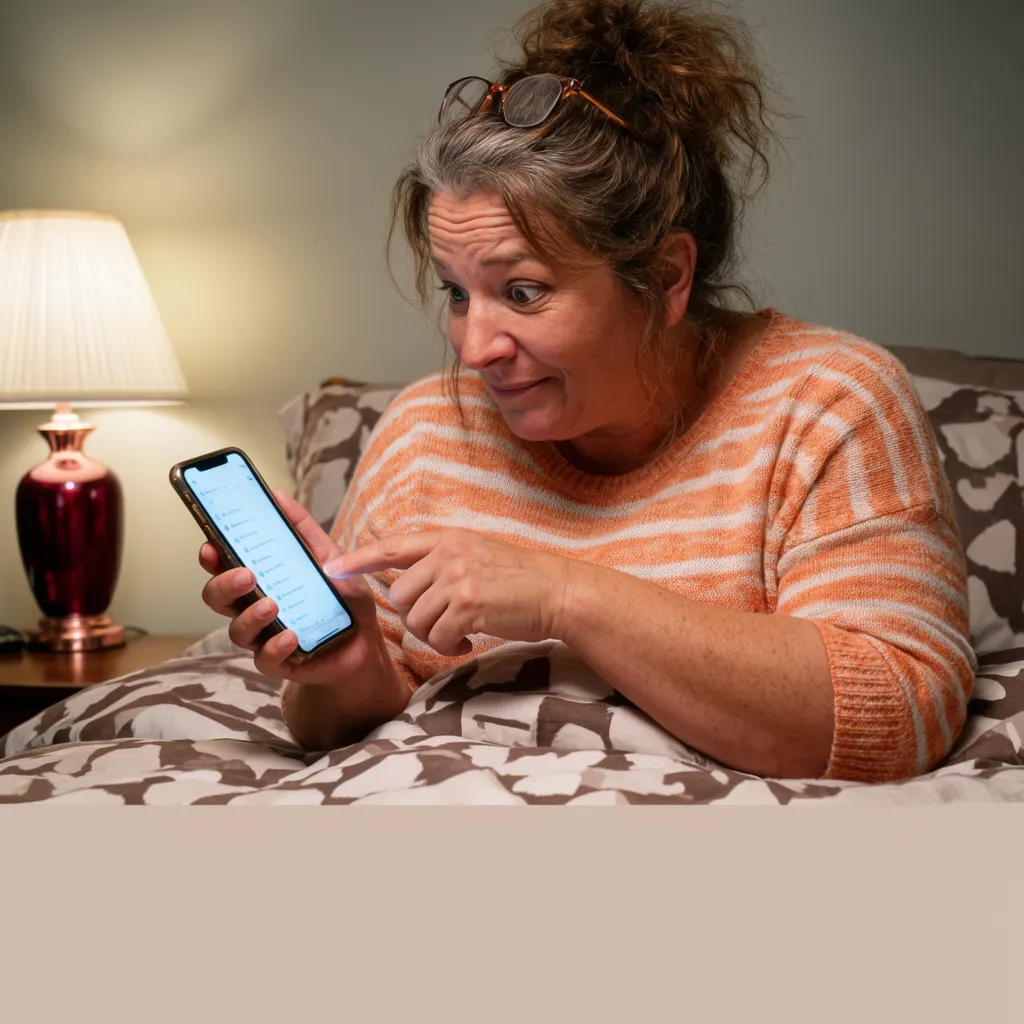
The group chat has a new kind of message, and you know it's different the second you read it.
Not the screenshot of a hot flash meme. Not the 'is this normal??' with eleven question marks. This one is quieter. Someone's period did something it has never done before - showed up after months of nothing, or flooded through in the middle of a meeting, or left a clot that made her actually look at it. And she typed the sentence every woman types before she googles at 1 a.m.: "It's probably just peri, right?"
Here's the thing about that sentence: sometimes it's exactly right. And sometimes it's the exact thing that almost cost a woman named Sarah Chapman her life.
The story the group chat needs to hear
Sarah Chapman's tiredness was blamed on age and menopause from 2011 - repeatedly, for years - before her uterine cancer was finally diagnosed. When Yahoo Life and MSN told her story in late August 2026, the clinical core hit different: abnormal bleeding is the symptom most often mistaken for hormonal change Press: Yahoo Life/MSN.
Read that sentence twice. It's not saying bleeding changes are always cancer. It's saying the 'everything is hormones now' explanation - the one we all use, the one that got us through the last four years of weird symptoms - has a specific blind spot. And the blind spot is bleeding.
She's not alone in the mechanism. The Wall Street Journal documented a woman whose persistent itch was waved off as perimenopause by multiple doctors. It was cancer Press: WSJ. Two women, two symptoms, one pattern: the peri label is so convenient that it can swallow a real signal.
That's why this article exists. Not to scare you. To draw the line so you never have to guess.
The line: peri is a wave, these are signals
Perimenopause genuinely makes periods irregular. Skipped months, closer-together months, lighter, heavier, unpredictable - that's the documented wave Established: Mayo Clinic. Irregular is normal. Here's the part that isn't:
Bleeding after months of nothing. Not a skipped month - months. The longer the gap, the more this needs a conversation, not a shrug.
Flooding. Needing to change a pad or tampon every 1-2 hours, or needing two products at once, or bleeding through to clothes and bedding. That's not 'heavy-ish.' That's the NHS threshold Established: NHS.
Large clots. Bigger than about 2.5cm - roughly the size of a grape or larger Established: NHS.
Periods lasting past 7 days. Consistently, not once in a blue moon Established: NHS.
Bleeding after sex. This one gets the 'see a GP' label regardless of age - it's investigated, not filed under hormones Established: NHS.
Any bleeding after a full year with no period. Postmenopausal bleeding of any kind is a 'call your GP' item, full stop Established: NHS.
And the cleanest rule underneath all of them: a change in character. Your body's pattern is yours. When a symptom breaks its own pattern - a new loudness, a new timing, a new occurrence - that's the signal. Peri is a wave. A red flag is a knock.
Why this is a workplace conversation too
Here's the part nobody puts on the checklist: bleeding changes are a work issue, and the silence around them is costing women real money and real cover stories.
The Menopause Hub's 2026 survey found a quarter of women have missed work due to menstrual symptoms - and over one in three don't disclose the real reason at all when there's no workplace policy to protect them Press: The Menopause Hub. So the woman flooding through at her desk doesn't say 'I need to see a gynecologist about a bleeding change.' She says 'migraine' and takes a half-day, and the appointment goes on the to-do list for next month, and next month, and next month.
The bleeding question isn't just medical literacy. It's the difference between a symptom you can name and a symptom you have to hide. You can't track what you can't say out loud. Name it - in the group chat, in your tracker, and eventually in the exam room.
The one-sentence script
You don't need to be the most assertive woman in the building. You need one turn:
"I've had a bleeding change - [after months of nothing / flooding / larger clots / after sex]. I know it can be peri. What would you want to rule out?"
That's the whole move. You're not arguing. You're not diagnosing. You're giving the doctor the specific change and asking for the second sentence - the plan.
If the answer is "it's probably hormones" with no plan and no follow-up, use the second sentence from our normal-but-treatable piece: "I hear that it's common - what are my treatment options?" And if you still get a full stop, that's a data point about the doctor, not about you. Take the log to someone who reads it.
The both/and
Let's be very clear, because the internet will try to make this either/or: perimenopause explains a huge share of midlife bleeding changes, and the specific changes above deserve a conversation no matter what. Both of those are true. That's not fear-mongering - it's the opposite. Fear is guessing alone at 1 a.m. Confidence is knowing exactly which changes are 'mention at your next visit' and which are 'call now.'
Irregular is the wave. Flooding, clots, bleeding after months of nothing, bleeding after sex - those are the knock. One sentence. That's how the Sarah Chapman story doesn't happen to you.
Screenshot this for the group chat - the woman who needs it most is the one who just typed 'it's probably just peri, right?'
This article is education, not a diagnosis. Bleeding changes deserve a clinician's evaluation - that conversation is exactly what the checklist is for.