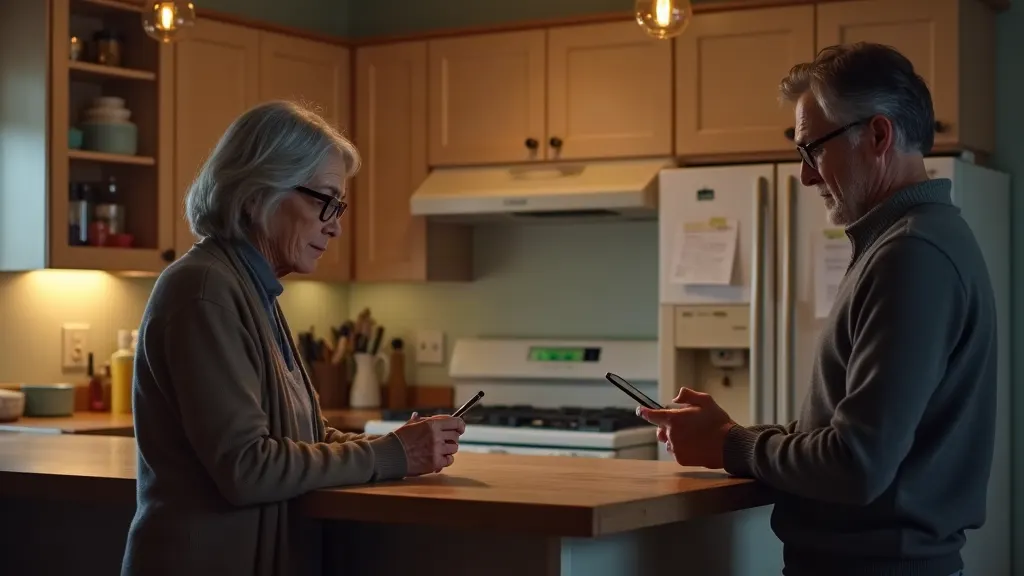
Here's the counterintuitive number that should stop you cold: the overall divorce rate in America is at a 50-year low, and gray divorce is still climbing. Divorce after 50 now accounts for more than a third of all divorces in the country, and the couples driving that number aren't the ones who fought for thirty years. They're the ones who stayed Established: The New York Times.
That's not a coincidence. That's the demographic you're in.
The empty-shell marriage
The New York Times' June 2026 reporting on the gray-divorce wave gives the pattern a name: the empty shell marriage Established: The New York Times. You know it before you know its name. The shared mortgage. The shared calendar. The kids' schedule that ran like clockwork for two decades and now runs itself. The grocery rotation. The in-laws. The annual tax appointment.
It works. That's the trap. Nothing is broken, and nothing is there.
The shell is a marriage that still does logistics but ran out of emotional content years ago. No crisis ended it because no crisis was required - it just eroded, the way a shoreline does, so slowly you can't remember when the tide went out. And perimenopause is the moment the shell becomes visible, because perimenopause is the moment your tolerance for a life that was never going to improve drops to zero.
No activating event. That's the point.
A family lawyer told Flow Space that roughly 70% of her clients are 50 or older, the majority are women initiating, and most gray divorces are not tied to an activating event - no affair, no explosion, no single thing you can point to Established: Flow Space.
Read that again, because it's the most important sentence in the whole gray-divorce wave: most gray divorces aren't tied to an activating event.
That matters more than any statistic, because it changes the story women tell themselves. When there's no triggering event, there's no villain and no moment of truth - which means there's also no clean grief. You can't mourn a betrayal that never happened. You can only sit with the slow realization that the marriage became a project you manage, not a life you live.
And here's what the lawyer's numbers add up to: women are the ones initiating the majority of late-life divorces, and they're doing it in the same window - 50 to 60 - that perimenopause and menopause occupy. The 2026 data wave keeps landing on the same observation: women initiate as identity needs shift after midlife Established: Flow Space.
The hormones don't cause the divorce. They cause the clarity. And clarity, it turns out, is the thing that ends empty-shell marriages.
The three-way question
When you start having the 2 AM conversations with yourself, run the three-way question. Not two ways. Three. Because the two-way version is a trap: is it peri or is it the marriage? forces a false choice when the real answer is usually all three at once.
One: Is it peri? Does the aversion track your cycle? Does it lift for parts of the month? Is it part of a broader pattern - irritability, brain fog, sleep disruption, a shorter fuse with everyone, not just him? Mood that tracks your cycle - worse in the late-luteal window, lifting in the follicular week - is a signature worth noticing; if the marriage feels unbearable only in that window, that's a pattern to name, not a verdict.
Two: Is it the marriage? Would you feel this way on your best hormone day? Picture yourself at your most even-keeled, most rested, most resourced self. Is the emptiness still there? Because if it is, that's not the hormones lying to you. That's the shell, finally visible.
Three: Is it 20 years of backlog? This is the one women skip, and it's the one that hurts most. A ledger of small deferred grievances - the thing you stopped saying in year five, the pattern you stopped naming in year ten, the ways you stopped asking because asking cost more than it returned. Perimenopause doesn't create the ledger. It gives you the energy to audit it.
Most women who do the three-way question honestly find all three answers are yes. That's not a mess. That's a diagnosis.
The one-cycle rule
Here's the guardrail, because the clarity is real but the timing is treacherous: don't make a major life decision at cycle bottom. Your sleep is compromised, your patience is short, and you are not a reliable witness to your own conclusions in that window. Track it for two full cycles before you trust the verdict.
And while you track, ask the third question on paper, not just in your head. The backlog loves the dark. It doesn't survive being written down.
The gray-divorce boom is a perimenopause story because the shell was always there - and the hormonal years are when the last healthy decades become visible as a finite resource. The women ending these marriages aren't giving up. They're finally auditing the ledger, at the one moment in their lives when they can afford to see it.
That's not a crisis. That's a countdown ending.
If you're sorting through whether it's peri, the marriage, or the backlog, the sibling pieces help: is it peri or is it the marriage for the hormonal-aversion checklist, and the sleep divorce for the question of whether separate beds are a symptom or a strategy. If you're having thoughts of harming yourself, that's urgent - help is available tonight, and a clinician or crisis line is the right call, not next week.