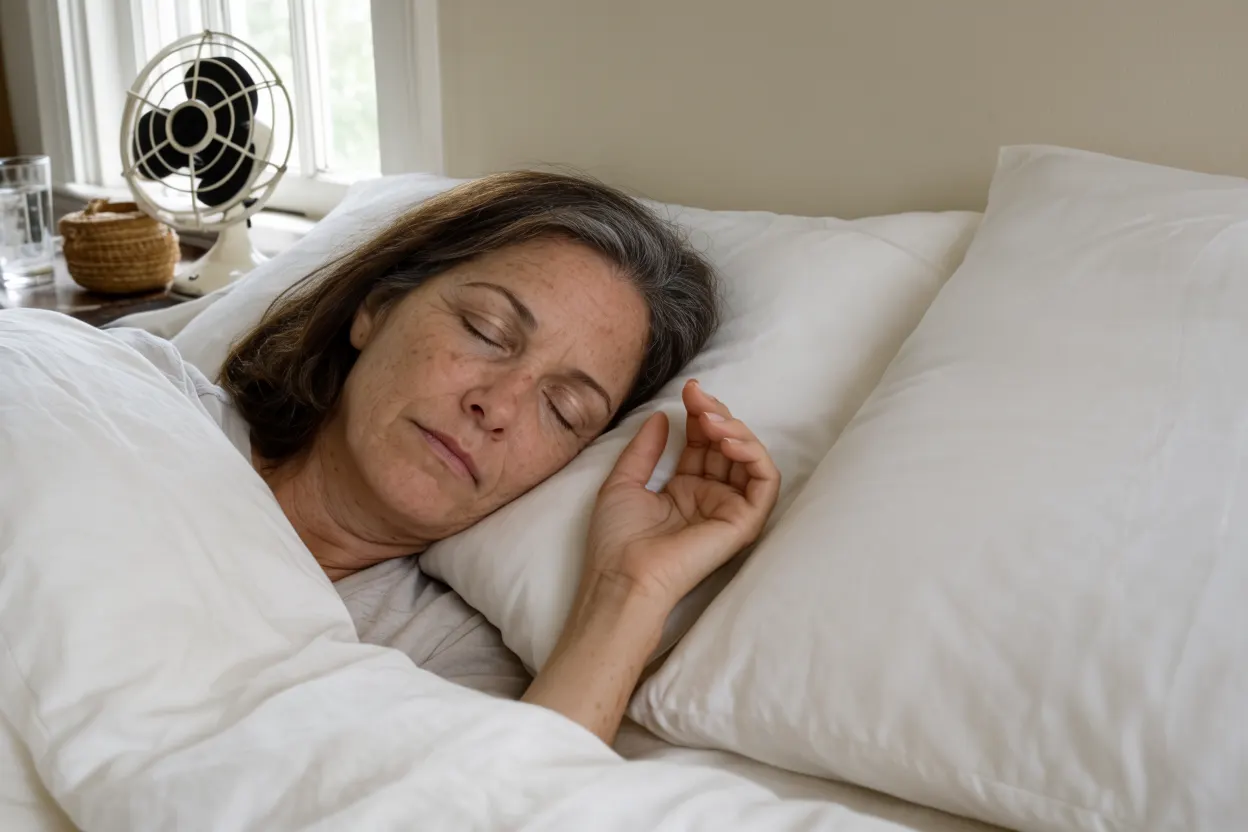
The first time someone suggests sleeping in separate beds, it lands like a small divorce. You picture your grandparents' twin beds, the sitcom joke, the end-of-marriage imagery. Then the 3 a.m. hot flash hits, you're lying there soaking wet next to a peacefully sleeping man in a fleece, and suddenly the twin beds look less like a failure and more like a floor plan.
Here's the number that should retire the guilt: 31% of U.S. adults have slept in a different bed or space to get a better night's rest, and adults aged 35 to 44, prime perimenopause years, are the most likely of any age group, at 39% Established: AASM. One in three. That's not a fringe lifestyle. That's a third of the population quietly choosing a second pillow over a second argument.
The sleep divorce is not a failure of your marriage. It is a failure of the bed, and the bed was never the marriage.
The guilt question, answered
The question under all the sleep-divorce content is the one nobody says out loud: if we sleep apart, does that mean we're done?
No. And the professional sleep-medicine community is explicit about it. In its survey coverage, the American Academy of Sleep Medicine frames sleep divorce as "mutual respect regarding the sanctity of the sleep space", more to do with sleep health than with a troubled relationship Established: AASM. The AASM is not a marriage counseling practice. It's the sleep doctors. When the sleep doctors tell you separate beds are a sign of mutual respect, you can stop treating the guest room like a breakup.
Here's the distinction that matters:
- Sleeping apart because you both need to rest = a fix. This is the sleep-hygiene version of the thermostat war, you're not fighting over the temperature, you're removing the temperature from the negotiation entirely.
- Sleeping apart because you can't bear to be near each other = a different conversation. That's not a sleep problem; that's a relationship problem wearing sleep's pajamas.
The test is simple: do you still want to be in the same life? Then the bed is negotiable.
Why perimenopause makes you the sleep-divorce candidate
Let's be honest about what's happening at 3 a.m. The classic perimenopause night looks like: hot flash at 2:40, soaked sheets at 3:10, fully awake at 3:30 with your brain deciding to revisit every conversation from 2007. Meanwhile your partner is under a duvet in a sweatshirt, emitting the soft breathing of someone whose internal thermostat still functions.
None of this is a character flaw in either of you. Your body's temperature regulation is genuinely different right now, and the night sweats article covers what's happening and when it's worth a clinical conversation. The 3 a.m. wake-up is so universal it has its own starter pack.
When one person is a space heater and the other is a furnace of calm, sharing a bed means at least one of you sleeps badly every night. Sleep is not a luxury item, consistent, quality sleep is one of the core healthy-sleep habits federal guidance recommends, full stop Established: NHLBI. And a marriage running on two exhausted people is a worse marriage than a marriage running on two well-rested people in separate rooms.
The fix version: how couples actually do this well
The sleep divorce has a right way and a wrong way. The couples who make it work describe something closer to a sleep arrangement than a separation:
- Same marriage, separate climate. The goal isn't distance; it's sleep. You still have dinner together, the plans, the partnership, you just stop negotiating blankets at 3 a.m. The cooling sheets guide covers the sheets that actually breathe, and the mattress cooling guide has the topper-and-pad options when your side of the bed runs its own climate.
- The 3 a.m. toolkit travels with you. Eye mask, white noise, blackout curtains, the 3 a.m. fix kit is designed for exactly this: sleep disruption that needs an environment upgrade, not a marriage intervention.
- Check in during the day. Couples who sleep apart usually report they talk more during the day, because they're no longer exhausted and resentful at each other across a pillow line. The bed was where the marriage stored its grievances. Removing the bed from the equation doesn't remove the marriage.
- Keep the rituals. Coffee in bed is a ritual. The 10 p.m. chat is a ritual. Separate sleep doesn't mean separate lives, it means the rituals move to the couch, the kitchen, the porch, where nobody is sweating.
And the honest truth: for a lot of couples, it's temporary. The perimenopause years are exactly that, years, not forever. The sleep arrangement can be as seasonal as the wine tax: a chapter, not an identity.
The version that deserves a doctor's visit
There's one version of the sleep divorce that isn't a fix, and it's the one where snoring is the reason you left.
If your partner's (or your own) loud snoring, gasping, or choking during sleep is what drove you out of the bedroom, that's not a bedding problem; that's a screening question. The AASM is blunt: snoring that's disrupting sleep "could be a sign of something more serious, like obstructive sleep apnea," and excessive snoring deserves a conversation with a healthcare professional Established: AASM. Sleep apnea is common, often undiagnosed, and untreated it can cause serious problems beyond a bad night Established: NHLBI. Our sleep apnea explainer has the full when-to-push-for-a-sleep-study guidance, because perimenopause insomnia and sleep apnea are easy to confuse.
Similarly, if the sleep divorce is happening because you're avoiding each other, the distance feels like relief you're ashamed of, not sleep you're choosing, that's a conversation for the marriage, not the mattress aisle. The thermostat war piece and the is-it-peri-or-the-marriage checklist cover how to tell the difference between a hormonal season and something that needs real attention.
The bottom line
The sleep divorce is one of the most common, most normal, most unspoken arrangements of the perimenopause years, so common that nearly a third of the country is quietly doing it, and so normal that the sleep doctors describe it as mutual respect Established: AASM.
It's not a failure. It's a fix. The marriage is the daytime project; the bed is where sleep happens. When your body is running the perimenopause climate, the kindest thing you can do for your marriage is stop making it share the bed with a space heater.
Send the sleep divorce explainer to the friend who needs permission to take the guest room, and keep the daytime rituals. The bed was never the whole story.