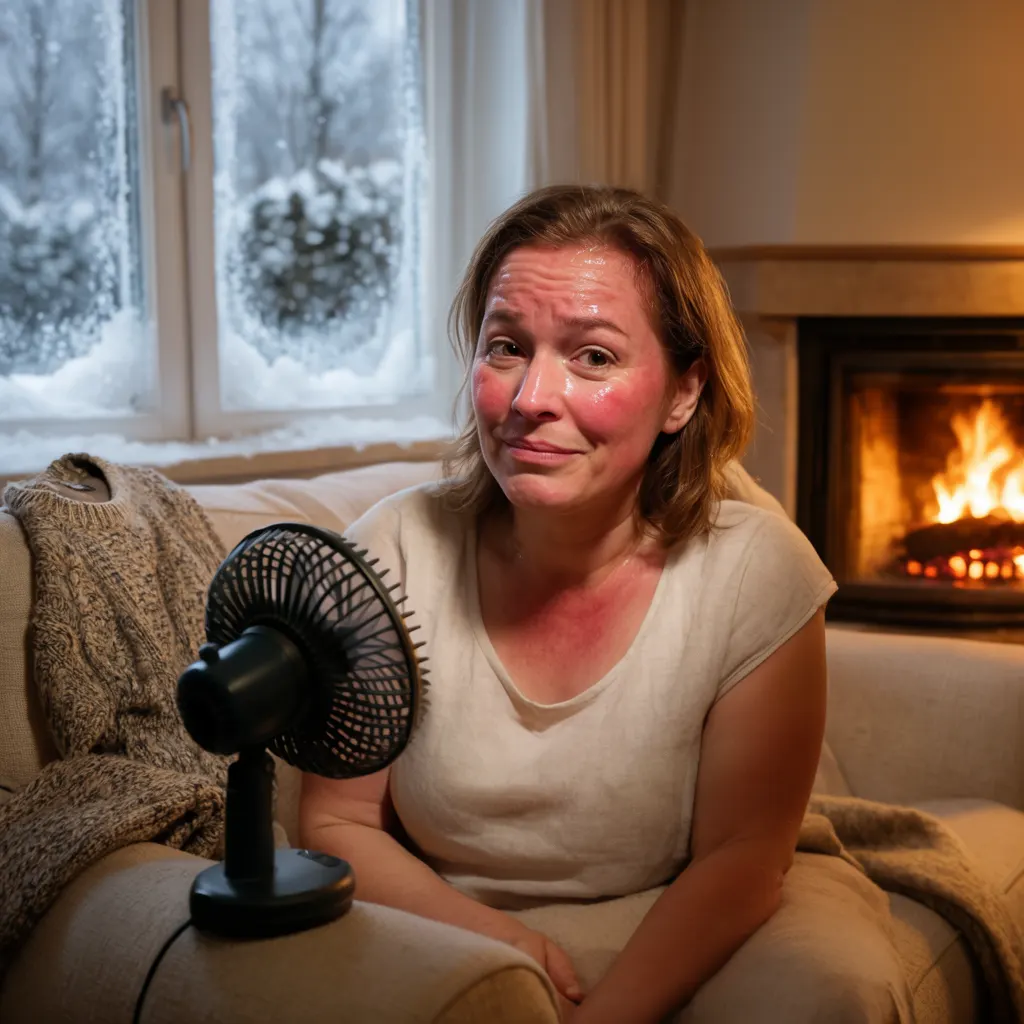
The group chat message arrives every winter, reliably, like clockwork: "It's January and I'm sitting here in a tank top with the window open and my husband is in a hoodie asking if I'm sick."
The replies come fast: "Me too. Since 2020." "I have to wash my sweaters for the season but I never wear them." "Someone turned up my thermostat and I didn't ask for it."
Nobody in that thread is having a hot flash. Hot flashes come and go, a wave, a flush, a minute or two, done. What these women describe is different: a baseline. A permanent state of running hot that never leaves. It is perimenopause, it is real, and it is almost invisible to the medical system that is supposed to catch it.
Here's the part nobody says out loud: the whole intake system is built around the flash. And when the system only recognizes the flash, women learn, fast, that the flash is the only symptom that counts.
The 24/7 heat profile: not a flash, a setting
A hot flash is a sudden wave of heat, usually face, neck, chest, often with flushing and sweating, sometimes with a racing heart Established: Mayo Clinic. It's the most common menopause symptom: as many as three out of four women get them Established: OWH.
Constant heat intolerance is the other shape:
- Episodic vs continuous. A flash peaks and fades in minutes. Constant heat is present when you wake up, present at noon, present at 2 a.m., present in January. Nothing triggered it. Nothing stops it.
- The 2020 pattern. Women in the threads date their onset with eerie precision: "I've been hot since 2020." The pandemic-year clustering is so consistent it's become shorthand: the year the world went inside, the heating bills went up, and an entire cohort of women started running hot Community: r/Perimenopause.
- Fabric intolerance. The symptom that sounds least medical and is most diagnostic: you can't stand warm textures against your skin anymore. Wool that used to be cozy now feels like a punishment. You've washed your sweaters for the season and accepted you won't wear them. Bamboo, cotton, linen, nothing synthetic, nothing insulating, nothing that traps heat.
- The thermostat language. Women describe the experience in terms of the room, not the body: "someone turned up my thermostat and I didn't ask for it," "my perfect temperature is 70.2845727 degrees, no more, no less" Community: r/Perimenopause. It's a language of lost control over the environment, because that's what it feels like. Your internal thermostat has been re-set without your consent, and everyone around you is dressed for a different climate.
If that's you, if you're not flashing, you're just hot: you're not broken and you're not imagining it. You're the other half of the vasomotor story, the one that didn't make it onto the intake form.
Why you might have to fake the flash to get care
Here's the uncomfortable part, and we're going to be honest about it: in the menopause threads, women openly describe exaggerating "declared" hot flashes to qualify for HRT, because constant heat isn't a recognized, billable symptom Community: r/Perimenopause.
Read that again. Women report having to fake the famous symptom to access care for the real one they actually have.
This is not a medical claim. It's a report of what patients say they experience, and the pattern is consistent enough that it's worth naming. When the questionnaire asks "do you have hot flashes?" and your honest answer is "no, I'm just hot all the time," the conversation can stall right there. The form has no checkbox for what you're describing. And when the form has no checkbox, the clinician has no hook.
So women learn the workaround. They learn that "hot flashes" is the password that opens the door, and they use it, even when it's not what they have. That's not patients gaming the system. That's patients translating their real symptom into the only vocabulary the system accepts.
The honest intake-form script (no faking required)
You don't need to lie. You need better language, accurate, specific, clinical-sounding without being false. Bring this to your appointment:
"I don't get hot flashes. I have continuous heat intolerance: I feel hot all day and night, every day, not in waves. It started around [2020]. It's worse with layers, warm rooms, and exercise. I can't tolerate warm fabrics anymore: wool and synthetics feel unbearable against my skin. My temperature comfort window is very narrow, and nothing except cold helps. It's affecting my sleep and my daily comfort, and I'd like to understand what's driving it and what my options are."
Notice what this does: it names the symptom (continuous heat intolerance), gives a timeline, gives aggravating factors, names the fabric intolerance, and states the impact. A clinician can work with that. It's honest, it doesn't claim flashes you don't have.
And if the first clinician still won't engage? That's information. The NHS is explicit that if you think you're experiencing perimenopause or menopause symptoms, you can contact a GP to talk through your options Established: NHS, that's a deliberately low bar, and constant heat counts as a symptom worth discussing. You're allowed to ask for a second conversation. You're allowed to ask specifically: "Is constant heat intolerance a recognized presentation, and how should we evaluate it?"
The red-flag check (do this once, then get back to living)
Constant heat from hormones is one thing. Heat that's actually your body failing to cool is another, and the NHS separates them clearly. Heat exhaustion, the body's cooling system struggling, looks like: tiredness, dizziness, headache, nausea, heavy sweating with pale clammy skin, cramps, a high temperature, very thirsty Established: NHS. It's driven by environment overwhelming your system, not by estrogen.
The never-ignore list: a fever with your heat, unexplained weight loss, night sweats with fever, abrupt onset of heat intolerance alongside other new symptoms, or a racing heart that doesn't settle. Those deserve a prompt clinician conversation, not a shrug Established: NHS. And if you have a heart condition, circulation issues, or take medication that affects how you handle heat, the heat conversation is worth having explicitly.
Once the red flags are clear, the constant heat is a management problem, not a mystery: same cooling toolkit as hot flashes, deployed permanently instead of episodically Established: OWH. Layers you can shed. Natural fibers against your skin. A fan that lives on your desk, not in a drawer. Cold packs for pulse points on the bad days. None of it cures anything, that's not the claim. It buys you a tolerable Tuesday while you get the care conversation to happen.
The bottom line
A hot flash comes and goes. This heat never left. They are both perimenopause, and the one that never leaves deserves the same credibility as the one that does.
If you've been "just warm" since 2020, if you've washed your sweaters and accepted defeat, if you've watched your husband in a hoodie and questioned your sanity, you're not broken. You're describing a real symptom in a system that only has a checkbox for the famous one. Use the script above. Ask the question out loud. And if you have to translate your symptom into their vocabulary to be heard, know this: that's a failure of the form, not a failure of you.