The text arrives at 2:47 PM on the third day of the heat wave: "Why am I SO much worse this month?? I'm having like 10 a day. Is this just me getting older or what."
It is not you. It is August.
Here's the whole explanation, in one image: your body is a thermostat that's already broken, and August is the house catching fire. The thermostat was never going to win that one.
The margin, explained
A hot flash is a sudden wave of heat – usually face, neck, chest – often with flushing and sweating, sometimes with a racing heart Established: Mayo Clinic. It's the most common menopause symptom: as many as three out of four women get them Established: OWH.
Here's the part nobody says out loud: your body handles a hot flash by dumping the heat. The flush spreads across your skin, the sweat evaporates, and the excess heat leaves your body. That's the recovery. That's the whole system.
The system needs one thing: air that's cooler than you are. In August, the air is not cooler than you are. The air is 103 degrees and has opinions.
So the same flash that would have peaked and faded in five minutes at a normal room temperature now has nowhere to go. The heat arrives, the flush spreads, the sweat evaporates into air that's already saturated with heat – and you just sit there, marinating in your own thermostat failure, for longer, feeling hotter, looking more flushed, wondering what's wrong with you.
What's wrong with you is the weather. The flashes were always going to happen. The weather just took away your margin to recover from them.
Same flashes. Less room.
The doctors' offices call hot flashes and night sweats "vasomotor symptoms" – symptoms of the blood vessels doing their own thing Established: OWH. And vasomotor symptoms are the same in August as they are in November. Your hormone levels didn't read the forecast.
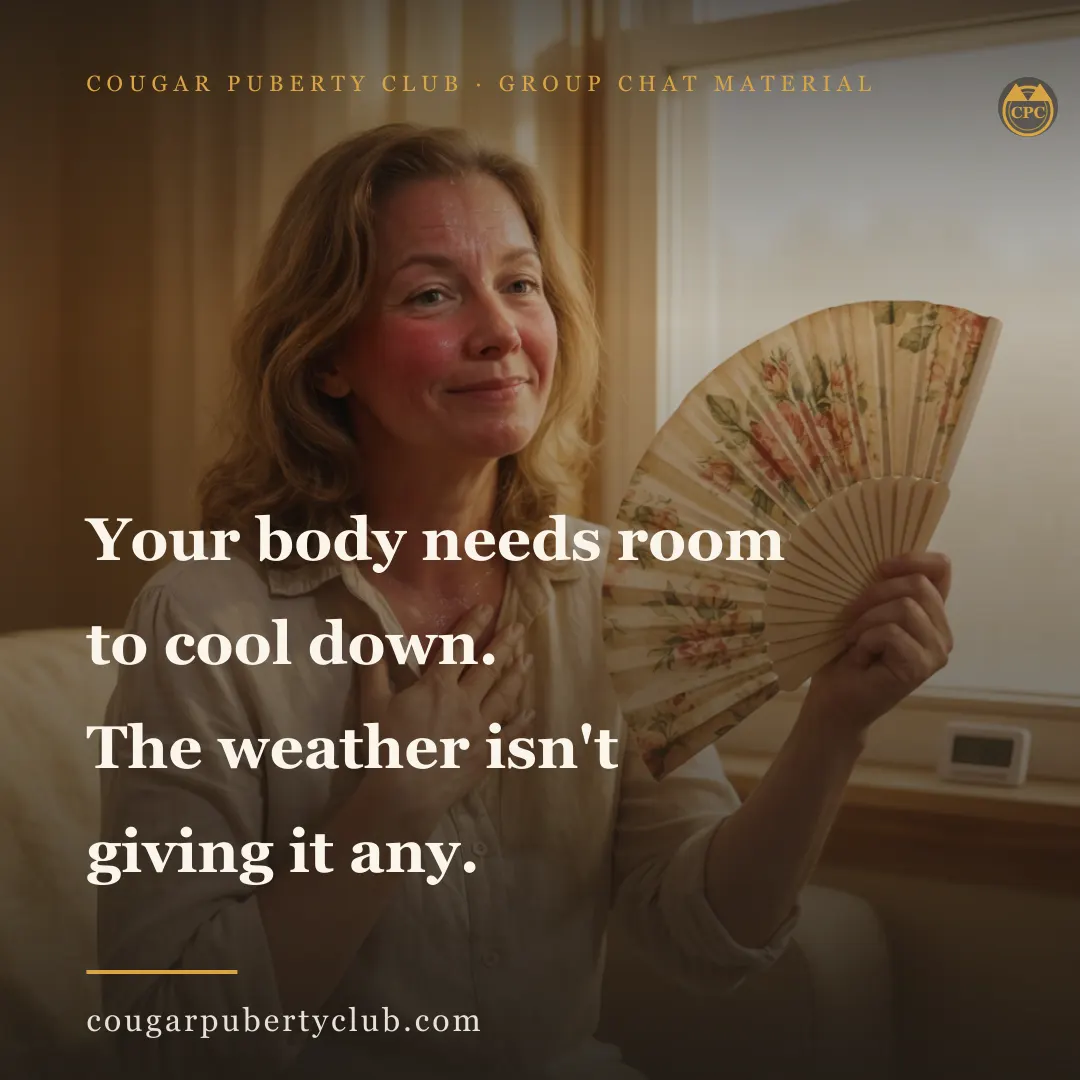
What changed is your environment. And this is the reframe that matters, so we're going to write it in a way you can screenshot:
Your body needs room to cool down. The weather isn't giving it any.
That's it. That's the whole August story. Not a regression. Not a new, worse phase. Not your body betraying you harder. Just: the same internal storm, with the escape hatch blocked by a high-pressure system.
You are not more menopausal this month. You are less coolable.
Hot flash or heat exhaustion?
One thing is worth knowing during a heat wave, because the two feel similar and the responses are different.
A hot flash is the wave: sudden heat, flushing, sweating, sometimes a racing heart – over in minutes, then it passes Established: OWH. Annoying, memorable, temporary.
Heat exhaustion is the cooling system failing: tiredness, dizziness, headache, nausea, heavy sweating with pale, clammy skin, cramps, a high temperature, being very thirsty Established: NHS. The giveaway is that it doesn't pass – it's the persistent version, and it needs real intervention: get cool, get fluids, get help if it doesn't improve.
The red flags that take it from "handle at home" to "medical emergency": a very high temperature, hot skin that is not sweating, fast breathing or a fast heartbeat, confusion, a seizure, or losing consciousness. That's call-999 territory, not wait-it-out territory Established: NHS.
The one-line version: if it comes in waves and passes, it's your thermostat. If it builds and stays, it's the heat – cool down, drink up, and if it's not better in 30 minutes of doing that, get help Established: NHS.
What actually helps when it's 103
The cooling playbook, in order of what you can do right now:
- Put cold on your pulse points. The NHS heat-illness guidance says it plainly: cold packs, wrapped in a cloth, under the armpits or on the neck Established: NHS. Those are the spots where your blood runs close to the surface – you're cooling the blood that's about to go back inside. A cold water bottle against the back of your neck counts. This is the single most effective five-second fix.
- Fan the air. A fan, even a cheap one, gives your sweat somewhere to go. OWH lists using a fan as a first-line hot-flash strategy Established: OWH, and if you're going to own one, the portable fan guide covers bedside, purse, and desk options.
- Layers you can shed, not a single thing to suffer in. "Dress in removable layers" is literally on the federal list Established: OWH. In August it feels stupid to layer – but one light cotton shirt you can peel to a tank top is exactly the point.
- Water, and if you've been sweating a lot, something with salt. Heat exhaustion guidance: drink plenty of water; an isotonic sports drink or oral rehydration salts replaces what you lost Established: NHS. This is the August upgrade to your usual hydration habit.
- Move your whole self to a cooler place. Even one room – the one with the fan, the one that's been dark all day – is a place with margin. The NHS step one for anyone overheating: move to a cool place Established: NHS.
And for the broader "why is the heat kicking my ass" question – the fatigue files cover the summer-exhaustion misread (blaming the heat when it's the hormones, and the reverse), and if you're traveling through this heat, the travel survival guide has the hotel-thermostat and carry-on-fan logistics.
The part where you stop blaming yourself
The reason this framing matters – the reason the group chat needed it – is that August is when women start asking what they did wrong. Why am I worse this month? Did I mess something up? Is this just what 47 is?
None of it. Your menopause did not get worse in August. The weather stopped giving your body any margin to work with Observed: Kartar Health. Same flashes. Less room.
So the next time you're standing in front of the open freezer, or holding a cold bottle to the back of your neck at your desk, or peeling off a third layer in a parking lot – say it out loud, because it's true:
It's not you. It's August.
Send the card to the friend who asked. Then send her this page, so she has the red flags and the playbook, not just the solidarity.