The dentist said the word first.
Not your GP. Not your gynecologist. The dentist, mid-cleaning, looking at your gums the way someone looks at a check-engine light: "Have you noticed any changes since perimenopause started?"
You nearly cried into the spit sink. Because nobody - not one doctor, not one article, not one friend - had ever connected your mouth to your hormones. And yet here was a professional who saw it in your gums the way other people see it in your hot flashes.
This is the chapter they didn't warn you about. It's also one of the most documented oral-health stories in the menopause conversation right now - about 13 million women in the UK alone are living through the transition, and around half of postmenopausal women experience dry mouth Established: Nature (BDJ Team). Here's the honest version of what's happening in there, and what actually helps.
Why your mouth changes at all
The short version: estrogen runs your mouth's maintenance crew.
Saliva is not just spit. It's the mouth's neutralizer and defense system - it washes away food, neutralizes acids, and keeps bacteria from setting up shop. Estrogen supports saliva production, and as estrogen falls in the transition, saliva production drops with it. Less saliva means more acid, more bacteria, and more decay Established: Harvard Health.
That one mechanism explains most of the mouth's menopause plot: dry mouth, more cavities, gum inflammation, and - because estrogen also supports gum tissue and jawbone density - recession and teeth that feel less anchored Established: Nature (BDJ Team) Established: Harvard Health.
The BDJ Team's five changes women should not ignore, straight from the Nature piece:
- Dry mouth that doesn't go away - reduced saliva leaves teeth vulnerable to acid, bacteria, and decay.
- Bleeding gums during brushing - gum sensitivity and inflammation commonly increase during the transition; new or worsening bleeding is a clinical signal, not a brushing failure.
- A burning or metallic sensation - burning mouth syndrome affects 18-33% of postmenopausal women and is frequently misdiagnosed or dismissed.
- Teeth that feel more sensitive - as gums recede, root surfaces become exposed.
- A sense that teeth feel less stable - estrogen deficiency reduces the density of the bone supporting the teeth; any mobility or shifting warrants prompt assessment.
Established: Nature (BDJ Team)
The 3 a.m. cotton mouth
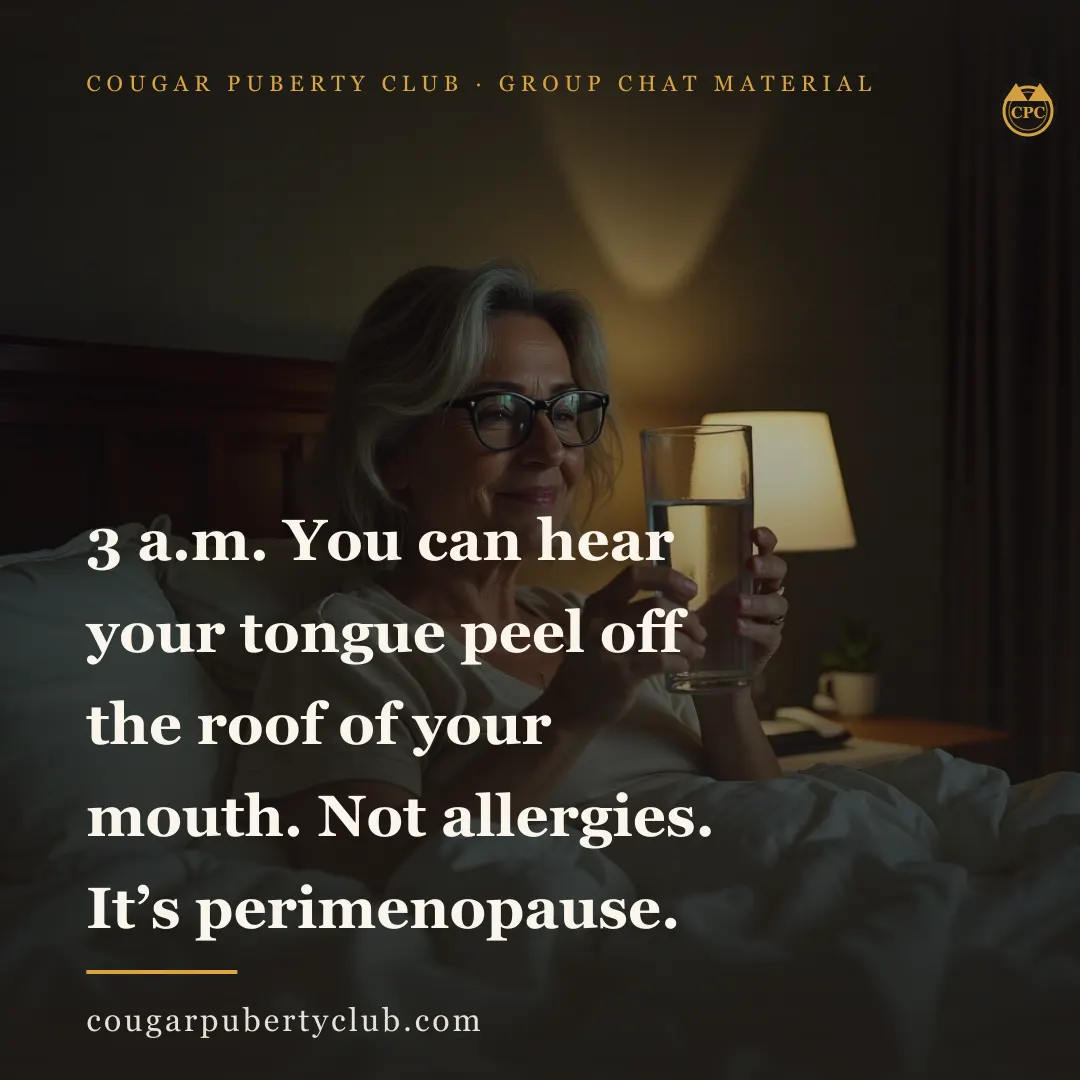
There is a specific perimenopause experience that deserves its own entry: waking at 3 a.m. with a mouth so dry you can hear your tongue peel off the roof of your mouth, hand already reaching for the water glass that lives permanently on the nightstand now.
It's partly the hormone shift and partly the night itself. You're not drinking or swallowing, so saliva pools less; if you mouth-breathe at night - blocked nose, congestion, or just how you sleep - that dries things out further Established: NHS. The NHS's own guidance for exactly this moment: keep water by the bed and take regular sips Established: NHS.
And if you've been quietly blaming your allergy meds? Check the leaflet - dry mouth is a common medicine side effect, so it might genuinely be both Established: NHS. Peri and the meds can stack. That's not a contradiction; it's a pile-up.
The dental bill nobody warned you about
Here's the part that actually hurts, and not just your gums.
The Renewed Women's Health Strategy - the UK government's landmark menopause policy document - makes no specific mention of oral health at all, even though the transition affects the mouths of roughly 13 million women Established: Nature (BDJ Team). A 2025 scoping review confirmed what every woman in the comment threads already knows: clear clinical guidelines for menopause-related oral health remain absent, and healthcare providers frequently don't advise women on the oral changes they may experience Established: Nature (BDJ Team).
So the system missed it, the providers didn't mention it, and the bill showed up anyway: a cavity here, a crown there, the periodontal deep-cleaning that wasn't in the budget. The women's health industry is only now catching up - Delta Dental partnered with Midi Health in June 2026 specifically because menopause oral care became a recognized lane Context: Delta Dental × Midi Health partnership, 2026-06-02.
That's why the dentist saying the word out loud matters so much. It's often the first professional conversation where the mouth gets connected to the hormones. The fix isn't exotic - it's just nobody told you to do it.
What actually helps (the honest relief list)
This is the part where we buy things, so let's be precise about what earns its shelf space and what doesn't. These are the NHS-endorsed basics plus the genuinely useful additions - relief, not cure. Nothing here replaces the dentist, and we're not going to pretend a rinse is a treatment.
The free stuff first (do these before you spend anything):
- Water by the bed, regular sips. NHS's number one. Boring, free, correct Established: NHS.
- Sugar-free gum or sugar-free sweets. They stimulate saliva flow, which is the actual fix mechanism - more saliva, more neutralization Established: NHS.
- Lip balm for the cracked corners Established: NHS.
The worth-buying category:
- Alcohol-free moisturizing mouthwash. This is the one product upgrade with a direct NHS endorsement: brush twice a day and use an alcohol-free mouthwash, because dry mouth raises your decay risk and alcohol-based rinses dry you out further Established: NHS. Swap your current rinse, don't add a second one. Dry mouth relief on Amazon
- Saliva substitute sprays, gels, or lozenges. A pharmacist can advise on the ones that keep the mouth moist; not all products suit everyone, and the NHS specifically warns against acidic artificial saliva products if you have your own teeth Established: NHS. Ask, don't guess. Dry mouth relief on Amazon
- A quiet bedroom humidifier. Not an NHS-cited fix - this is the "adds ambient moisture, can't hurt, cheap to try" category for the 3 a.m. cotton mouth, especially if you mouth-breathe at night. Set expectations accordingly: it's comfort, not a cure. Bedroom humidifiers on Amazon
What we're not linking: dental visits, fluoride treatments, prescription saliva stimulants. Those are medical care, not products - and per our standing honesty rule, we don't take a cut off your dental bill. The most valuable purchase on this page is the appointment where you ask your dentist about menopause. We'll never get a commission on that, and that's exactly why we'll keep recommending it.
When it's not peri (the red flags)
Dry mouth is common, but it's not always hormones. See a GP when:
- It makes talking or eating difficult
- It's still dry after a few weeks of home and pharmacy treatment
- Taste problems aren't going away
- Your mouth is painful, red, swollen, or bleeding
- You have sore white patches
- It comes with other symptoms - needing to pee a lot, or dry eyes (the diabetes / Sjögren's check)
And on the dental side: new or worsening bleeding gums, teeth that feel like they've moved, or any sense of instability are all reasons to book a dentist, not to wait Established: Nature (BDJ Team). Catching recession and mobility early is the difference between a conversation and a procedure.
The bottom line
Your mouth is not off the menopause list. It was never off the list - it's just the part nobody sent you the memo about. The good news is that the fixes are mostly simple, mostly cheap, and mostly about adding back what estrogen used to do for free: water, saliva stimulation, alcohol-free rinsing, and a dentist who knows the word.
And the next time you're at the 3 a.m. water glass, holding it up like a toast to absolutely nobody: that's not allergies, and it's not the desert. It's the sequel nobody warned you about. Now you know.
The shortlist: dry mouth relief on Amazon · bedroom humidifiers on Amazon · why you wake up soaked at 3 a.m. · the mouth weirdness files (metallic taste, burning mouth)