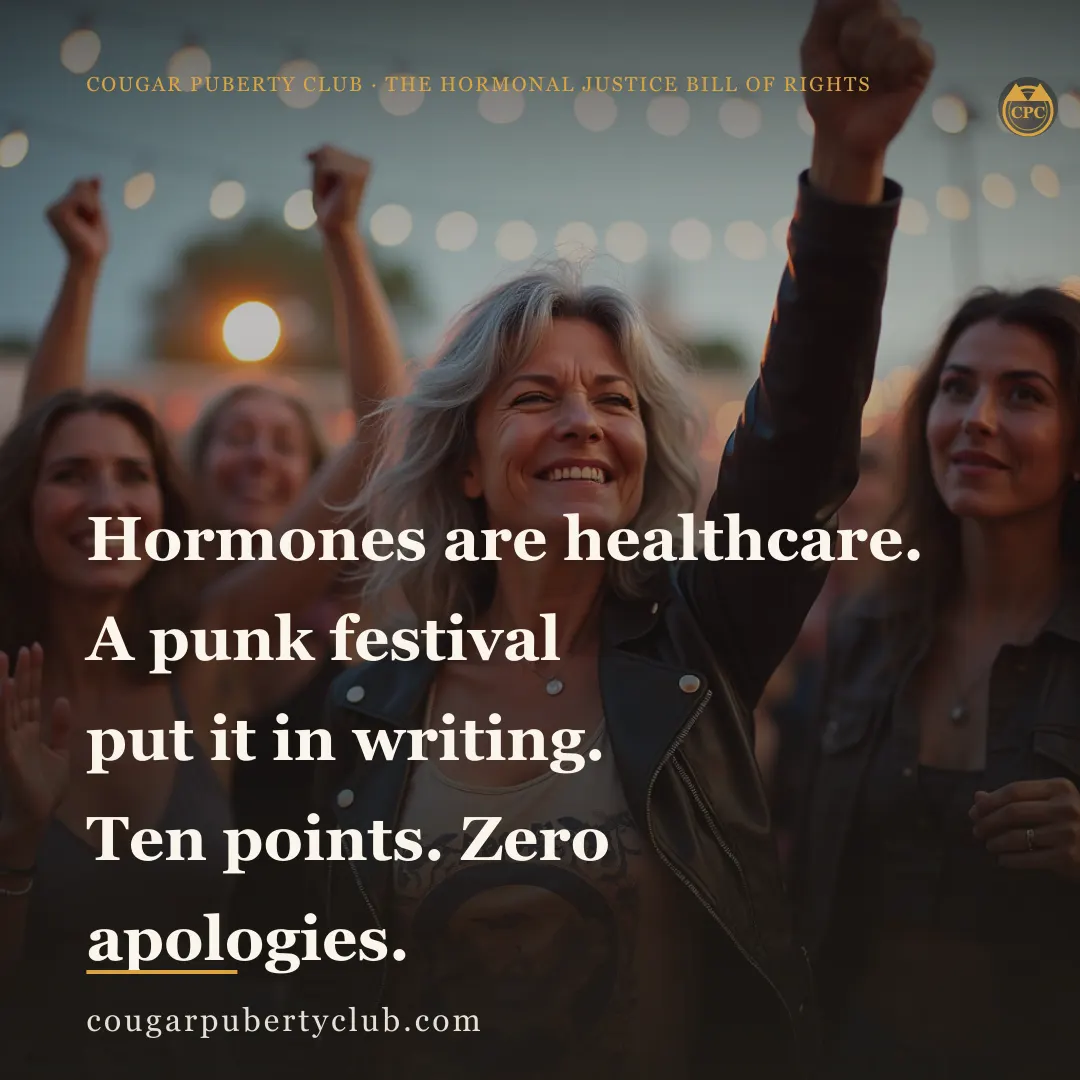
The last weekend of June 2026, in Portland's Crystal Ballroom, a drummer got her estrogen patch applied on stage like a championship belt, a band rewrote Lorde's "Royals" into a hot-flash anthem, and about 750 people chanted the loudest menopause slogan of the year: "Hormones are healthcare!"
That's Menopunkapalooza - riot grrrl-era Gen X punk musicians, the women who were primed for this by the 1990s, turning perimenopause into protest culture. The Guardian's feature on it ran July 7, and it's the clearest signal yet that the peri conversation has left the doctor's office, skipped the group chat, and found the mosh pit.
Here's what the festival actually taught us - about HRT, about being dismissed, and about the difference between a slogan and a treatment plan.
The scene: ceremony, parody, and a Bill of Rights
The festival opened with a ceremonial estrogen-patch application on drummer Teresa Esguerra - the patch as ritual object, applied with the gravity it deserves but rarely gets. Then came Ménage àh Twats parodying Lorde with a lyric that should be on a tote bag: night sweats, hot flash, never getting good sleep - dry puss, moustache, feeling like a crazy.
A 10-point Hormonal Justice Bill of Rights was read aloud to the room. Riot grrrl pioneers reunited after 35 years to close the festival, which is the kind of sentence that makes you want to cry into your kombucha. Founder Alicia J Rose, 56, summed up the movement's origin story in four words about her fatigue and hot flashes: "I can't live like this."
Peaches, who appears in the upcoming Menopunks documentary (2027), put the loss more bluntly: menopause "affected my confidence in my pussy." Which is a sentence the medical literature has never once managed to write, and it's why the punk version of this conversation is winning.
The emotional core: best shape of my life → cascade
The moment that should be framed and hung in every menopause clinic: Calamity Jane's Gilly Ann Hanner, 59, describing herself before it all went sideways:
"I was doing kung fu. I was jogging. I was just in the best shape of my life. I was in two bands. I was working and just killing it."
Then, after a bout of Covid in 2021: a cascade - joints that hurt, food she couldn't digest, weakness that made her feel, at 53 and 54, old and feeble. Doctors couldn't connect the dots. A nurse practitioner finally did: perimenopause. She recommended HRT. Hanner's response was the same one half our readers will recognize:
"Isn't that bad for you?"
And the nurse practitioner's answer is the whole article in seven words: "That was the story, but new evidence has come to light."
That exchange is the festival in miniature. The fear is a thirty-year-old headline. The relief is a professional who read the update.
What the festival got medically right
Strip away the stagecraft and the movement's claims line up with current guidance:
- HRT is the main treatment. The NHS names hormone replacement therapy as the main treatment for menopause and perimenopause symptoms, and The Menopause Society calls hormone therapy the most effective treatment for bothersome hot flashes Tier 1: NHS. The chant isn't a demand for experimental medicine - it's a demand for the standard stuff, applied to them.
- The scare story was revised. The "HRT is dangerous" narrative traces to the early 2000s Women's Health Initiative headlines. Experts now generally agree benefits tend to outweigh risks for most women who start within about 10 years of menopause onset or before age 60 - with risks that vary by type, dose, route, and history The Menopause Society.
- The symptoms are real and treatable. Hot flashes, sleep disruption, mood changes, the whole ride - the Office on Women's Health lists them as common transition symptoms with real treatment options, hormonal and non-hormonal Tier 1: OWH. "Just aging" was never a treatment plan.
- The system is the bottleneck. Dr Sara Kennedy of Planned Parenthood Columbia Willamette told the Guardian that perimenopause gets about one hour of education in all of medical school. One hour. That's why "I can't live like this" gets answered with "it's probably stress" - not because clinicians are cruel, but because they were given sixty minutes.
The Bill of Rights, translated for your appointment
The festival read ten points to a cheering room. We don't have their flyer - but we know what it's asking for, because it's the same ten things women have been writing to us for months. So we turned it into the thing you can actually use: a checklist to bring to your clinician. (The group-chat version is the card at the bottom of this page - same ten points.)
- My symptoms get taken seriously. Hot flashes, night sweats, the brain fog, the rage - described in my words, not minimized into "stress" or "aging."
- Treatment is offered, not extracted. HRT is the main treatment for menopause symptoms - I get to be offered it, with my history discussed, not interrogated for wanting it.
- The risks get the 2026 version. Not the 2002 headline. Benefits and risks explained for my age, my history, my situation.
- My timeline gets heard. If symptoms arrived after illness, surgery, or a life change - that timeline is data, not coincidence.
- "Just aging" is not a diagnosis. If it's treatable, it's worth treating.
- Non-hormonal options are on the table too. If HRT isn't for me, I get the actual menu, not a shrug.
- My clinician can name the one-hour problem. Perimenopause gets about one hour of medical-school education - I deserve a provider who knows what they don't know.
- No shame, no lectures. I don't need to justify wanting to sleep through the night.
- My questions are welcome. The "isn't that bad for you?" question gets an answer, not an eye roll.
- Hormones are healthcare. Full stop.
The group-chat version is the card at the bottom of this page - same ten points, framed for sending to a friend.
The bigger rebellion
Here's the part that connects Menopunkapalooza to everything else we cover: the women on that stage spent their twenties being told to take up less space, and their fifties are a Get-Bigger Rebellion - louder, angrier, and far more organized than the polite wellness version of menopause content. The punk festival is the protest-culture branch of the same reversal: not shrinking, not suffering quietly, not "managing gracefully."
If the festival taught us one thing, it's that the women who were told to be quiet about everything else are done being quiet about this. The conversation has crossed into protest culture - and honestly, it was overdue. The group chat couldn't fix the one-hour problem alone.
What to do with all this
You don't need to own a leather jacket to benefit. You need:
- The questions. Bring the Bill of Rights checklist above to your next appointment, or at minimum ask: Is hormone therapy something I should be offered, given my history?
- The timeline. If your symptoms arrived after a viral illness, say so. The "best shape of my life → cascade" story is a confession magnet in forums because it's real - and your clinician should hear it from you, not from a nurse who happens to connect the dots.
- The update. When you hear "that was the story" about HRT, ask for the new one. The evidence moved. The headline didn't.
And if you need a slogan: hormones are healthcare - no mosh pit required.