You have been getting smaller your whole life, and not one part of it was your idea.
Smaller portions. Smaller opinions. Smaller presence. The polite laugh that doesn't take up room. The apology for needing a seat, for taking a breath, for existing at full volume in a world that told you the assignment was less. Somewhere between the first diet at fourteen and the third decade of "you look tired, are you eating?" you internalized the arithmetic: a good woman is a small woman.
Then perimenopause showed up with its own shrink-ray. The muscle that used to hold you together starts negotiating its exit. The midsection that was trained to be small gets a new tenant anyway Established: Endocrine Society. And the wellness industrial complex's answer is - of course - to get even smaller. Cut the carbs. Cut the calories. Cut the joy. Shrink harder.
And a growing number of midlife women are looking at that instruction and saying the four words that started a rebellion:
I'm done getting smaller.
The training we never signed up for
Let's be precise about what "getting smaller" has actually meant, because it was never just about weight. It was a full-body curriculum:
- Smaller appetites - the endless lesson that wanting things, especially food, is slightly shameful.
- Smaller voices - the meeting-room deferral, the "sorry, but" prefix, the joke you swallow because it might take up space.
- Smaller bodies - the diet that is always starting Monday, the scale as a moral instrument, the photo you delete because your arm looks like it takes up room.
- Smaller needs - the parentified girl's specialty: her needs were the first to go, and she got praised for it. (We wrote about that. It's the same rebellion, different organ.)
It's the same arc that shows up in the r/AskWomenOver40 threads and the Guardian essays and every group chat since about 2024: I spent years trying to get smaller. Until I decided to get bigger. (Guardian, July 2026.) Not bigger in the diet-industry sense of the word. Bigger in the way that matters: more muscle, more strength, more appetite for life, more permission to exist at full size.
Muscle is armor
Here's the part that makes the rebellion work instead of just feeling good for a week: strength training is the rare midlife habit where the evidence and the identity arc point the same direction.
- Muscle is the metabolic insurance you already own. Strength training preserves the muscle mass that tends to decline with age, and more muscle means a body that burns more at rest - the honest version of "boost your metabolism" that diet culture sold you in a pill.
- Muscle holds your skeleton together. Weight-bearing and resistance exercise is a first-line, evidence-backed support for bone health, right up there in the NHS osteoporosis guidance with calcium and vitamin D Established: NHS. The musculoskeletal changes around menopause - muscle loss, joint aches, the body suddenly feeling like it's negotiating from weakness - are exactly what strength work answers Established: NHS.
- Muscle is the argument your body wins. Every rep is a negotiation where your body loses the "you can't" and you win the "watch me."
This is why the rebellion isn't a diet. Diets are the old programming with a new font. Getting bigger is a different direction entirely: instead of shrinking to fit, you build to fill.
What "getting bigger" actually looks like
Not bodybuilding. Not a gym membership you guilt yourself into. The practical version:
- Two or three strength sessions a week - bodyweight, dumbbells, bands, machines, whatever survives contact with your schedule.
- Progressive overload, gently - the weight goes up over months, not days. Slow is a pace, not a failure.
- Protein with intent - not a shake cult, just making sure the muscle you're building has materials. (This is where the commerce gets honest: protein is a legitimate support for a strength habit, not a cure for anything.)
- The boring consistency - the same magic that made you a good employee now works for you.
And yes, for the days the old programming wins: creatine has a modest, honest case for muscle maintenance, and a pair of resistance bands turns your living room into a gym. We'll get to those.
The group-chat version
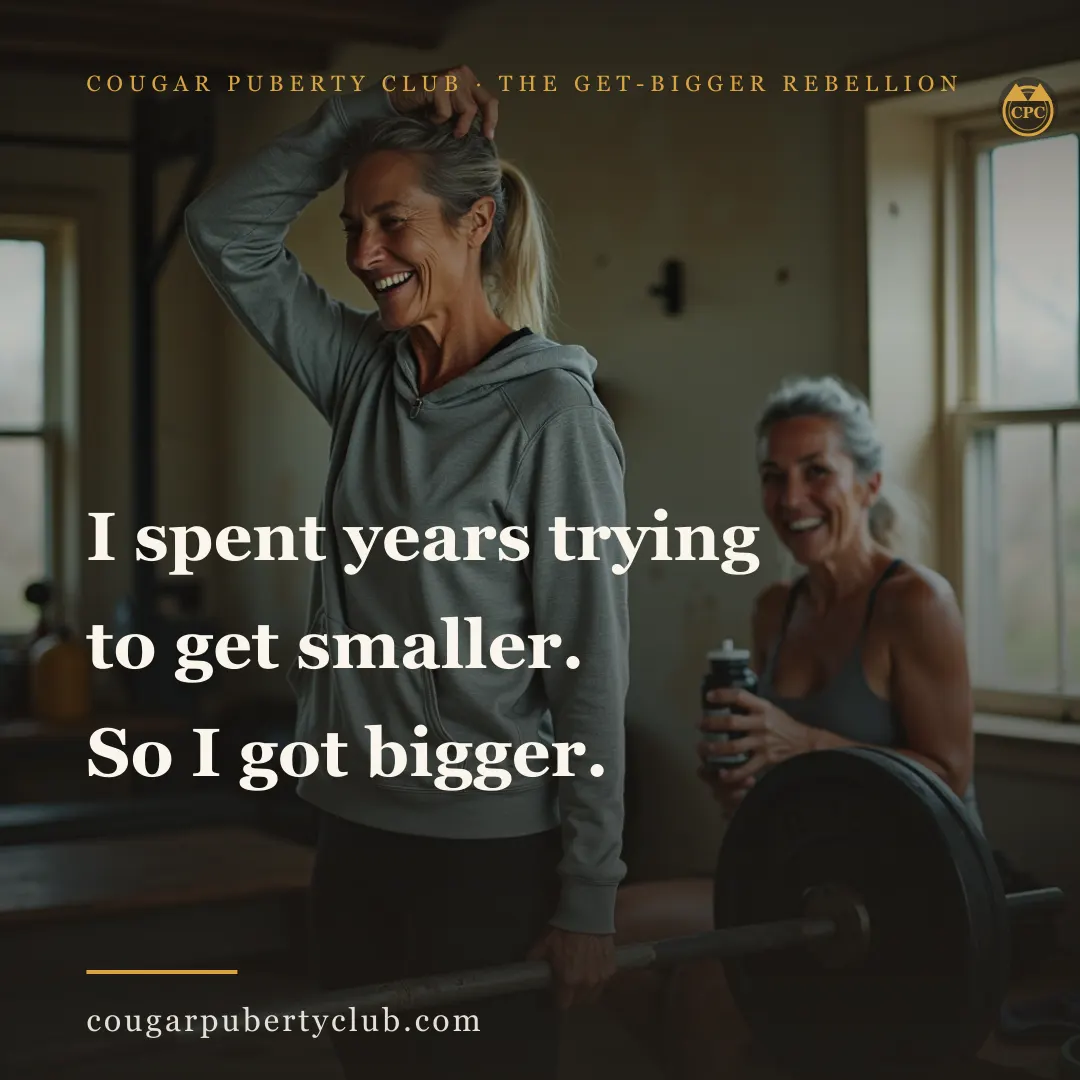
The card exists because the recognition moment is the whole point. You don't need to be convinced - you need to be seen. That's the friendship part of this: you send it to the friend who has been "good" for thirty years, and you both laugh, and then one of you says okay but actually, and suddenly you're comparing notes on squat racks instead of points.
That's the rebellion. Not a movement with a hashtag - a friend group that stops apologizing for taking up space.
The honest fine print
Two things we will not do, because the industry has done them to us for forty years:
We will not sell you smaller. No "get-bigger" tea, no waist trainer for your soul. The only product that matters is the habit, and the habit is free to start.
We will not pretend supplements are the point. Protein, creatine, and bands are support for strength training - the legitimate bridge between an essay and an action. They are not replacements for the work, and anyone who tells you a powder fixes perimenopause is selling you the shrink-ray in a new package.
Where to go next
- The bone-density conversation - if you're going to lift for your skeleton, you should know what's actually happening in there: Am I Losing Bone Density Without Knowing It?
- The fatigue wall - the 2–5 p.m. crash is real, and strength training interacts with it: Why Am I So Tired? The Perimenopause Fatigue Files
- The sister rebellion - unlearning the people-pleasing that trained you small in the first place is the same war, different front. Ask your group chat about it.
Start where you are. Two sessions this week. One more than last week. That's the whole strategy: bigger, on purpose, one rep at a time.