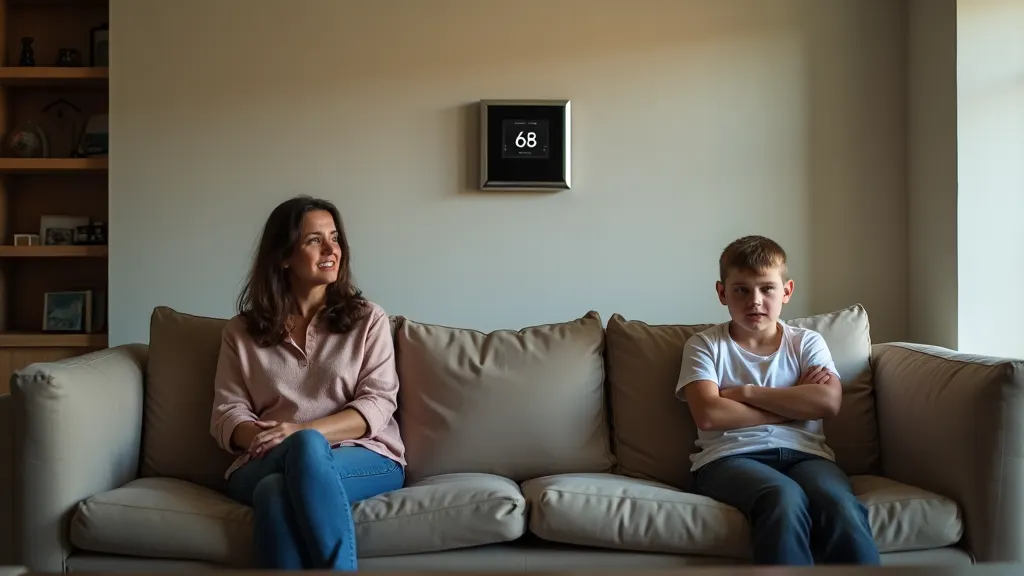
You are 44. Your daughter is 14. She slammed a door because you asked about homework. You cried in the bathroom because a dog food commercial had a sad ending and also because the recycling situation is getting out of hand. You are both, technically, going through puberty.
She has a permission slip. You do not.
This is the two-puberty household, and if nobody has said it yet: it's a thing. A real, documented, surprisingly common thing. Women are having babies later Established: CDC, and perimenopause often starts in the early-to-mid 40s Established: OWH. Simple math: if you had a kid at 30, they're 14 when you're 44. And 44 is prime perimenopause territory.
That means a meaningful number of households right now contain two humans whose hormones are staging a coup simultaneously.
The unexpected overlap
Here's the part nobody mentions: the two puberties have more in common than anyone wants to admit. Two people in one house, both rewritten by hormones, both convinced the other one is doing it on purpose. It is the cougar puberty phenomenon with a live audience and no off switch.
Mood swings. Your teenager is furious because someone looked at them. You are furious because your partner is chewing. Neither of you is entirely sure why. Both of you are technically correct.
Sleep disruption. Your teenager cannot fall asleep before midnight and cannot wake before noon. You fall asleep at 9 PM and wake up at 3:17 AM for reasons your phone cannot explain. At 3:17 AM you are the only conscious person in the house, and it is very quiet and also very annoying.
Body temperature chaos. Your teenager wears shorts in January. You are wearing a tank top in a 68-degree room with a fan aimed at your face while your partner is under a duvet. The thermostat is the most contested object in the home.
Skin doing something new. Your teenager has acne where there was no acne yesterday. You have dry patches where there was no dryness and also, inexplicably, acne. You are both staring at the same bathroom mirror with the same expression: what now?
Appetite changes. Your teenager eats everything in the refrigerator and then asks what's for dinner. You no longer recognize your own hunger signals: sometimes ravenous, sometimes forget to eat entirely, sometimes craving things at 11 PM that you didn't even like before.
Identity negotiation. Your teenager is figuring out who they are. So are you. Different chapter, same question: who am I now, and is this version of me okay?
The thing nobody says out loud
There is a quieter, harder overlap: you are both going through something big, and sometimes you are each other's trigger.
Your teenager's mood swing sets off your rage. Your hot flash makes you short with them. They roll their eyes and you snap, and neither of you meant it, and neither of you knows how to say "I'm not actually mad at you, my body is staging a rebellion I did not authorize."
It's okay to acknowledge that this is hard. It is not a character failure to find the two-puberty household challenging. It is not a parenting failure. It is not a marriage failure. It is two humans with changing brains and bodies sharing a refrigerator.
What helps (the practical version)
Name it. Tell your teenager what's happening, not in clinical detail, not as an excuse, but as information. "I'm going through something called perimenopause. It's basically a second puberty. My body is doing things I didn't authorize. I might be irritable or warm or forgetful, and it's not about you." Teenagers respect directness more than they respect pretending everything is fine.
The thermostat treaty. This is a real negotiation. Set a baseline (68-70°F works for most), agree on layers, and acknowledge that different bodies have different needs. The person who is hot gets the fan. The person who is cold gets the blanket. No arguing about the temperature at 3 AM.
Separate your moods. When you're both having a bad hormone day, it's okay to say: "I'm having a rough body day and it's making me short-tempered. Can we table this conversation for later?" This teaches your teenager to do the same thing, which is actually an excellent life skill.
The fridge rule. Label your snacks. Yes, really. The puberties-hunger overlap is real.
Find the humor. Not in a toxic-positivity way. But sometimes the situation is genuinely absurd: two humans, one bathroom mirror, both baffled by their own faces. That's comedy.
When it's more than hormones
Some things deserve a clinician, not a group chat:
- Mood changes that feel like depression, not just irritability, especially if they last more than two weeks
- Your teenager showing signs of significant distress, withdrawal, self-harm, or disordered eating
- You feeling unable to function or experiencing thoughts of harming yourself
- Heavy or prolonged bleeding, chest pain, or other physical red flags
The two-puberty household is not a crisis. But either puberty can create one, and both deserve professional attention when they do.
The upside
Here's something the pamphlets don't mention: there can be an unexpected closeness in this. You understand something about each other that the rest of the household doesn't. Your body is changing. Their body is changing. You are both confused. You are both annoyed. You are both going to be fine.
And when your teenager eventually goes through their own second puberty in 30 years, they will know what it is, because you told them. That's not nothing.
Welcome to the two-puberty household. The thermostat is set to 68. There are snacks in the fridge with labels on them. You're both going to be okay.