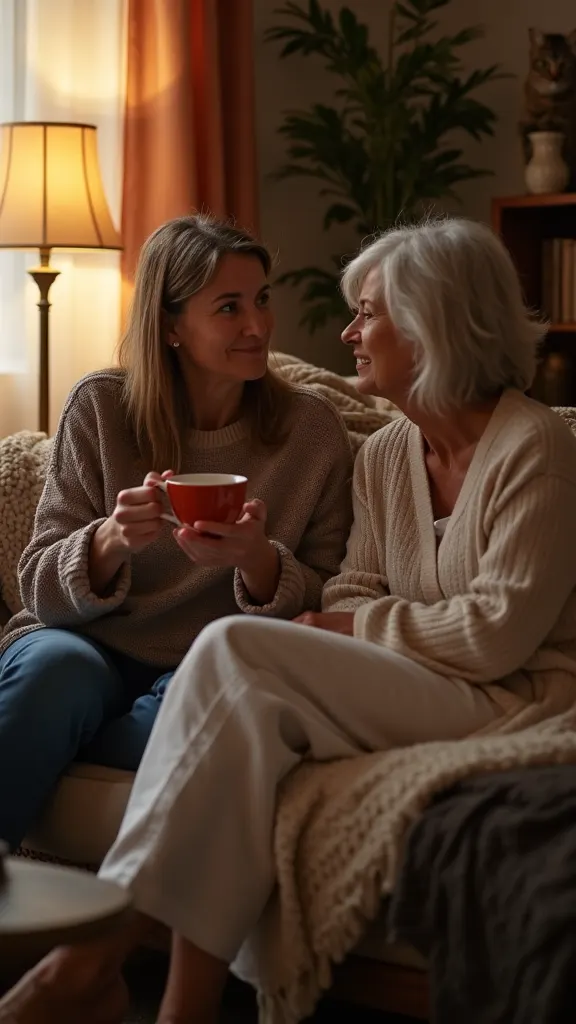
Your mother never said the word. Your grandmother never said it either. Somewhere in your family tree, a woman went through the entire transition - the rage, the insomnia, the mystery complaints, the year she just wasn't herself - with no name for any of it, and the silence got passed down like a china cabinet nobody wanted.
You are the generation that gets to stop the handoff.
When the matriarchal-revolution Threads post went viral in August 2026, thousands of replies did generational accounting, and one promise kept surfacing: "If we can help the next generation find their voice and not suffer, it's a good start!" Press: BuzzFeed. The women who were never prepared are now deliberately preparing the daughters coming up behind them - naming symptoms early, normalizing the doctor conversation, so she doesn't spend five years thinking she's crazy.
This is the practical version of that vow. Not a TED talk. Not a 300-page book. A conversation you can actually have - tonight, in the car, over the kitchen island - before she needs it.
Why this conversation is different from every one you didn't get
Here's the thing about the talk you never got: it wasn't malicious. Your mother didn't withhold it - she didn't have it to give. Perimenopause was a private, shame-adjacent, vaguely medical thing that happened to women in their late 40s, and the culture's message was figure it out quietly.
You now have the words she didn't. Perimenopause typically lasts 2 to 8 years, averaging about four, during which hormone levels vary wildly Established: Mayo Clinic. Symptoms include irregular periods, hot flashes, night sweats, sleep problems, mood changes, and brain fog Established: NHS. The transition usually begins in the 40s, and menopause is reached after 12 months without a period Established: MedlinePlus.
Read that list again. That's not a diagnosis - that's a map. And the map is the gift. You got the territory with no map. She gets both.
The conversation starters that actually work
You don't need an opening monologue. You need one honest sentence and the willingness to let the silence breathe. Here are the frames that work, in escalating order of commitment:
The casual drop. "So heads up - I'm starting perimenopause. It turns out nobody tells you anything about it, so you're getting the version I wish I'd had." That's it. That's the whole script. It names the transition, names the silence, and positions her as the beneficiary of a better deal than you got.
The teachable moment. Next time you're mid-hot-flash and she asks if you're okay: "I'm fine - that's a hot flash. My hormones are doing the same kind of chaos yours did in puberty, just twenty years later." Immediate, accurate, and it connects her lived experience to yours Established: MedlinePlus.
The recognition opener. If she's older: "I've been reading about perimenopause and I keep thinking about how nobody warned me. I don't want that for you. Can I tell you what I've learned?" This is the frame adult daughters described in the viral thread - the transmission vow made concrete.
The what-not-to-do list (yes, it's also a starter). Don't do it at her birthday dinner. Don't do it as a crisis. Don't open with "I'm falling apart." Open with the fact that you're fine, this is normal, and she deserves the heads-up.
Naming symptoms is the whole ballgame
Here's the uncomfortable truth the thread exposed: most women don't know what perimenopause actually is beyond "hot flashes and missed periods." The full symptom list is wide - sleep disruption, mood changes, brain fog, and vaginal or urinary changes are all documented parts of the transition Established: OWH, and Cleveland Clinic's weird-symptom list runs to 29 entries Established: Cleveland Clinic.
Why does naming matter? Because the most expensive version of this story is the one where your daughter hits 44, starts feeling like she's losing her mind - the insomnia, the rage at the dog, the forgetting the word for "microwave" - and concludes she's broken. That's the five-years-thinking-she's-crazy tax. One sentence from you - "that's a perimenopause symptom, it's real, it's common, here's what helps" - and she skips the entire shame detour.
The rule: name the shape, not the whole beast. She doesn't need all 29 weird symptoms in one sitting. She needs the concept - this is a real, named, temporary transition, and here are its most common visitors - so that when one shows up unannounced, she recognizes it instead of panicking.
Normalize the doctor visit while you're at it
The second-generation gift isn't just the words - it's the permission to use them with a professional. Your mother's generation got waved off. Hers doesn't have to.
The framing that works: "If you ever start having symptoms that worry you, that's a normal thing to bring up with a doctor - not something to tough out." The NHS is explicit that contacting a GP about perimenopause symptoms is the right move, not an imposition Established: NHS. And the practical details are worth modeling out loud: what a doctor can actually do about symptoms Established: OWH, and the fact that treatment exists.
You're not just teaching her a symptom list. You're teaching her that her body is a legitimate topic of conversation - with you, and with medicine. That's the doctor-visit normalization the previous generation never got, and it's the single most practical thing you can hand down.
The both/and rules (read this twice)
This conversation has two failure modes, and they're both about you:
She is not your therapist. You're giving her the map, not the tour of every symptom. If you're in active distress, that's what friends, doctors, and support groups are for. The moment the conversation becomes her managing your menopause, you've reversed the generational flow - and you've taught her that being a woman means absorbing other people's bodies.
You are not giving a eulogy. This isn't "my body is ending." It's "my body is changing, it's normal, and here's what I wish I'd known." Your framing becomes her template. If you present the transition as a horror story, that's what she'll expect. Present it as what it is: a long, annoying, survivable transition that millions of women navigate every year Established: Mayo Clinic.
And the biggest one: it's not her job to have this conversation. You're offering her information and a door. If she's not ready, she's not ready. The vow from the thread - she won't suffer the way we did - is fulfilled the moment she knows the information exists. Her using it is her timeline.
The house with two puberties
If she's a teenager, you're not just having a generational conversation - you're having it in a house where two hormonal transitions are running simultaneously. Your daughter's puberty and your perimenopause can share a house, a thermostat, and a very fragile peace Read: When Your House Has Two Puberties.
That's actually the easiest possible context for this talk, because you have a built-in bridge: "You're going through hormone changes, and I'm going through hormone changes, and we're both a little unhinged right now. That's not a personality flaw in either of us - it's chemistry. And now you know what mine is called." Two puberties, one house, both named. Nobody in that kitchen has to wonder if they're crazy.
That's the revolution, by the way. Not the dramatic part. The part where a mother and daughter sit in a kitchen, both hormonally unhinged, both knowing the words. The silence skipped a generation, and you're the one who ended it.
The bottom line
You didn't get the talk. Your mother didn't get the talk. Her mother didn't get the talk. Somewhere back there, a woman white-knuckled her way through an entire transition with no name for it, and her silence became your inheritance.
You can do one better: hand the words down. Not a lecture, not a binder of symptoms - one honest sentence that says this is real, this is normal, this is what it's called, and you deserve to know before you need it.
She'll file it away. She might roll her eyes. She might bring it up in eleven years when her own first hot flash hits and suddenly remembers her mom wasn't crazy after all.
That's the whole point. That's the pay-it-forward generation doing the only thing that was ever asked of us: making sure the next one doesn't suffer the way we did.