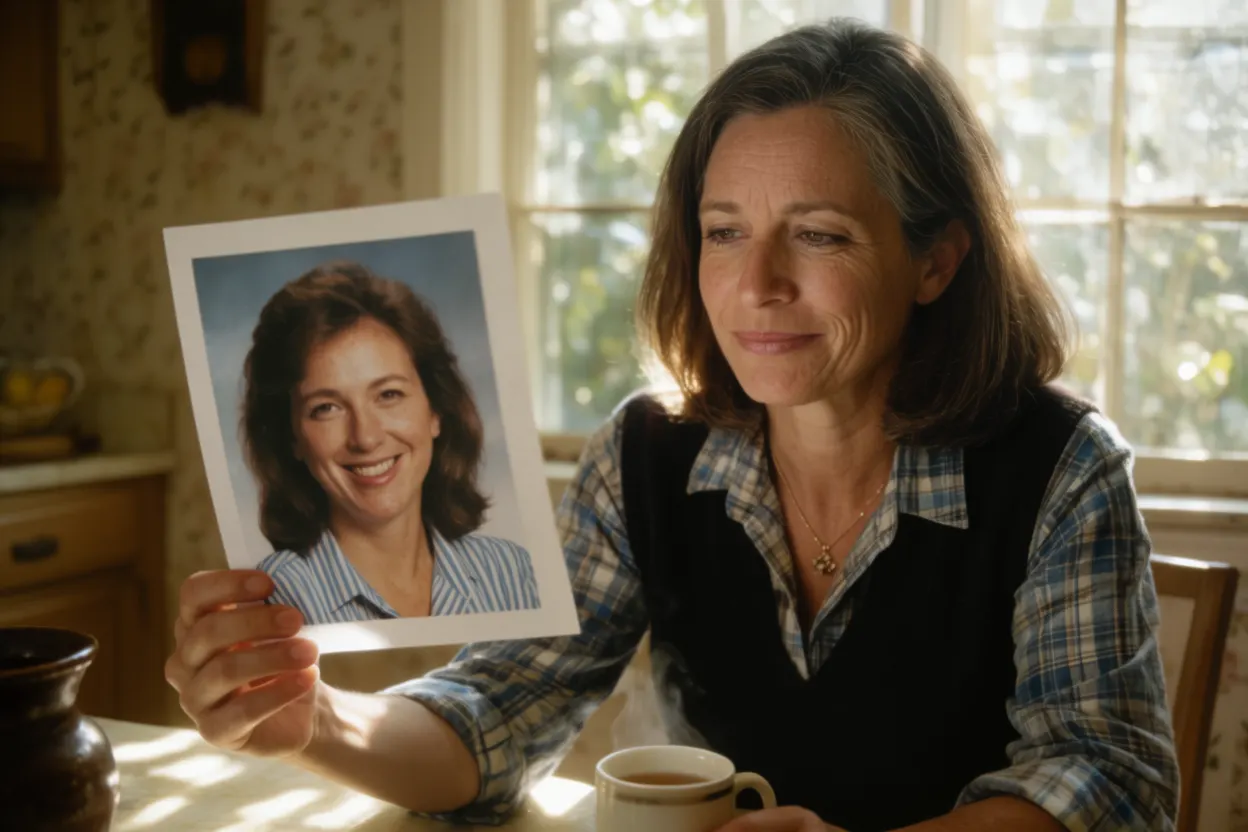
There's a question that shows up in the comments of every menopause explainer on the internet, and it's never about the reader herself. It's about her mother:
Wait. Did my mom have this?
You're 46. You're three years into your own perimenopause, you finally know what a hot flash actually feels like (why did no one mention the internal oven), and suddenly you're not just learning about yourself. You're re-reading your mother's entire midlife -- the years you filed under "Mom being difficult" -- and the pages are starting to look different.
In a May 2026 thread on r/Perimenopause, a woman described the moment it clicked. Her mother, she wrote, had a "very noticeable mental breakdown" in her mid-40s -- paranoia, hoarding tinned food and soap in a cupboard "just in case," withdrawing from everyone. It never occurred to the daughter, for decades, that any of it could have been a menopause issue. Then she hit her own perimenopause, got her intrusive thoughts and anxiety resolved with estrogen patches, and realized: my mother went through a horrible menopause with no support at all. Another woman in the thread answered the generational question outright: "I think it was a case of just get on with it in the past."
That's the retrospective recognition. It's grief and discovery arriving in the same package. And it's one of the most under-served searches on the internet: everything tells you to recognize your own symptoms. Almost nothing helps you recognize your mother's.
The re-read: what you're actually looking at
Here's the thing about perimenopause: its symptoms are wide, they're weird, and the public version of them is a caricature. Hot flashes, sure. Missed periods, fine. But the full documented list -- the one the NHS, the Office on Women's Health, and MedlinePlus all carry -- includes rage, anxiety, insomnia, brain fog, mood swings, and withdrawal Established: NHS. That's not a side list. That's most of the list Established: Cleveland Clinic.
Now play that list against the mother you remember:
The rage years. She was "always angry," or "so short-tempered," or "walking on eggshells around her." Maybe she snapped over things that seemed small -- and then seemed ashamed of herself. That's the pattern of hormone-driven irritability: it arrives fast, it feels enormous, and it doesn't match the trigger.
The withdrawal. She stopped going. Book club, church, the cousins' thing. She "kept to herself," "stayed in her room," "wasn't herself." Depression is a documented perimenopause symptom -- and so is the quieter version where a woman just... disappears into the house.
The insomnia. She was up at 3 a.m. every night. You remember the lights on downstairs. Maybe she slept in a separate room from your dad for years and everyone treated it as a marriage problem.
The mystery complaints. She went to doctors who told her nothing was wrong. "It's stress." "It's just getting older." "Lose some weight." She stopped going. The medical gaslighting of midlife women is so routine that most daughters watched it happen and assumed it was normal.
The hoarding-adjacent behaviors. The apocalypse cupboard. The extra everything. The sudden organizing of the basement into labeled bins. Anxiety does strange things to control-seeking brains, and perimenopause is an anxiety factory Established: OWH.
The disappearing libido and the marriage that quietly died. A lot of women in that generation lost desire and never got the words for it -- and the marriage got the blame.
None of these were her "personality." They were a transition, untreated and unacknowledged.
Why she never said the word -- and why she may not have known it
Here's the part that broke the internet when Gen X started talking about it: your mother didn't just fail to tell you. It's entirely possible no one ever told her.
Her own mother's generation didn't name menopause either -- "the change" was a whisper, a euphemism, something a woman endured privately and never discussed with her children. So the silence was inherited, not chosen. She didn't have a script for this conversation because she'd never heard it spoken aloud.
And for women who hit their midlife in the early 2000s, there was a specific historical catastrophe: in 2002, the Women's Health Initiative study sent shockwaves through medicine, and the medical establishment panicked about hormone therapy. Prescriptions plummeted. Doctors who had been treating menopause symptoms for decades suddenly stopped offering help -- often over-correcting into "just get on with it." A generation of women were left to endure perimenopause and menopause with no treatment and no guidance, at exactly the moment the science was about to get good.
The FDA itself has since walked back the 2002 overstatement -- removing the black-box warnings from estrogen-containing hormone therapy in November 2025, with the FDA chief calling the aftermath "an American tragedy." But your mother didn't get the correction. She got the panic, the silence, and a decade of "it's nothing."
So when you ask "why didn't she tell me?": because she couldn't tell you what nobody told her. The silence isn't a failure of her love. It's a failure of everyone around her.
The honesty: not everything was peri
Before you rewrite the family history, the other half of the truth: not everything was perimenopause.
Your mother was a person. Some of what she did was genuinely hard, some of it was her, and some of it may have been other things entirely -- thyroid, depression, trauma, life. Retrospective recognition is a new frame, not a full explanation. It's a lens, not a verdict.
The both/and is the honest position, and it's the one that keeps this from becoming another way to erase a woman's actual self: she was doing hard things, and she was doing them through a hormonal transition that was never named, never treated, and never acknowledged Established: MedlinePlus. Both of those are true. You can hold her accountable and understand her at the same time -- that's not contradiction, that's adulthood.
And it's worth saying plainly: if she's still here, and she's in her 60s, 70s, or 80s -- perimenopause is long over. She's not going to start a treatment that would have helped 20 years ago. The conversation isn't about fixing her. It's about the part that's still possible: being understood.
How to have the gentle conversation
The goal is not to deliver a diagnosis. The goal is to hand her a new sentence about her own life and see if it fits. Three frames that work:
The apology frame: "I've been reading about perimenopause -- the rage, the insomnia, the anxiety, all of it -- and I keep thinking about your 40s. I think you went through it completely alone, and I'm sorry nobody helped you."
The curiosity frame: "Mom, did you ever have hot flashes or anything like that? I'm trying to figure out what's normal and what's not." This one invites her in as the expert on her experience and lets her name it at her own pace -- or not at all.
The third-person frame: "A friend's mom just got diagnosed with perimenopause that she'd been hiding for years. Wild, right?" This gives her an exit ramp: she can talk about "her friend" or stay quiet, and either way the door is open.
What not to do: don't make it about you. Don't say "so that's where I get it from" -- that reads as blame. Don't frame it as "you were mean to me because of hormones" -- that reads as her suffering being converted into your grievance. The recognition is for her, first.
And if she doesn't want to talk about it? Then the recognition is still yours. You don't need her to confirm it for it to change how you see her. Half the women in that Reddit thread never had the conversation -- their mothers were gone, or unreachable, or unwilling. The discovery still mattered. It still made the mother make sense.
The closure that's actually available
Here's what nobody says about the retrospective recognition: the closure isn't about the past. It's about the present tense of the relationship.
The daughter who finally understands her mother's midlife gets to stop being 13 years old in her own head -- the version of herself who was hurt, confused, and quietly certain her mother didn't like her. Understanding "she was drowning and nobody threw her a rope" doesn't erase the hurt. It converts it. It turns "why was she like that" into "she was like that and she was fighting something she couldn't name."
That conversion is available whether your mother is here or gone, whether she can hear it or not, whether she agrees or not.
And if she's still here -- even a stubborn, "I'm fine, I don't need to talk about it" version of here -- say the sentence anyway. Not the diagnosis. The sentence: I understand you now. It's the thing she waited forty years to hear, from the one person she never expected to say it.
The takeaway
Your mother wasn't difficult. She was perimenopausal. And nobody told her either.
The silence she carried wasn't hers -- it was inherited, medical-system-inflicted, and generational. You're the first woman in your line who gets to break it. Not by giving her a lecture about hormones. By giving her the one thing the whole chain of silent women never got:
Someone who looked at her midlife and said, oh. That's what that was.
Now go call her. Or if she's gone, go tell someone who knew her. The recognition is the gift, and it doesn't expire.