The invite said brunch at 11. What it didn't say was the actual price: the brunch, the two hours of performative catching-up, the drive home with the radio off, and the nap that used to be optional but is now mandatory. Plus the evening you'd planned to use productively, gone. Plus tomorrow morning's version of you, which is a coin flip.
The lunch that used to energise you now requires a nap afterward. Long plans feel like commitments you cannot predict your body will honour. And the question underneath it all - am I becoming antisocial, or is something actually different? - deserves a real answer.
Here it is: something is different, it has a mechanism, and it is not a personality change.
The recovery-cost mechanism
Here's the model that makes sense of the whole confusing decade: every event now has two prices. The one on the invite - the time, the drive, the small talk - and the one you pay afterward in recovery units.
The recovery bill is new. It's not that you don't enjoy people anymore. It's that the same event now draws down more than it used to, because your baseline operating costs went up.
- Tiredness is a recognized perimenopause symptom in its own right - not a side effect of being busy, a symptom Established: NHS.
- Stress genuinely changes how you feel and behave, including irritability and sleep disruption Established: NHS.
- Estrogen receptors sit in the brain regions that regulate mood, and the transition is a window of heightened vulnerability to low mood Established: The Menopause Society.
- And social withdrawal - the pulling-back, the zero tolerance for small talk, the need to be alone after being with people - is itself documented as a real symptom women genuinely suffer, not a euphemism for being rude Reported: BBC News.
Add all of that to a body that's also running hot, sleeping badly, and doing more work to hold itself together, and you get the new pricing:
A lunch that used to cost 10 units now costs 30. The event didn't get longer. Your operating costs went up.
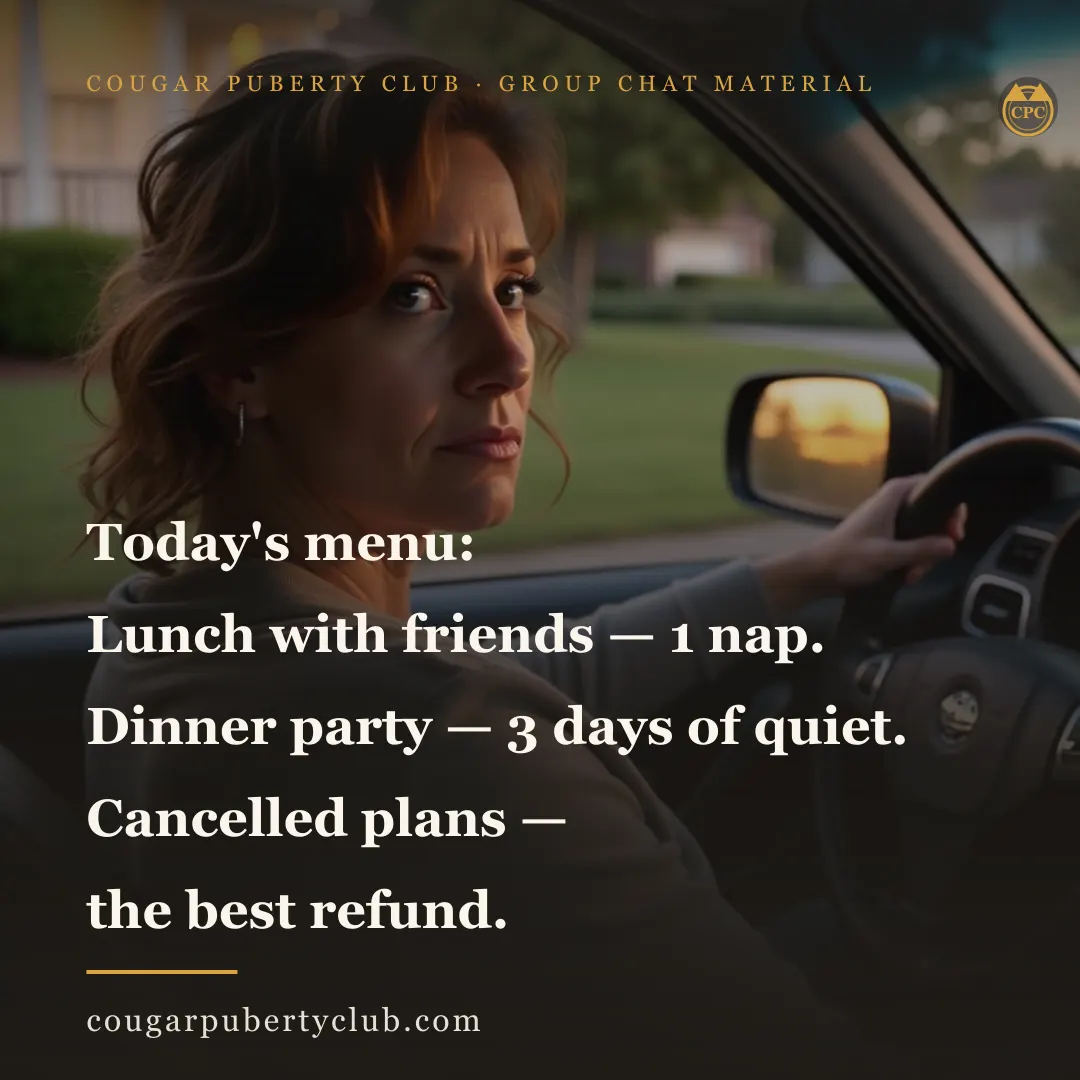
Events, re-priced in nap units
Women in the group chats describe the new economy with eerie precision: a lunch that used to energise you now requires a nap afterward. So let's just use the unit everyone actually understands.
The Social Battery Recovery Menu (perimenopause edition):
| Event | Old price | New price | |---|---|---| | Coffee with one good friend | 0 naps | ½-1 nap | | Lunch, the long version | 0 naps | 1-2 naps | | Dinner party | 0 naps | 1-3 days of quiet | | The group dinner where everyone talks over each other | 0 naps | Full social hangover | | Small talk with a relative who asks about your weight | Free, apparently | Unpriced. Do not attempt. | | Cancelled plans | - | A refund. The best refund. |
The chart is funny because it's true, and it's true because it's mechanical. The recovery bill scales with the demand of the event - noise, people-count, emotional labor, how long you have to perform - not with how much you love the people. You can love someone with your whole chest and still owe yourself a nap after ninety minutes of them.
The different friendship conditions reframe
Here's the reframe that actually fixes the guilt, and it's not "be more social" or "try harder":
You're not declining the friendship. You're changing the conditions under which you can show up.
The friendship doesn't have to be the dinner. It can be the walk. The 1:1 instead of the group. The shorter, quieter, earlier version with a planned exit. The friendship that used to run on marathon brunches can run on a Tuesday-morning walk where you both complain and then go home restored instead of wrecked.
What this looks like in practice:
- The walk, not the dinner. Movement and one person beats a table of eight. The walk has a natural end. Nobody is trapped.
- The 1:1, not the group. One friend, one conversation, no trying to keep four threads alive while wondering if you've been quiet too long.
- The capped event. "I can do 90 minutes." Not "let's see how it goes." The cap isn't rude - it's the boundary that lets you actually come.
- The exit on empty. You're allowed to leave when the battery hits zero, mid-event, with a warm goodbye instead of a fake emergency. The warm-greeting-to-brisk-goodbye flip is one of the most recognized moments of this decade - the battery hits zero mid-encounter with no warning [Observed: TikTok, Aug 2026]. Plan for it: "I'm so glad we did this - I'm hitting my wall, that's my cue."
- The slow reply, stated plainly. The friendship-killer isn't the slow reply; it's the silence without context. One sentence fixes it: "I'm slow replying lately. It's not personal. My social battery is in its own menopause."
The friends who matter will take the walk. The ones who only accept the dinner were charging you more than they were paying - and that's information, not a loss.
The scripts
Because the hardest part isn't knowing the mechanism - it's the sentence that comes out of your mouth when the invite lands. Here are the ones that work:
- The slow reply: "I'm slow replying lately. It's not personal - my social battery is running its own menopause."
- The downgrade: "I love you and I'm running on fumes. Can we do the walk instead of the dinner this week?"
- The cap: "Yes - I can do 90 minutes and then I have to go be horizontal." (You do not have to specify what you're going to do. Horizontal is a plan.)
- The cancel with context: "I'm so sorry to cancel - I'm genuinely out of battery, not out of wanting to see you. Can we reschedule for a walk?"
- The exit: "This was so good. I'm hitting my wall - that's my cue. Love you."
None of these are apologies for existing. They're price tags. You're telling them the real cost so the friendship can be renegotiated on terms you can actually honour - instead of silently overspending and then resenting the bill.
The two-hour battery and the lights-out moment
Two different mechanisms get conflated, and separating them helps:
- The two-hour battery - the capacity version. You show up, you're warm, and at hour two you're done. This is the woman who used to be a dynamo and now does two hours and is toast [Observed: Midlife community, 2026]. The fix is menu design: shorter events, capped attendance, the planned exit.
- The lights-out moment - the switch version. Fine one minute, done the next, no warning, mid-encounter. The warm greeting that shifts to a brisk goodbye [Observed: TikTok, Aug 2026]. The fix is a pre-agreed exit and the honest sentence - "that's my cue" - delivered warmly instead of vanishing.
One is a battery that holds less. The other is a battery that sometimes drops from 60 to 0 without passing go. Both are real, both are common, and neither is a character flaw. One is a capacity problem; the other is a sudden-discharge problem. Both respond to the same menu: fewer, shorter, quieter, with exits.
When it's more than a battery
The line between managing your battery and withdrawing from your life is worth knowing, because the guilt makes you an expert at minimizing your own signals - I'm fine, everyone's tired, this is just what getting older is.
The flags that deserve a clinician conversation, not a better nap schedule:
- The list shrinks to zero. Battery management is doing fewer, different, quieter things. Withdrawal is doing none of them - even the ones you used to love.
- The two-week rule. Low mood most of the day, most days, for two weeks or more. That's the threshold where it's a conversation, not a character arc Established: NHS.
- The anhedonia test. You still want the people, but nothing lands - not the coffee, not the joke, not the good news. Enjoyment that's gone isn't a battery problem; it's a signal.
- The avoidance tell. You're not resting - you're dodging. The phone stays down, the invites go unanswered for weeks, and there's a small relief that has stopped feeling like a refund and started feeling like a win against your own life.
- The physical suspects. Persistent exhaustion that never lifts, even with the naps, is worth screening for the usual midlife suspects: anaemia, thyroid, sleep apnea - before anyone blames your personality.
The honest sentence: a battery that runs low is a management problem. A life that's getting small is a conversation. You get to have the first one on your own terms - and the second one deserves a clinician, not a guilt spiral.
The group chat version
Here's the whole piece in the version you'd send to the friend who just texted "I'm in my recovery era" after a birthday brunch:
The lunch that used to energise you now costs a nap. That's not you becoming antisocial - your operating costs went up, and the event didn't. Every event has two prices now: the invite price and the recovery bill. The fix isn't trying harder - it's menu design. The walk, not the dinner. The 1:1, not the group. The 90-minute cap with the planned exit. And the sentence that saves the friendship: "I'm slow replying lately. It's not personal." It's not a decline of the friendship - it's a renegotiation of the conditions. The friends who matter will take the walk.
And if the list is shrinking to zero, and nothing feels good even when you cancel - that's not the battery. That's the signal, and it's worth a conversation, not another nap.
Send this to the friend who needed to know she wasn't becoming a hermit - she was becoming someone who prices events in naps, which is a completely different thing, and arguably a more accurate one.
Send it to the friend who's currently horizontal, phone face-down, recovering from a lovely time.