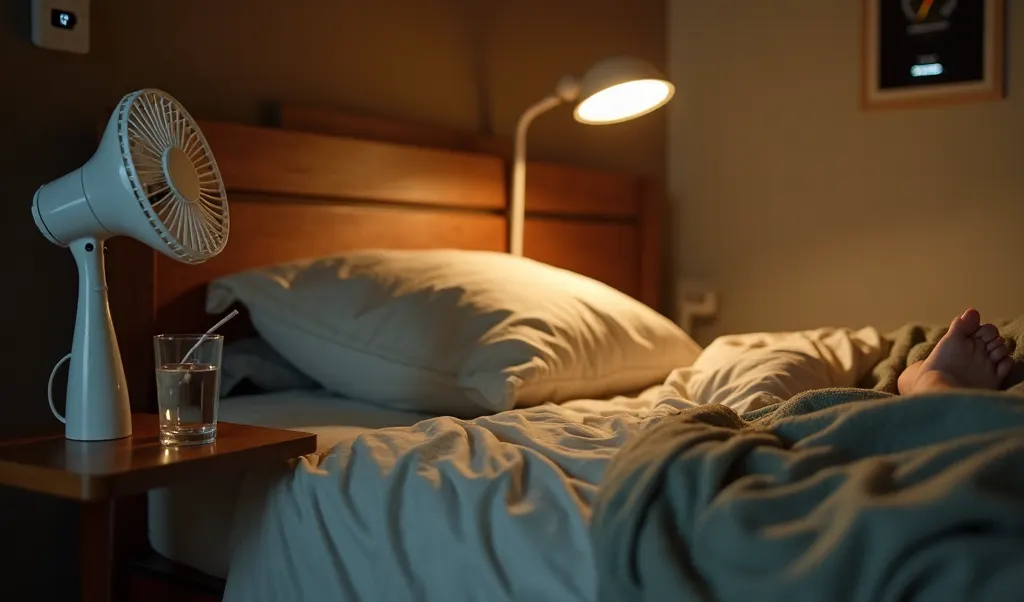
The phone says 3:17 a.m. You are awake. You didn't choose this. Your brain has already started the highlights reel - 2007, the thing you said at the work dinner, the email you maybe should not have sent in 2019 - and your body is running its own temperature experiment.
You know the starter pack. You've got the fan, the leg out, the water. What's missing is the part after that: what do you do now?
This is that part. It's a checklist, not an essay. Symptom on the left, next step on the right, no judgment anywhere in between.
First, the thirty-second triage
Night sweats are hot flashes that happen while you sleep - a sudden wave of heat in the face, neck, and chest, sometimes enough to soak your nightclothes or bedding even in a cool room Established: NHS. For most women this is perimenopause, not an emergency Established: The Menopause Society.
So before you do anything else, take the deep breath. You are not dying. You are running the new operating system, and it does not come with a changelog.
The checklist
1. You woke up hot
- Next step: Leg out, covers off, small fan on, aimed at your face, maximum power, zero shame.
- Then: Ice water on the nightstand, two sips, not a whole glass - you want to go back to sleep, not start a hydration project.
- If it happens again tonight: kick off another layer before you're fully awake. The goal is to stay asleep through the temperature swing, not to fight it after the fact.
2. You're not hot, you're just awake
- Next step: Don't fight it in bed. Get up. The bed is now a negotiation you cannot win.
- Then: Ten minutes of something boring, in dim light, not on your phone. The kitchen reset is valid; just don't let it become a snack run.
- The 3:17 phone check: if you must look, look at the clock and put it down. The phone is the rabbit hole. The phone is where you'll end up reading about whether this is normal at 1 a.m. and scaring yourself at 2.
3. The brain has started the highlights reel
- Next step: Recognize it for what it is: the 3 a.m. brain revisiting old material because it has nothing else to do. It is not a signal. It is a screensaver.
- Then: Give your brain a boring job. Count backward from 300 by 7s. Recite the lineup of every team you've ever followed. Mentally rearrange the pantry. Anything tedious that requires just enough attention to crowd out 2007.
- If the thoughts are dark, not just embarrassing: this is the line. Severe low mood, anxiety that won't quit, or any thoughts of self-harm at 3 a.m. (or any time) is the moment to treat this as urgent and get real support. Not a checklist item. A phone call.
4. The partner is asleep and possibly snoring
- Next step: Admire the injustice. Then let it go. This is not fixable at 3:17 a.m. and waking them up fixes nothing.
- Then: If the snoring is a pattern - loud, gasping, stopping - that deserves a daytime conversation about a sleep study, not a 3 a.m. argument. Snoring that pauses breathing is worth a screening conversation with a clinician Established: NHS.
5. The thermostat is now a hostage negotiation
- Next step: Do not engage. Do not change the thermostat in the middle of the night. You'll win the negotiation and lose the argument.
- Then: Set the room cool before bed, keep layers you can shed, and remember: your partner under a duvet shivering at 68° is not a personal attack on you. It's physics, and you're both right.
When it stops being a checklist
Some things are not normal perimenopause, and this is the part of the page with no jokes:
- Sweating soaked - enough to change your nightclothes and flip the pillow - frequently, in a cool room: get it assessed Established: NHS.
- Night sweats with fever, cough, or unexplained weight loss: that's a different conversation. Call your clinician.
- Chest pain, pressure, or a racing heart that's new: hot flashes can impersonate cardiac symptoms. When in doubt, get it checked.
- Sleep disruption with severe low mood, anxiety, or thoughts of self-harm: urgent. Real support. Now.
Bring a list to your appointment: how often, how soaked, what time, what helps. You don't need the diagnosis; you need the conversation.
The bottom line
The 3 a.m. wake-up is one of the most normal things about the second puberty, and one of the most fixable. You're not losing it. Your body is just running a new operating system at night, without the courtesy of a changelog.
Save this checklist. Send it to the friend who's also awake right now. Then, when it's a sane hour, come join the club.
The 3 AM Club is the weekly email where we collect the funniest and most useful stuff about this whole thing - one thing we learned, one WTF moment, one product worth knowing about, one thing we're not buying, and one thing to send the group chat. No spam, no creepy tracking, unsubscribe anytime. Join the 3 AM Club →
Cougar Puberty Club is a media publication, not a medical practice. This page is not medical advice. Read the medical disclaimer and talk to a real clinician about anything that worries you.