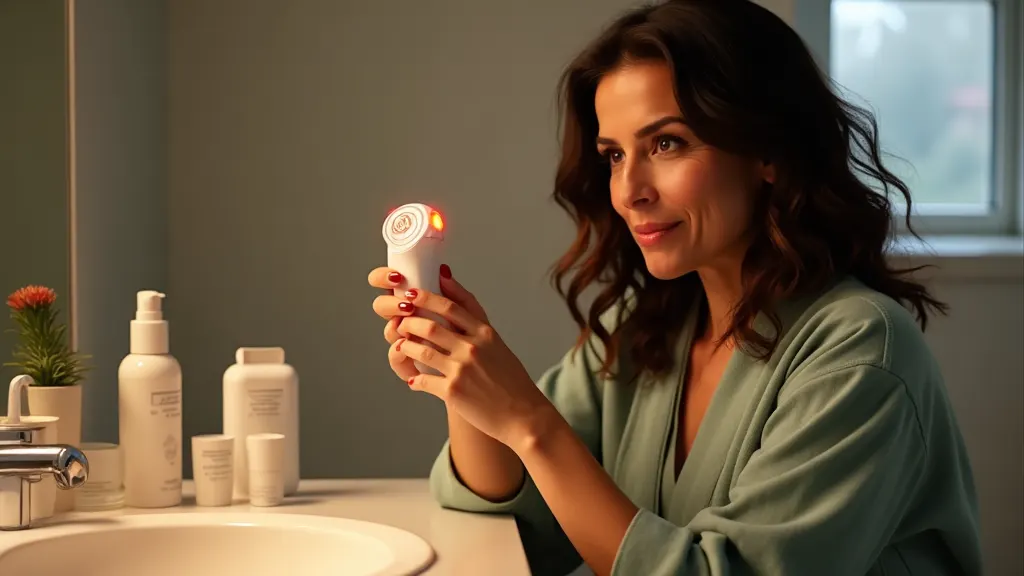
Your skin changed teams sometime in your early 40s. Dry where it was oily. Oily where it was dry. Less bounce. More sensitivity. A relationship with SPF that borders on codependency. You didn't ask for this refresh, but here we are.
The beauty device market has noticed. LED masks, microcurrent toners, radiofrequency wands, sonic exfoliators, the at-home device category has exploded, and much of it is marketed directly at women over 40. Some of it is backed by actual clinical evidence. Some of it is a $300 version of doing nothing.
Here's what the research supports, what's a gamble, and what's a gimmick, specifically for skin navigating perimenopause.
What perimenopause does to your skin (the short version)
Estrogen affects collagen production, skin thickness, moisture retention, and wound healing. When estrogen declines during perimenopause, collagen production drops, by up to 30% in the first five years after menopause, according to some estimates. Skin gets thinner, drier, less elastic. Fine lines accelerate. The barrier function weakens.
This is why your skin suddenly cares about things it ignored for 40 years. It's not product betrayal. It's biology.
The devices (ranked by evidence)
1. LED Light Therapy Masks: BEST EVIDENCE
What it is: A face mask or panel that emits red and near-infrared LED light at specific wavelengths. You wear it for 10-20 minutes, 3-5 times per week.
What the research says: Red light therapy (630-660nm) and near-infrared (830-850nm) have the most robust evidence for skin rejuvenation. Multiple randomized controlled trials show improvements in collagen density, fine lines, skin texture, and elasticity. It works by stimulating fibroblasts (the cells that produce collagen) and increasing cellular energy production. This is not pseudoscience. This is photobiomodulation, and it has a real evidence base.
Why it matters for perimenopause skin: Since declining estrogen reduces collagen production, anything that stimulates fibroblasts is directly relevant. LED therapy doesn't replace estrogen. But it appears to partially compensate for reduced collagen signaling, which is exactly what perimenopause skin needs.
What to look for: FDA-cleared devices with published wavelength specs. Red (633nm) + near-infrared (830nm) combination. Avoid devices that don't disclose wavelengths or power output. A mask should feel warm, not hot.
We'd start here: Omnilux Contour ($395) or CurrentBody Series 2 ($469). Both are FDA-cleared, wavelength-disclosed, and independently reviewed. Dr. Dennis Gross DRx SpectraLite ($435) adds blue light for acne if that's also a concern.
What's annoying: You have to use it consistently: 3-5 times per week, 10-20 minutes per session. Results take 8-12 weeks. This is not instant. Anyone promising "one-week glow" is selling something else.
Skip if: You're not willing to commit to the routine. Inconsistent use = no results = wasted money.
2. Microcurrent Devices: MODERATE EVIDENCE
What it is: A handheld device that delivers low-level electrical current to facial muscles and skin. Often called a "non-surgical facelift." Think NuFace, Foreo Bear, Ziip.
What the research says: Microcurrent increases ATP production in skin cells and may temporarily improve muscle tone in the face. The evidence for wrinkle reduction is mixed; some studies show improvement, others show placebo-equivalent results. The effects are generally temporary (hours to days), not cumulative. It's more of an event-day tool than a long-term skin changer.
Why it matters for perimenopause skin: The temporary lifting/tightening effect can be genuinely useful for events. But it doesn't address the underlying collagen issue the way LED does. Think of microcurrent as makeup for your facial muscles: effective, temporary, not a treatment.
What to look for: FDA-cleared devices with adjustable intensity. Conductive gel is required (included with most devices but needs replacement).
We'd start here: NuFace Trinity ($225) is the most-reviewed option. Foreo Bear ($299) has app integration with guided routines. Ziip Beauty ($495) uses nanocurrent + microcurrent but is harder to justify at nearly double the price.
What's annoying: You need conductive gel. You need to use it consistently (5 days/week for 6-8 weeks, then maintenance). Results are temporary. The device needs to make contact with gel-wet skin, which feels weird.
Skip if: You want results that last. Microcurrent is for the day of, not for the long game.
3. Radiofrequency (RF) Devices: MIXED EVIDENCE
What it is: A device that delivers radiofrequency energy to heat the deeper layers of skin, theoretically stimulating collagen production. Think TriPollar, NEWA, MLAY.
What the research says: Professional RF treatments have strong evidence. At-home RF devices have much weaker evidence: lower power, less controlled delivery, and far fewer independent studies. Some show modest improvements; many are indistinguishable from placebo when tested rigorously. The risk of burns or hyperpigmentation is higher than with LED or microcurrent.
Why it matters for perimenopause skin: In theory, RF targets the same collagen problem as LED. In practice, at-home RF doesn't deliver enough energy to match professional treatments, and the safety margin is narrower.
Recommendation: Skip at-home RF for now. If you want RF treatment, get it professionally. If you want an at-home device with real evidence for collagen stimulation, get an LED mask.
4. Sonic Cleansing / Exfoliation Brushes: LOW EVIDENCE FOR ANTI-AGING
What it is: Clarisonic (discontinued but cloned), Foreo Luna, PMD Clean, vibrating silicone brushes for cleansing.
What the research says: They clean skin slightly better than hands alone. That's it. No anti-aging benefit. No collagen stimulation. No wrinkle reduction. They're a cleansing tool, not a treatment device.
Recommendation: Fine if you like the sensation. Not a skin-changing device. Don't spend more than $50.
The verdict
| Device Type | Evidence | Value | For Perimenopause Skin | |---|---|---|---| | LED Mask | Strong | High | Best-researched at-home option for collagen support | | Microcurrent | Moderate | Medium | Temporary lifting, event-day tool, not a treatment | | At-Home RF | Weak | Low | Skip. Get professional RF or buy an LED mask | | Sonic Brush | Very Low | Low | Cleansing only. Not an anti-aging device |
We'd start here: An FDA-cleared LED mask with red + near-infrared wavelengths. Omnilux Contour or CurrentBody Series 2. Use consistently for 12 weeks before evaluating.
Best value: If $400+ is too steep, the Dr. Dennis Gross SpectraLite FaceWare Pro ($435) frequently goes on sale, and the LED Esthetics mask ($299) has decent specs for the price.
Worth the splurge: The Omnilux Men's mask is identical to the women's version, same wavelengths, often $50 cheaper. The "Men's" label is marketing. Your skin doesn't know what gender the box says.
Save your money: At-home RF devices, $200 "smart" mirrors that claim to analyze your skin, and anything promising results in "one week."
How to use an LED mask with perimenopause skin
- Cleanse and dry your face completely: no products, no moisturizer
- Wear the mask for the recommended time (usually 10-20 minutes)
- Apply your regular skincare routine after: the treatment enhances absorption
- Use 3-5 times per week, consistently, for at least 8-12 weeks
- Take a "before" photo. Results are gradual enough that you won't notice without documentation
What won't help (and why)
- "Collagen-boosting" creams: Collagen molecules are too large to penetrate skin. They sit on top. At best, they moisturize. They do not stimulate collagen production.
- "Stem cell" anything in a jar: Plant stem cells cannot become human skin cells. The marketing is creative. The biology is not.
- Jade rollers / gua sha: May improve circulation and lymphatic drainage temporarily. No evidence for collagen stimulation or wrinkle reduction. Nice ritual, not a treatment.
- Crystal-infused anything: The crystals are pretty. They do not emit therapeutic wavelengths. Buy them if you like them. Don't buy them for your skin.
The bottom line
Your perimenopause skin needs a few things it didn't used to need: more moisture, more diligent SPF, gentler handling, and maybe, if you're interested, a device that stimulates collagen production at the cellular level.
An LED mask is the only at-home device category with evidence strong enough to justify the price for collagen support. Microcurrent can be useful for temporary results. Everything else is either a professional treatment you should get in-office, or a gadget that costs more than it delivers.
Your skin has changed. Here's what's normal, what helps, and what's marketing. · Full perimenopause skincare guide →