Here's the sentence that should stop every one of us this week, from a husband writing in the Courier-Journal and the Tennessean about his wife's Alzheimer's: the medical system looked at her - a Black woman struggling with her memory - and told her she was hormonal. Four times. He writes that it wasn't bad luck. It was a pattern. Reported: The Courier-Journal
His wife, Kim, was diagnosed with early-onset Alzheimer's around age 50, in 2017 - years after the first signs showed up in ways that, reading them now, are devastatingly concrete: struggling to track details at work. Minor car accidents. Asking for help with baking, something she'd always done alone. Reported: The Tennessean
We read that story differently than most people, because we're the audience that already knows the other half of it. We know how real perimenopause brain fog is. We have the colander jokes, the doorways, the 3 a.m. google that this site literally made a card for. So when a story like Kim's lands, the temptation is to swing to one of two useless places: "see, it's all a scam to sell hormones" or "my god, I forgot my keys this morning, I'm dying."
Both are wrong. The useful place is both/and, and it's the whole point of this article:
Most brain fog in perimenopause is perimenopause. And some of it isn't. Here's how you tell the difference without losing your mind - or dismissing one.
First, the baseline: your fog is probably exactly what you think it is
Let's establish the floor, because the fear story only works when you forget how common the boring version is. As many as two-thirds of women going through perimenopause report problems with memory or trouble focusing Established: OWH. Two-thirds. If your brain has started misplacing the word for colander, walking into rooms and forgetting why, and calling the flight attendant a "space waitress," you are not a medical anomaly. You are the statistical majority of your age group.
That fog has a shape. It's retrieval problems - words, names, keys, the reason you entered the kitchen. It comes in waves: worse in the luteal phase, worse after a 3 a.m. wake-up, worse in the weeks where you're surviving on four hours and rage. It is annoying, occasionally hilarious, and mostly boring in the best way. Why you forget the word for colander has the full explainer, and it ends the same way this section does: for the overwhelming majority of women, this is not early dementia. It's a disruption of recall under hormonal and sleep pressure, not a loss of who you are.
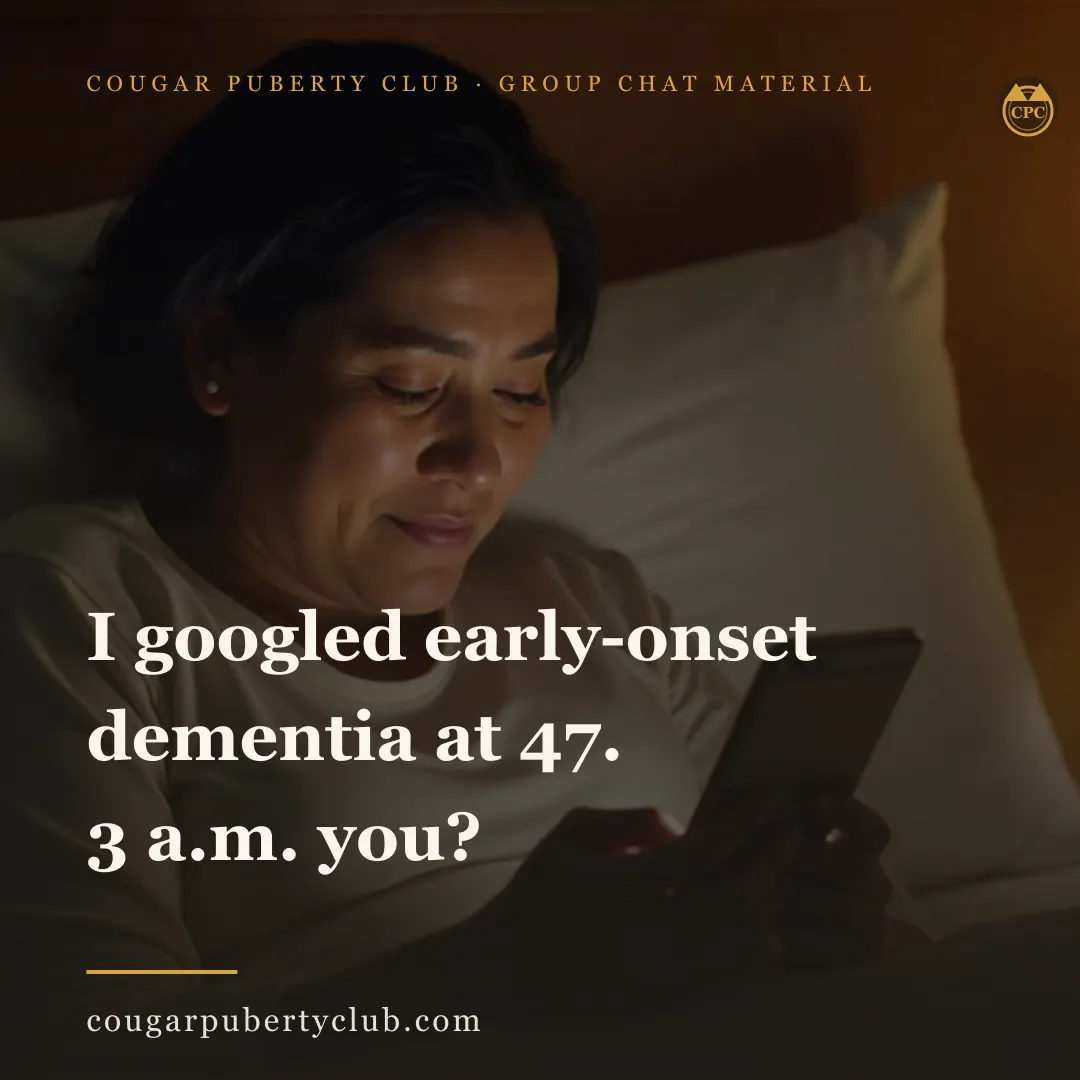
So: if you're here because you googled "early-onset dementia at 47" at 3 a.m. - you're not alone. The fear is common enough that we made a card for it (you'll see it at the bottom of this article, where the good stuff always lands). But here's the answer the 3 a.m. google doesn't give you: the fog is usually the fog. "Usually" is doing real work in that sentence, though - and the rest of this article is about the minority case, because the minority case is exactly the one that gets waved off as "just peri" until it's not.
The pattern test: waves vs. a slow tide
Before you get to any red-flag list, run the single most useful diagnostic you have: the pattern test. This is the thing no doctor appointment can do for you, because only you have the data.
Perimenopause fog waves. It fluctuates with your cycle, your sleep, your stress load. Bad luteal week? Your brain is soup. Post-vacation, slept nine hours, walked in the sun? Noticeably sharper. The fog follows the weather systems of your life. Established: OWH
Dementia symptoms progress. They develop and get worse over time, in a way that doesn't track your cycle or your sleep - a slow, steady tide, not a wave pattern. The NHS is specific that dementia symptoms vary by type but progress over time, becoming more pronounced as the condition develops Established: NHS.
So track it before you panic about it. Two weeks of notes: when does the fog hit, what does it look like, how does it correlate with your sleep and cycle? If your notes show waves, that's the peri signature. If your notes show a line that keeps sloping down regardless of what your body is doing - or if the person who lives with you says the notes don't match what they see - that's the conversation.
And one more layer of the pattern test, from Kim's story: the kind of forgetting changed before the amount did. Early on, the details she struggled with weren't words - they were work details, driving, the multi-step sequence of baking something she'd made a hundred times. That's not the colander shape. That's the flag shape. Reported: The Tennessean
The red flags that deserve a neurology conversation (not a shrug)
Here's the honest list, straight from the NHS's dementia symptoms guidance - tier-1, no vibes. These are the patterns that deserve an actual clinical conversation, promptly, whether or not you're perimenopausal:
1. Confusion about time and place - the familiar-route version. Forgetting why you walked into the kitchen is peri. Not computing how to get home from the grocery store you've been to for a decade is not. The NHS lists confusion about time and place among dementia symptoms Established: NHS. If a familiar route stops computing, or the time of day/date stops tracking, that's a conversation, not a joke.
2. Routine multi-step tasks falling apart. The peri version is autopilot fails - coffee grounds in the water reservoir, because the routine ran but the inputs were wrong. The flag version is losing the ability to sequence the routine at all: a recipe you've made for twenty years, the monthly bills, the medication schedule. Kim asked for help with baking - something she had always loved doing alone. That's not a word-slip. That's a familiar task becoming unfamiliarly hard Reported: The Tennessean, and difficulty concentrating and following through is on the NHS's dementia symptom list Established: NHS.
3. Language problems in a different shape. Word-finding - "the thing, you know, the kitchen strainer" - is the club anthem. The flag version is trouble following a conversation you'd normally follow, or your side of the conversation derailing in ways people notice. The NHS includes difficulty following a conversation and language problems among dementia symptoms Established: NHS. Same brain, different failure mode: retrieval vs. comprehension.
4. Personality change - the one the partner sees first. Perimenopause mood shifts are real, and we're not pathologizing the irritability or the 3 a.m. dread. But the NHS notes that early symptoms of some dementia types include personality changes and reduced sensitivity to others' feelings Established: NHS. The test is recognition: if your partner says "that's my woman, just crankier," that's peri. If they say "I don't recognize her, and it's not getting better," that's the version where you both go to the doctor.
Family history is the multiplier on all of this. Early-onset dementia runs in families in ways late-onset doesn't, and it's one of the strongest risk factors - Kim's grandparents went undiagnosed in rural Kentucky, and both her parents were later found to have dementia too Reported: The Tennessean. A parent or sibling with early-onset dementia doesn't mean your fog is dementia. It means the "it's just peri" answer deserves a second look, and your doctor should know the history before they opine, not after.
The 5 p.m. version of the joke that isn't funny
One more flag, because we have a specific relationship with it: the evening pattern. We have a whole franchise about the perimenopause witching hour - the 5 p.m. crash, the low battery, the "don't talk to me until the wine is poured" hour. That's real, and it's peri, and it's funny because it's shared.
There's a different evening pattern that isn't the joke: new, hard-to-understand behavior in the late afternoon or early evening - intense distress, agitation, confusion - that doesn't track your energy crash or your cycle. The Alzheimer's Society calls this sundowning, and it's a recognized behavioral pattern in dementia: sometimes a person with dementia will behave in ways that are difficult to understand in the late afternoon or early evening, becoming intensely distressed or agitated, potentially continuing into the night Established: Alzheimer's Society.
How do you tell the witching hour from sundowning? Same way you tell every flag from the fog: pattern, recognition, and whether it's new. The witching hour is a battery problem you've had for years, and a nap or a quiet hour fixes it. Sundowning is a new evening pattern of confusion and distress - and critically, it's often the family who notices it first, because it looks less like tiredness and more like a different person arriving after dinner. If that's what you're seeing in someone you love - or if someone is seeing it in you - that's the assessment conversation, not the "she's just exhausted" conversation.
How to ask for the investigation (the script)
The hardest part of Kim's story isn't the disease. It's that it took four appointments before anyone ordered a memory test - and it only happened because her husband sat in the room and asked, directly: "Can she get a memory test?" Reported: The Courier-Journal
That's the whole trick, and you can borrow it. Specific complaints get specific responses; vague ones get "it's just peri." Here's the script:
Instead of: "I'm so forgetful lately, is it my hormones?" Say: "Since [month], I've had [three concrete examples with dates]. I've tracked it for two weeks and it doesn't seem to track my cycle or my sleep. What would make you refer me for a memory assessment, and what would that involve?"
If you get "it's just perimenopause, it's normal": "I hear that, and I'd like to rule out the other things that affect memory before we land there - sleep, thyroid, medications, mental health. Can we check those? And can we set a cognitive baseline now, so if anything changes we have something to compare it to?"
That last line is the quiet superpower. A baseline isn't a diagnosis - it's a "before" photo. Nobody can tell you your brain is fine forever; a baseline tells you whether this is fine now, and it gives the next appointment a number instead of a shrug.
And if you're the one in the room watching someone you love get waved off: the second opinion is not disloyalty, and the referral is not drama. Ask for the records, ask for the referral to a neurologist or memory clinic, and keep asking until the specific question gets a specific answer. Kim's husband asked four times, in four rooms, before one said yes. Reported: The Courier-Journal
The family-advocate playbook: what the partner in the room should do
This is the part of Kim's story that becomes an action plan, because her husband did the quiet, unglamorous things that eventually broke the pattern - and none of them required a medical degree:
1. Go to the appointments, and sit where you can be seen. The advocate in the room changes the math. Her husband remembers sitting in that fourth exam room, the bad feeling in his gut, while she heard the same explanation for the third time Reported: The Tennessean. If you're the witness, you're not being pushy - you're being the memory the patient is worried about losing. We wrote the whole case for it: bring someone to the appointment.
2. Keep the timeline, not the adjectives. "She's been forgetful" is a vibe. "March: struggled to track details at work. June: two minor car incidents. August: asked for help baking a recipe she's made for years" is evidence Reported: The Tennessean. Write the dates down as they happen, while they're specific. The specific examples are what survive contact with a busy appointment.
3. Track the shape, not just the amount. What exactly is being forgotten? Words? Keys? Or routes, recent events, appointments, the steps of familiar tasks? The shape of the forgetting is the signal - and it's the difference between the colander and the flag.
4. One specific ask per visit. You don't need to argue medicine. You need one question that forces a decision: "Can she get a memory test?" "What would make you refer us?" "Can we see a neurologist?" A specific ask is hard to wave off. A general worry is easy to wave off.
5. Know that some people get waved off harder. Kim's husband is explicit about this: she's a Black woman, and the "you're hormonal" file opened faster and closed harder for her than it would have for a whiter, older, more 'typical' patient Reported: The Tennessean. If you're advocating for someone who doesn't fit the dementia "typical" picture - younger, Black, busy, capable - expect the dismissal to be louder, and bring your timeline anyway.
6. If it's not dementia, you've still won. Here's the part nobody says: a neurology referral that comes back clean is not a wasted appointment. It's the all-clear that lets her stop wondering at 3 a.m. It's the baseline for the future. The advocate's job isn't to prove dementia - it's to make sure the question gets asked by someone qualified to answer it.
The both/and ending
This article exists because two things are true at once, and the medical system keeps failing the second one:
Perimenopause brain fog is real, common, and for the vast majority of us, not the beginning of the end. Two-thirds of us report the memory complaints Established: OWH. The colander jokes are ours, and we get to keep them.
And early-onset dementia exists in our age window, it gets mislabeled as perimenopause, and the people it happens to deserve better than being told they're hormonal four times. The red flags are specific. The pattern test is free. The conversation script is above. The family-advocate playbook is above that.
If you're the woman at 3 a.m. with the phone glow: most nights, the answer is the fog. If the fog starts failing the pattern test - if it stops waving and starts sloping, if familiar routes and familiar tasks and familiar people start feeling unfamiliar - that's not the colander anymore. That's the conversation. Have it early. Have it with specifics. Have it with someone you love in the room.
That's the whole lesson of Kim's story: not that every fog is a flag. It's that the flag deserved a look years before it got one - and the look only happened because someone in the room asked for it, four times, until the answer was yes.
Read next: The perimenopause brain fog explainer for the full reassurance baseline, Should I Get an Alzheimer's Blood Test? for what the new tests can and can't tell you, and Some Things Are Peri. Some Things Aren't. for the wider both/and picture. If the fog has already caused a fall or a near-miss, the fall-risk stakes are the article to read before this one.