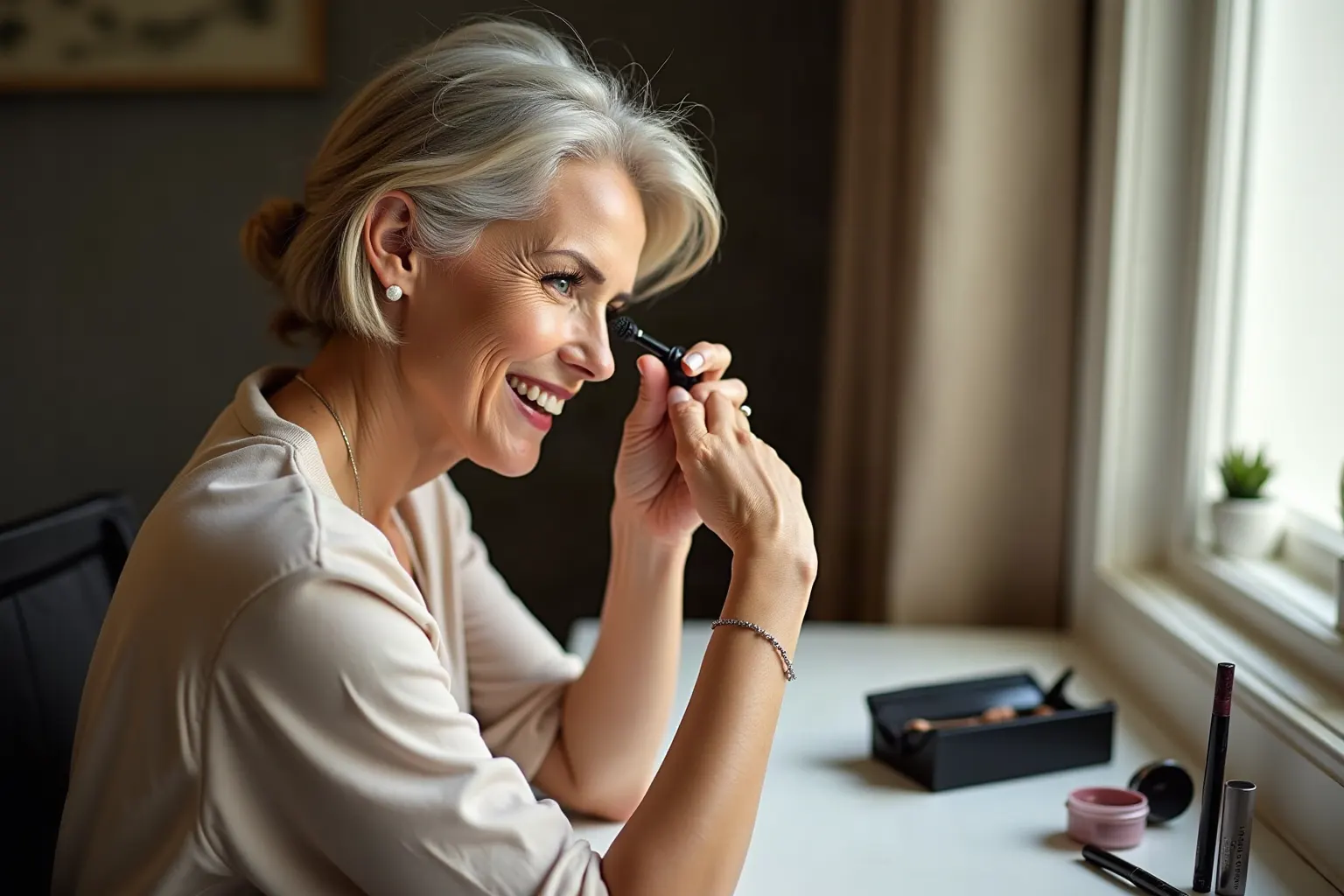
Your lashes were your best feature for thirty years. They curled, they held, they caught the light. You had a routine: curler, mascara, done. It worked every single day.
Then somewhere in your mid-40s, the routine stops working. The mascara doesn't lift anymore. There are tiny gaps along the lash line that weren't there last year. Your brows - which you've barely thought about since the 90s, when you plucked them into submission and they never fully recovered - are now fading from the tail inward, like they're slowly resigning.
And because women are excellent at blaming themselves, you will run through the suspects: the curler must be worn out. The mascara changed the formula. My technique is off. I'm scrubbing too hard.
Here's the plot twist: it's not the tools. It's the hormones. This is the face version of perimenopause hair loss - the part of the conversation that never makes the poster, because the poster is always about the scalp.
What's actually happening
Every hair on your body - including the two rows above your eyes and the ones on your eyelids - runs on the same system: a growth cycle where new strands replace old ones. Eyebrow and eyelash loss has a medical name, madarosis, and it happens when you're losing hair faster than your follicles can replace it Established: Cleveland Clinic.
Here's the normal baseline: it's perfectly ordinary to find a few lashes on your pillow in the morning, or a few hairs on the washcloth after washing your face. The NHS puts overall daily hair shedding at 50 to 100 hairs a day Established: NHS. The problem is when "a few" becomes "noticeably more," and the gaps stop closing.
And this is where perimenopause walks in. During the transition, your ovaries produce less estrogen and your hormone levels fluctuate - up and down, not a clean decline Established: Cleveland Clinic. Your follicles run on those hormonal signals. When the signals change, the cycle changes: hair that used to grow long and stay put spends less time growing, and the new stuff comes in finer.
Same mechanism as the scalp. Different address. That's why the hair-loss article you read last month didn't prepare you: it was all about the crown, and your face was doing it first.
The 'I blamed my eyelash curler' beat
There's a pattern here worth naming, because it's doing a lot of quiet damage: women blame tools and technique for what is actually hormones.
A personal essay that did the rounds this summer nailed it - a woman whose lashes were her best feature noticed the mascara wasn't lifting anymore, saw tiny gaps, and spent weeks blaming the curler, then her own technique, before discovering thinning lashes are a peri symptom. The twist: her daily waterproof mascara and the vigorous scrubbing required to remove it (she lived in Florida humidity; she needed the waterproof stuff) were actively pulling out the weaker follicles. Switching to a tubing mascara and gentler removal is where her recovery started.
The curler is this era's "I blamed stress." It's the wrong suspect, and it's costing you hair.
The gradual vs patchy rule (this is the important part)
Here's how you tell the boring-but-normal from the see-a-doctor version:
Gradual, symmetrical, quiet - the hormonal track. Both brows fading slowly, lashes thinning evenly, no pain, no redness, no patches. Annoying, real, and almost certainly the perimenopause/aging track. Nothing dangerous; a doctor visit is optional if you want reassurance or to rule out the boring stuff.
Patchy, sudden, or angry - the doctor track. Bald spots in the brows, a chunk of lashes gone from one spot, or hair loss plus pain, redness, flaking, or skin discoloration near your eyes. Cleveland Clinic's guidance is direct: see a healthcare provider or eye care specialist as soon as you notice hair loss - especially with symptoms like pain or skin discoloration Established: Cleveland Clinic. The NHS says a GP can often tell you what's causing hair loss just by looking, and lists temporary causes like illness, stress, weight loss, and iron deficiency Established: NHS. The conditions women actually worry about - thyroid issues, alopecia areata, blepharitis - all announce themselves with patchiness or skin changes, which is exactly why the gradual-vs-patchy rule works.
One more NHS note worth its weight: get the cause identified before you hand money to a commercial hair clinic Established: NHS. The diagnosis is free. The commission is not.
What actually helps (the honest shelf)
No miracle claims here. The NHS is blunt that no treatment is 100% effective Established: NHS, so let's rank what's real:
1. Stop yanking on them. This is the highest-leverage, zero-cost fix. Gentle removal, no scrubbing, no tugging at the lash line. Treat your brows and lashes like fragile cargo - they already are.
2. Tubing mascara. Not a medical treatment - a tactical weapon. It comes off with warm water and light pressure instead of 30 seconds of furious rubbing. If your routine is the accomplice (see: the curler beat above), this removes the accomplice.
3. The serum reality check. There are two different products hiding under "lash serum." The prescription-strength one is a real medication - it can grow lashes, it has real side effects, and it only works while you use it. That's a clinician conversation, not an Amazon order. The over-the-counter brow and lash serums are cosmetics: peptides and marketing, treat them as skincare and expect cosmetic results at best. Neither is a substitute for figuring out why the hair is leaving.
4. The castor oil reality check. The group chat swears by it. The evidence doesn't. Castor oil is a fine, cheap, harmless conditioner for the hairs you still have. It is not restarting follicles. If it feels like it's working, you're probably just looking harder.
5. Eyebrow micropigmentation. If the brows are genuinely gone and you want them back without daily pencil work, permanent make-up is a legitimate, NHS-listed option - it's literally a tattoo that looks like short eyebrow hairs Established: NHS. Get a good artist; brows are load-bearing for the whole face.
**6. Know what's not for your face.** The scalp-pattern-hair-loss treatments - minoxidil and friends - are for the scalp. That's not a brow serum, and your eyes are not a test site Established: NHS.
The bottom line
Gradual thinning on both sides, no other symptoms: that's the peri track, and it's mostly a management problem, not a medical one. Patchy, sudden, painful, or angry-looking: that's the doctor track - and Cleveland Clinic, NHS, and the dermatologists all point the same way.
And if you're currently staring at your eyelash curler with suspicion: it's not you, and it's not the tool. Your hormones are editing your face, one lash at a time, and now you know the difference between the version that's normal and the version that needs a professional.
Want the practical layer? Our perimenopause skincare guide covers the barrier-repair basics your whole face needs right now, or browse tubing mascaras and brow basics if you want a starting point. And if the scalp version of this conversation is also happening to you: why your hair just changed the rules.