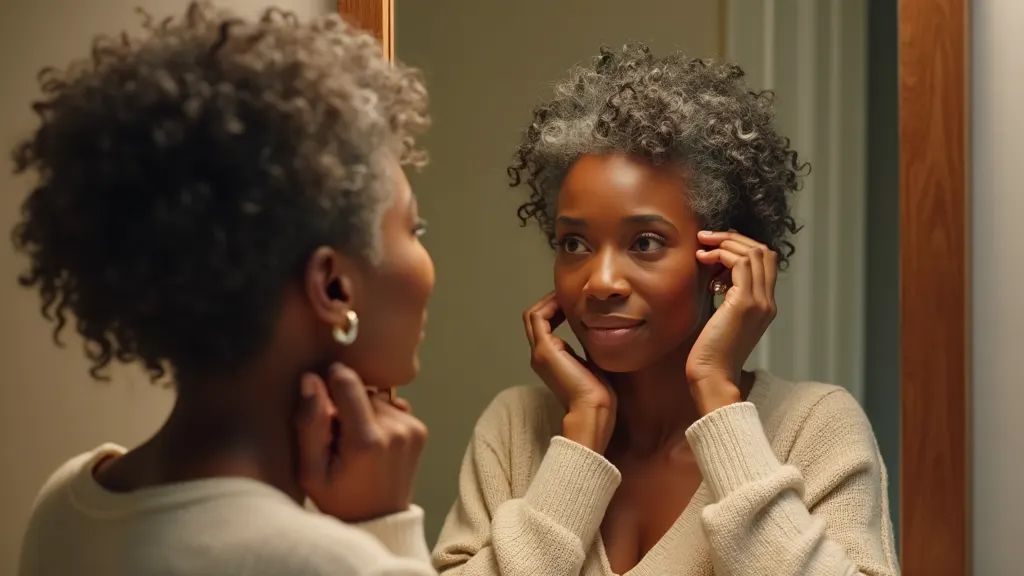
You've had the same hair for 40 years. You know what it does. You know which products work. You know how it reacts to humidity, to washing, to air-drying, to everything.
And then one day, it has a different personality.
This is not your imagination. This is not a product failure. This is perimenopause, and it absolutely changes your hair.
The moment that usually tips women off: they're standing in front of the bathroom mirror, holding a brush full of more hair than they expected, thinking wait, is this normal?
It is. And here's why.
What's actually happening
Estrogen does a lot more than regulate your cycle. It affects your skin's collagen production, your hair's growth cycle, and the oil glands on your scalp Established: The Menopause Society. When estrogen levels start fluctuating during perimenopause, your hair gets the memo, and it does not appreciate the memo.
Three things tend to happen, sometimes all at once:
1. Hair thinning or shedding. Estrogen helps keep hair in its growth phase longer. When estrogen drops, more hairs shift into the shedding phase at the same time. This is called telogen effluvium, and it's the most common perimenopause hair change. You're not going bald; you're shedding faster, and the new growth might be finer than before.
2. Texture changes. Straight hair starts to curl. Curly hair goes straight. Smooth hair gets coarse. Coarse hair gets wiry. Nobody knows exactly why this happens, but the leading theory is that hormonal shifts affect the shape of the hair follicle itself, and the follicle's shape determines the hair's texture. If the follicle changes shape, the hair that grows out of it changes texture. It's not magic. It's geometry.
3. Graying accelerates. Gray hair is caused by a loss of melanocytes, the pigment-producing cells in hair follicles. These cells naturally decline with age, but hormonal changes can accelerate the process. If you feel like you found five new grays this week, you might be right.
The "wait, is this something worse?" question
Hair changes in perimenopause are almost always benign. But some things deserve a clinician:
- Patchy hair loss: circular bald patches could be alopecia areata, not perimenopause
- Scalp changes: redness, scaling, pain, or visible inflammation
- Rapid, dramatic shedding: if you're losing clumps, not just more than usual in the brush
- Other symptoms together: hair changes plus fatigue, weight changes, or skin changes could indicate a thyroid issue, which also becomes more common in midlife
When in doubt, ask. The answer is usually "just perimenopause," but asking is free.
What actually helps (no miracle claims)
Let's be honest about what you can and can't control:
Things you cannot control: Whether your hair texture changes. Whether you gray. When these things happen.
Things you can influence: How healthy your scalp is. How you treat the hair you have. Whether nutritional gaps are making things worse.
The evidence-backed basics
Protein and iron. Hair is protein. If you're not eating enough, your body prioritizes your organs over your hair. Iron deficiency can cause shedding that looks exactly like perimenopause shedding Established: NHS. A simple blood test can tell you if either is an issue.
Gentle handling. Perimenopause hair is often more fragile. This is not the moment for aggressive brushing, tight ponytails, or daily heat styling. Treat it like it's going through something, because it is.
Scalp care. A healthy scalp grows healthier hair. If your scalp is dry (common in perimenopause, since estrogen affects oil production), a moisturizing scalp treatment can help. If it's suddenly oily, a clarifying shampoo might balance things out.
The right products for the hair you have now. This is the hardest adjustment. The products that worked for your old hair may not work for your new hair. If your texture changed, your product routine probably needs to change with it. This isn't product betrayal; it's product evolution.
The texture-change moment
Here is a scene that plays out in bathrooms across the country: a woman in her 40s, holding a blow dryer, looking at her hair, thinking what even are you now?
The answer is: your hair, in its perimenopause era. It's not broken. It's not betraying you. It's responding to a new hormonal landscape the only way it knows how.
For some women, this means learning to style curls they never had before. For others, it means accepting that the sleek blowout of their 30s is now a texturized wave of their 40s. For many, it means a shorter cut because the density changed and longer hair feels too thin.
All of these are valid. None of them are a failure.
The gray hair thing
You are allowed to feel whatever you feel about going gray. You are allowed to cover it. You are allowed to let it come in. You are allowed to do one for five years and then change your mind.
What is not required: feeling ashamed of gray hair. What is also not required: pretending you love it if you don't.
Gray hair is not a verdict on your age, your attractiveness, or your relevance. It is a pigment change. That's it. How you feel about it is personal, and there is no wrong answer.
Is this why women of a certain age cut their hair short?
Every few months the internet asks the same question with a laugh attached: why do women over 40 all seem to chop their hair off at the same time? The answers on offer are usually "they gave up," "the stylist talked them into it," or the anti-aging trope that short hair is supposed to be tidy and serious. For a lot of women, none of those is the reason.
Here is the part almost nobody says out loud: for a lot of women, the chop is not a style decision. It is a sensory exit.
When your neck runs hot and your scalp itches, long hair stops being hair and becomes something you are in constant physical contact with. You wake up hot and sweaty with strands clumped ropey against your skin. You put it up, and the updo still touches you. A ponytail does not create enough distance. So you cut it. Not to look younger. To stop feeling it.
The trigger is not your hair misbehaving. Hot flushes and night sweats are your body's thermostat misfiring, and they can leave your skin damp and clammy Established: NHS. When your skin is hot, sticky, or wet, hair against it stops registering as neutral and starts registering as sandpaper. Hair is simply the last layer you can take off.
Two honest distinctions, because this is not the same complaint wearing a different hat.
- Sensory exit versus density change. The density and texture shift covered above (under "What's actually happening" and "The texture-change moment") is about how your hair looks: finer, thinner, empty at the ends. The sensory exit is about how your hair feels. A woman with no thinning at all can still cut it because of touch, and a woman shedding heavily may keep it long because touch is not her trigger.
- Sensory exit versus the "mature woman" haircut. This is not the makeover trope. It is not about looking tidy, serious, or younger. It is closer to taking off a scratchy sweater you have been wearing for six weeks.
And one thing this is not: a diagnosis, or a claim that short hair treats anything. If your scalp itches along with redness, scaling, pain, or bleeding, or if you are losing clumps of hair rather than just more than usual in the brush, that is a clinician conversation, not a haircut Established: NHS.
If you cut your hair because you could not stand how it felt on your skin, you did not simply follow a trend. You solved a problem nobody had named for you. That is the whole thing.
The bottom line
Your hair changed because your hormones changed. This is normal. This is common. This is not a personal failure and it is not a sign that you are "letting yourself go."
What helps: treating the hair you have now with the right care, checking for nutritional gaps if shedding is significant, and giving yourself permission to be confused about how to style texture you didn't used to have.
Hair is one more surface the cougar puberty rewrite touches, and one of the few where the honest fix is patience plus the right products rather than a prescription.
Your skin has been through the same thing. It's not just you; it's the whole surface area.