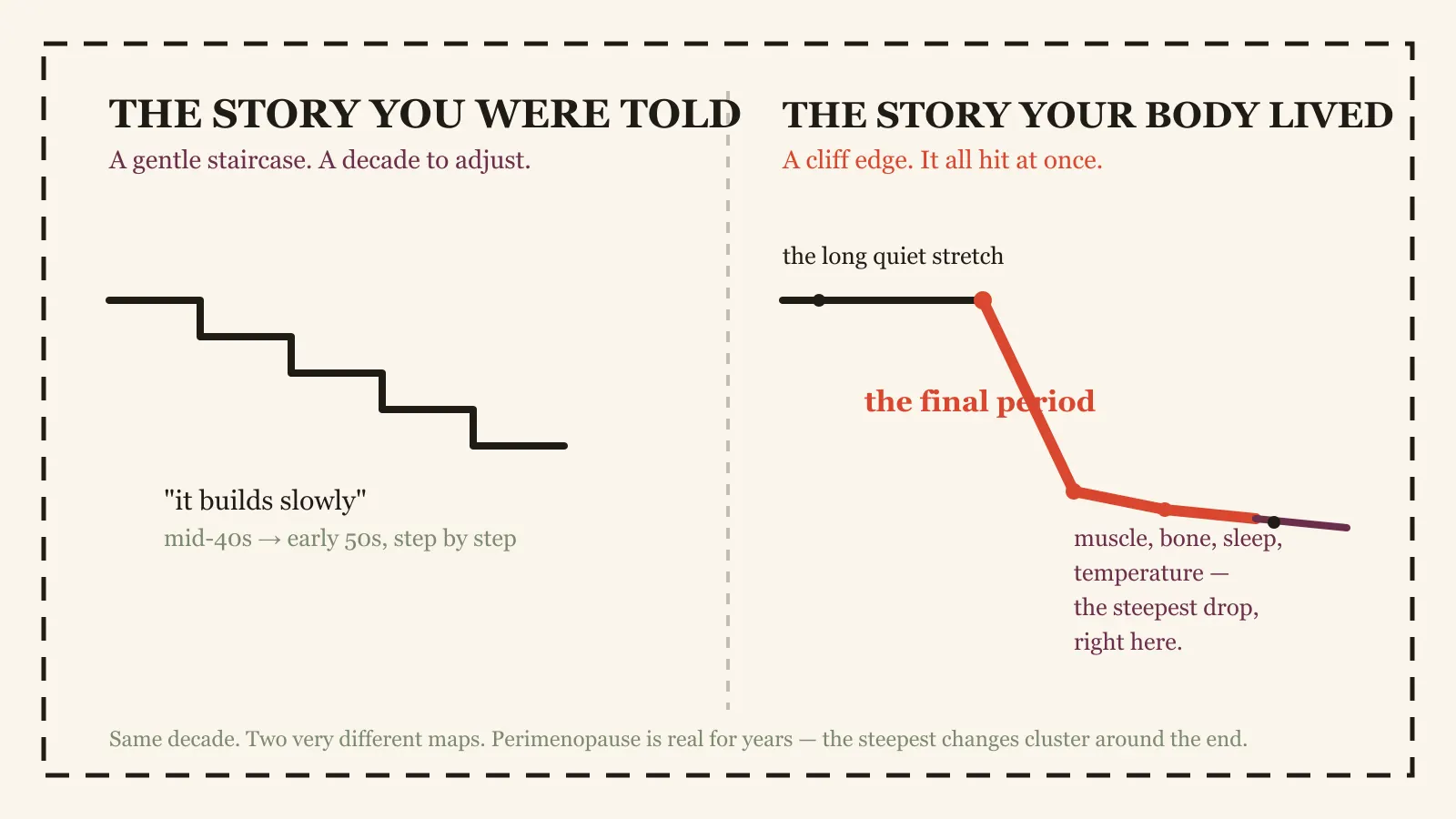
There's a version of this story where you get a graceful staircase: perimenopause arrives in your mid-40s, lowers you gently through a decade of adjustments, and by the time your periods stop, you're already acclimated. That's the pamphlet version. That's what we're all told.
And then there's the version that shows up in group chats at 11pm: "I thought I'd have years to get used to this. Why did everything change at once?"
Both versions have the same word in them – perimenopause – but they describe two different shapes. One is a slope. The other is a cliff. And the evidence says most of us are living on the cliff while reading the slope pamphlet.
This is not a metaphor you have to take on faith. It's the actual shape of the transition, and understanding the shape is the single most useful thing you can do with this information. Because the women who know they're on a cliff do different things than the women who are still waiting for the staircase.
The story you were told: a staircase
The standard briefing goes something like this: perimenopause is the years-long transition before menopause, hormones gradually decline, symptoms gradually appear, and you have time to adjust. Perimenopause does typically last 2 to 8 years, averaging about four Established: Mayo Clinic. Cleveland Clinic agrees: the average is about four years, and it can last up to eight Established: Cleveland Clinic.
So the duration part of the pamphlet is true. It's the shape that's wrong.
A staircase implies the descent is spread evenly – a little less estrogen every year, a little more symptom every season, nothing that should catch you off guard. But that's not how the transition actually works. The Menopause Society's STRAW+10 staging system – the consensus staging framework for reproductive aging – defines the transition by bleeding-pattern changes with distinct stages: an early transition marked by cycle-length shifts, and a late transition marked by skipped cycles and gaps of 60 days or more Established: The Menopause Society. Hormone levels fluctuate rather than declining in a straight line Established: Cleveland Clinic.
Stages, not a slope. And stages have edges.
The story your body lived: a cliff
Here's what the staging map actually looks like for most women: a long early stretch where things flicker – a weird cycle, a warm night, a mood that doesn't match the day – and then a late-transition window around the final period where the steepest changes cluster.
The big four:
Muscle. Muscle aches, weakness and joint pain are common around menopause – more than half of women report musculoskeletal pain, and women are about twice as likely to have joint pain and stiffness around menopause compared with before it Established: NHS MSK leaflet. The coverage that calls this "muscles falling off a cliff" isn't exaggerating the experience; it's naming the drop-off.
Bone. This is the steepest and most consequential one. Bone loss is most rapid in the first few years after menopause, when the protective effect of estrogen is gone Established: NHS. The window where bone density is decided is not spread across the whole decade – it's concentrated right around the final period. (That's why the companion read here is the bone-density explainer: the DEXA conversation is a now-conversation, not a someday-conversation.)
Sleep. Sleep problems are among the most commonly reported perimenopause symptoms Established: NHS, and they interact viciously with everything else: poor sleep worsens mood, focus, and the sense that you're falling apart. The 3am awake-staring-at-ceiling era isn't a side quest – it's one of the cliff's main features.
Temperature regulation. Hot flushes and night sweats are the body's thermostat losing its grip Established: NHS, and they're the symptom everyone expects – which makes the others the ambush. The cliff is not one symptom. It's the whole system renegotiating at once.
And underneath all four: the body-composition shift – a greater tendency to carry midsection fat after menopause, including visceral fat Established: Endocrine Society. Same calories, different body, and the jeans are confused.
None of this is evenly distributed across the decade. It clusters at the end. That's the cliff.
Why nobody warns you about the cliff
Because the women being warned are the ones who already know the shape. The people writing the pamphlets made it through, and they write the staircase version because it's reassuring – and because "you will be fine for years and then everything changes at once" is a worse marketing message than "a gentle transition, gradually."
But the silence has a measurable cost. In the Flo Health x Mayo Clinic survey of 7,640 U.S. women 35 and older, 34% could not identify their reproductive stage – and confusion peaked among women 40 to 44, where 42% didn't know whether they'd entered perimenopause at all Established: Flo Health / Mayo Clinic. Many stayed uncertain precisely because their cycles were still largely regular or their symptoms overlapped with other conditions Established: Flo Health / Mayo Clinic.
Read that again: the women who were in the transition couldn't tell they were in it. That's not a knowledge gap, it's a map gap. You can't brace for the cliff you weren't told exists.
The shape changes what you do
Knowing the transition is a cliff changes your decisions in three practical ways:
1. You stop waiting for a "real" diagnosis. The Flo/Mayo data shows women stay uncertain because their cycles are still regular-ish – but STRAW+10 stages the transition by bleeding-pattern changes, not by a blood test or a magic symptom threshold Established: The Menopause Society. If the flickering has started, the transition has started. You don't need to hit "official" to act.
2. You do the steep-window work early. The bone and muscle windows are the ones right around the final period Established: NHS. Strength training, bone-density awareness, the DEXA conversation – these pay off most when they start before the steep part, not after you're already at the bottom. (This is exactly where the get-bigger rebellion comes in: muscle as armor, on purpose, ahead of the cliff.)
3. You recognize the cluster when it arrives. If muscle, bone, sleep and temperature all start moving at once, that's not a personal failing or a bad run of luck – it's the late-transition cluster doing what the late-transition cluster does. The correct response isn't "what's wrong with me," it's "where am I on the map, and what's the highest-leverage next step?"
The staircase was never coming
Here's the freeing part: you weren't supposed to have a graceful decade of adjustment. That was the pamphlet. The actual transition is longer than the dramatic part, and the dramatic part is steeper than anyone admits – symptoms overall can last on average 7 to 9 years Established: NHS, with the steepest changes clustered around the final period.
You are not falling behind a schedule nobody sent you. You are standing at the edge of the shape that was always there.
The cliff is real. But knowing it's a cliff – and not a personal failure – is the difference between being blindsided and being prepared. And prepared women do different things.
So: where are you on the map? And what are you going to do before the steep part, instead of after it?