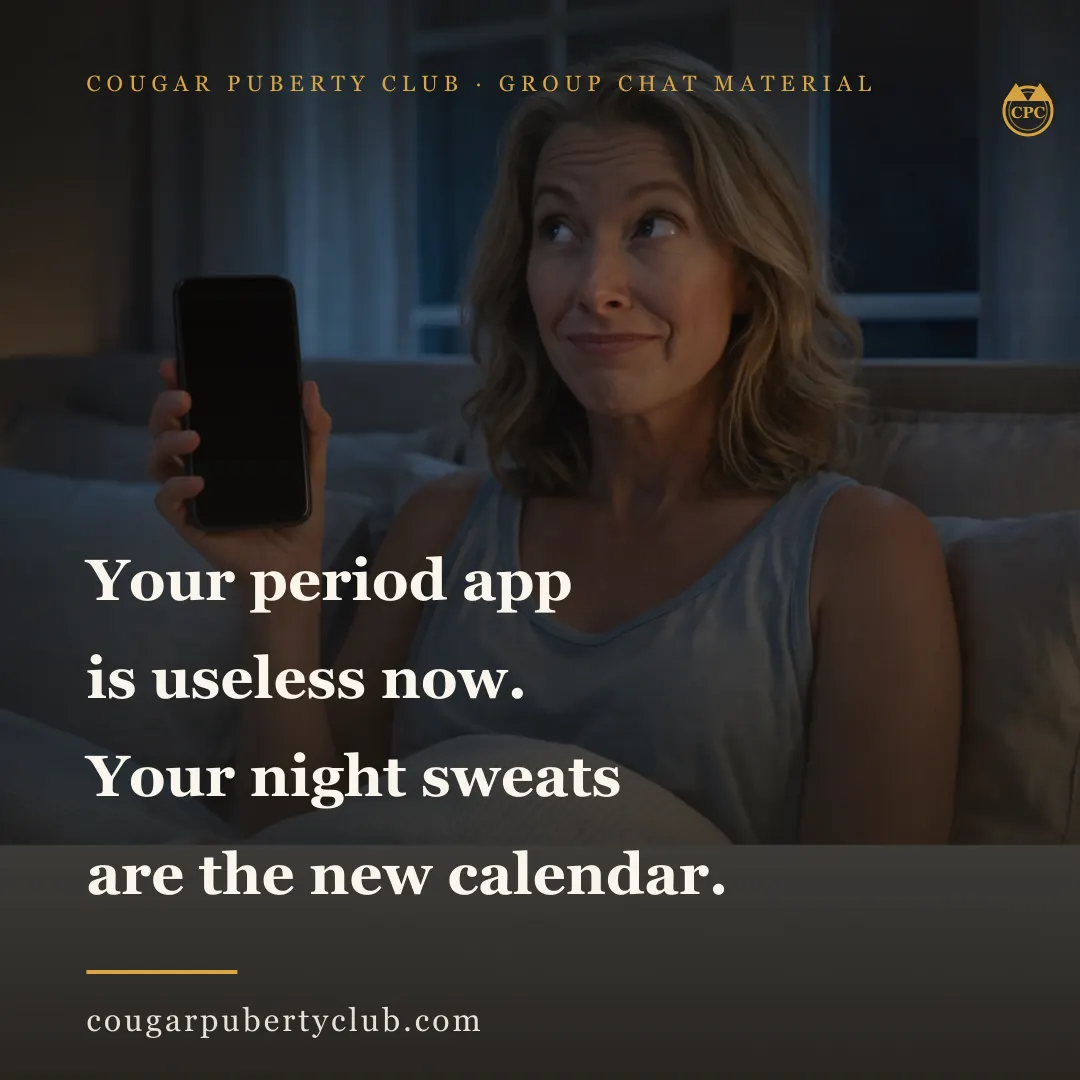
For ten years, that little notification was an oracle. Your period starts in 3 days. You planned the week around it. You trusted it like a train schedule.
Then, somewhere in your mid-40s, the oracle went vague. Your period is expected around this time. Then: Any day now. For three weeks straight, the app has been telling you your period is "any day now," and your period has been telling the app to go sit down.
Here's the thing nobody warns you about: the app isn't broken. Its source data quit.
And here's the thing women are teaching each other in the group chat: your body kept its own calendar the whole time. Night sweats aren't just the 3 a.m. ambush. For a lot of us, they're the new period predictor.
Why the app lost the plot
Period trackers work on a simple bet: learn your average cycle length, project the next start. That bet holds for a decade and then perimenopause walks in and changes the terms.
Changing menstrual cycles, longer, shorter, heavier, lighter, skipped, unpredictable, are often the first sign of the transition Established: ACOG; Established: OWH. Every erratic cycle corrupts the app's model. It keeps revising, the confidence window keeps widening, and eventually the notification reads like a horoscope: something is coming, in a window, probably.
That's not a failure of discipline on your part. You didn't log badly. The tracker's entire premise, the past predicts the date, is the exact thing perimenopause deletes.
The body kept a calendar anyway
Here's what the apps missed while they were recalculating: hot flashes and night sweats are the same mechanism, vasomotor symptoms, the thermoregulatory system's confused protest, and night sweats are just hot flashes that happen during sleep Established: The Menopause Society; Established: MedlinePlus.
And in perimenopause, hormones don't decline in a straight line. They fluctuate, up and down, up and down, which is exactly why the symptoms feel like ambushes Established: Cleveland Clinic.
Put those two facts together and you get the discovery women keep making out loud to each other: the sweat clusters track the cycle. The nights you wake up soaked, the 3 a.m. wake-ups, the week of terrible sleep, for many women, they bunch up in the days before a period, when estrogen and progesterone take their pre-period drop. The VMS cluster lands, and the period follows. Not always. Not for everyone. But often enough that the group chat has noticed.
That's the body-signal calendar. It's the tracker you reverse-engineered from your own thermoregulation, because the app's model broke and your body's never stopped reporting.
How to build yours (it's boring, that's the point)
No apps required. A notes file, a paper calendar, the back of a receipt, all of it works:
- Log the sweat clusters, not single warm nights. One hot night is a Tuesday. Two or three nights in a row where you wake up soaked, or the sheets need changing, is a cluster.
- Log when the period actually lands. Even when the app guessed wrong, especially then. The app's failure is your data point.
- Log sleep and mood around the clusters. Night sweats and sleep disruption travel together, and the mood shift is often part of the same pre-period package Established: OWH.
- Give it two or three cycles. Then look for your window: "the cluster usually lands about a week out" or "mine hits right before, every single time." The answer is allowed to be "I don't have a pattern", that's a finding too.
The point is not precision. The point is that you get to know your body's version of the forecast, instead of refreshing an app whose data is now historical fiction.
The honest limits (no, seriously)
The body-signal calendar is a pattern, not a promise:
- It is not birth control. If cycle timing matters for pregnancy prevention, an app was never the right tool, and neither is a sweat cluster. That conversation is for a clinician.
- It is not a diagnosis. It's a personal observation, and observation is not medicine. If anything about your cycle or your symptoms is worrying you, that's what the clinician is for.
- It won't work for everyone. Some women have no period-linked VMS pattern at all. Not having one doesn't mean your night sweats aren't real, it means your body has a different rhythm.
The part where it's NOT the peri calendar
Night sweats are common in the transition, but they don't belong to perimenopause exclusively. Medicines, anxiety, low blood sugar, alcohol or drug use, and other conditions can cause them too Established: NHS.
The body-signal calendar is a nice idea. These are the lines where it stops being cute:
- Night sweats regular enough to wake you most nights, or drenching enough to soak the bedding, worth an assessment, not just a shrug Established: NHS.
- Night sweats with fever, cough, diarrhea, or unexplained weight loss, that's the red-flag combo. See a clinician Established: NHS.
- Very heavy bleeding, bleeding between periods, or any bleeding after a year without a period, ob-gyn conversation, today Established: ACOG.
The calendar is a signal. The red flags are the ones that point somewhere else entirely, and they deserve real attention, not a prediction model.
The new calendar is you
The app lost its source data the day your cycles stopped cooperating. Your body never stopped reporting, it just switched channels. The night sweats aren't only a nuisance. They're the bulletin.
So log the clusters. Notice the pattern. Laugh about it in the group chat, because every single woman in there has an app that says any day now and a body that knows better.
Your period app is useless now. Your night sweats are the new calendar.
Read next: the full explainer on what night sweats mean and when they're a red flag: Waking Up Soaked at 3 A.M.. And the deeper sleep work: Perimenopause Sleep Troubleshooting.