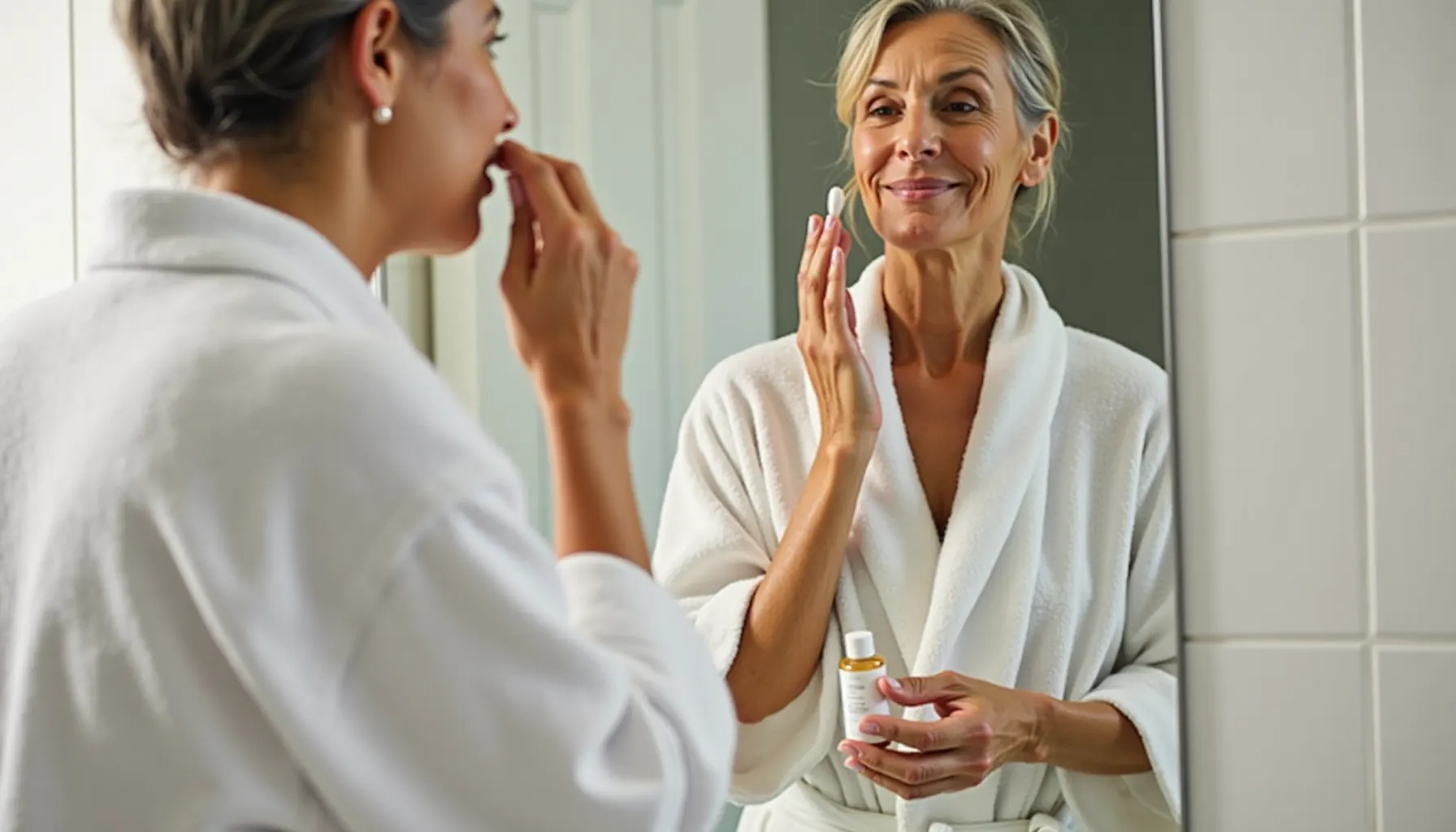
You know the moment. You're standing at the bathroom mirror, 37, 38, 39, somewhere in the neighborhood, and your skin looks… fine. Not wrinkled. Not broken out. Just flat. Like someone turned down the brightness on your face while you weren't looking.
You slept okay. You drank water. Your routine hasn't changed. And yet the skin that used to bounce back from a late night, a bad flight, a regrettable amount of wine, now just… stays. Slightly crepey at the jaw. Dull across the cheeks. Tighter in new places, oilier in others.
Before you add another serum to the cart: this is not a product failure, and it is not your imagination. For a lot of women, it's one of the first visible clues that perimenopause has entered the building, even in the late 30s, when nobody told you the building was on the tour.
What's actually happening under there
Estrogen does a lot more than run your cycle. It's also a skin operator: it helps maintain collagen (the structural protein that keeps skin firm), supports hydration, and keeps skin elastic Established: Climacteric 2022.
During perimenopause, estrogen doesn't decline in a tidy straight line. It fluctuates: up and down like a rollercoaster, as your ovaries start producing less Established: Cleveland Clinic. Skin is sensitive to those swings. The result is the exact thing you're seeing in the mirror: less bounce, less glow, more texture, and a dryness that your old moisturizer suddenly can't keep up with.
Here's the part that catches women off guard: perimenopause can begin as early as your mid-30s Established: Cleveland Clinic. It doesn't wait for a 50th birthday party. And skin changes are often one of the quiet early clues: they show up before the hot flashes and the cycle chaos, so you blame your skincare, your sleep, your age, anything except the thing that's actually happening.
The evidence backs the "your face is changing" feeling. A 2022 review in Climacteric, the journal of the International Menopause Society, describes menopause accelerating skin aging through estrogen loss, and notes collagen can drop by roughly 30% in the first five years after menopause, then keep declining more slowly Established: Climacteric 2022. That's the "bounce" leaving the building. It's real, it's measurable, and it is not your fault.
Is it aging, or is it your hormones?
This is the question few of us ask out loud, and it's the one that changes what you do next.
Skin changes in the transition get read as ordinary aging by default, because "I'm just getting older" is a simpler story than "my hormones are shifting." An October 2026 global survey funded by Galderma (a company that sells injectable skin treatments) found that 56% of women first put menopause-related skin changes down to aging, while only 29% connected them to menopause, and 70% had bought anti-aging products for changes that were hormonal (Industry-funded survey: Galderma, Oct 2026). Treat those numbers as a funder-branded signal, not neutral evidence: it's marketing research from a company with a commercial interest in naming a "menopausal skin" category. But the pattern it describes matches what women report, and it's a useful mirror for your own face.
So how do you tell them apart? Three tells, no lab test required:
- The timing. Aging drifts: slow, uniform, boring, a line deepening over years. Hormonal skin change often arrives as a step, a shift over weeks to months rather than a decade.
- The company it keeps. If the dullness showed up alongside irregular cycles, disrupted sleep, hot flashes, a mood shift, or new dryness elsewhere, that cluster points to the transition rather than the calendar.
- The texture of it. Hormone-driven change tends to bring crepiness, stubborn dryness your old moisturizer can't touch, and slower healing all at once, rather than one isolated complaint.
None of this is a diagnosis. It's a set of clues that make the question worth asking, which is the whole point of naming it.
And the honest handoff, because it matters more than the label: skincare and daily SPF are the first and best move, worth doing whatever the cause. The clinician conversation is the next one, especially if skin is riding along with other symptoms. No cream and no injectable reverses hormone-driven collagen loss. You can support the skin you have. You can't buy back the estrogen it lost.
What's fixable vs. what's just aging
Here's the honest split, because the skincare aisle would prefer you not have it:
Fixable. Sun damage is the single biggest controllable factor in skin that looks older than it should. UV rays literally break down elastin, the fibers that let skin snap back Established: Cleveland Clinic. Daily broad-spectrum SPF 30+ is the closest thing skincare has to a time machine, and it's the most boring purchase you'll ever make. Moisturizer matters too: your skin produces less oil in your 40s, and dry skin reads as dull skin Established: Cleveland Clinic. A gentle cleanser plus a moisturizer with ceramides or hyaluronic acid is not glamorous; it is effective.
Fixable, with patience. Retinol is the active with actual evidence behind it for restoring elasticity and thickening collagen, but perimenopause skin gets irritable fast, so start low, start slow, and expect a dry-and-flaky settling-in phase Established: Cleveland Clinic. This is the "trust the boring stuff for six months" category.
Not fixable with a jar. Hormone-related collagen loss. No cream reverses it, no matter the price tag or the celebrity attached to it. And anything that promises to "balance hormones" topically is lying to you: skincare does not balance hormones. Our perimenopause skincare guide walks through what's worth your money and what's pure markup, or if you just want a starting point, here's a plain search link to perimenopause skincare basics.
Also in the fixable column, annoyingly: sleep, water, and stress. They won't reverse collagen loss either, but chronic short sleep and dehydration make dullness worse, and they're the free part of the routine.
The hormone therapy conversation
If skin changes are your only symptom, skincare and SPF are the first moves, not hormone therapy. But if you're also dealing with sleep disruption, hot flashes, mood shifts, or cycle changes, skin is worth mentioning when you talk to a clinician, because it's often part of the same hormonal picture.
A note on expectations: no one should start hormone therapy for skin alone, and a clinician is the person to weigh your symptoms, your history, and what's actually bothering you. The conversation is free. The guesswork isn't.
When it stops being a skincare problem
Most late-30s dullness is normal transition stuff. But some changes deserve a clinician, not a serum:
- New moles, changing moles, or sores that don't heal: this is never a product problem; it's a dermatologist conversation, full stop
- A sudden, dramatic change in skin texture or color over weeks, not months
- Skin changes paired with fatigue, weight changes, or heavy hair shedding: worth asking about thyroid and iron, which also get chatty in midlife
- Pain, redness, or flaking that burns rather than just feels dry
When in doubt, ask. The answer is usually "this is normal, here's how to handle it," but asking is free and guessing is expensive.
The bottom line
Your skin stopped bouncing back because your hormones changed the terms of service, and for many women, that starts earlier than anyone warned them. It's not a product failure, it's not aging-you-did-to-yourself, and it's not the beginning of the end. It's the beginning of a different skincare era: SPF every day, gentler everything, boring moisturizer that actually works, and honest expectations about what a cream can and can't do.
Related: Perimenopause symptoms: the complete list · Perimenopause skincare: what your skin is doing & what helps · Why your hair just changed the rules · The skincare topic hub