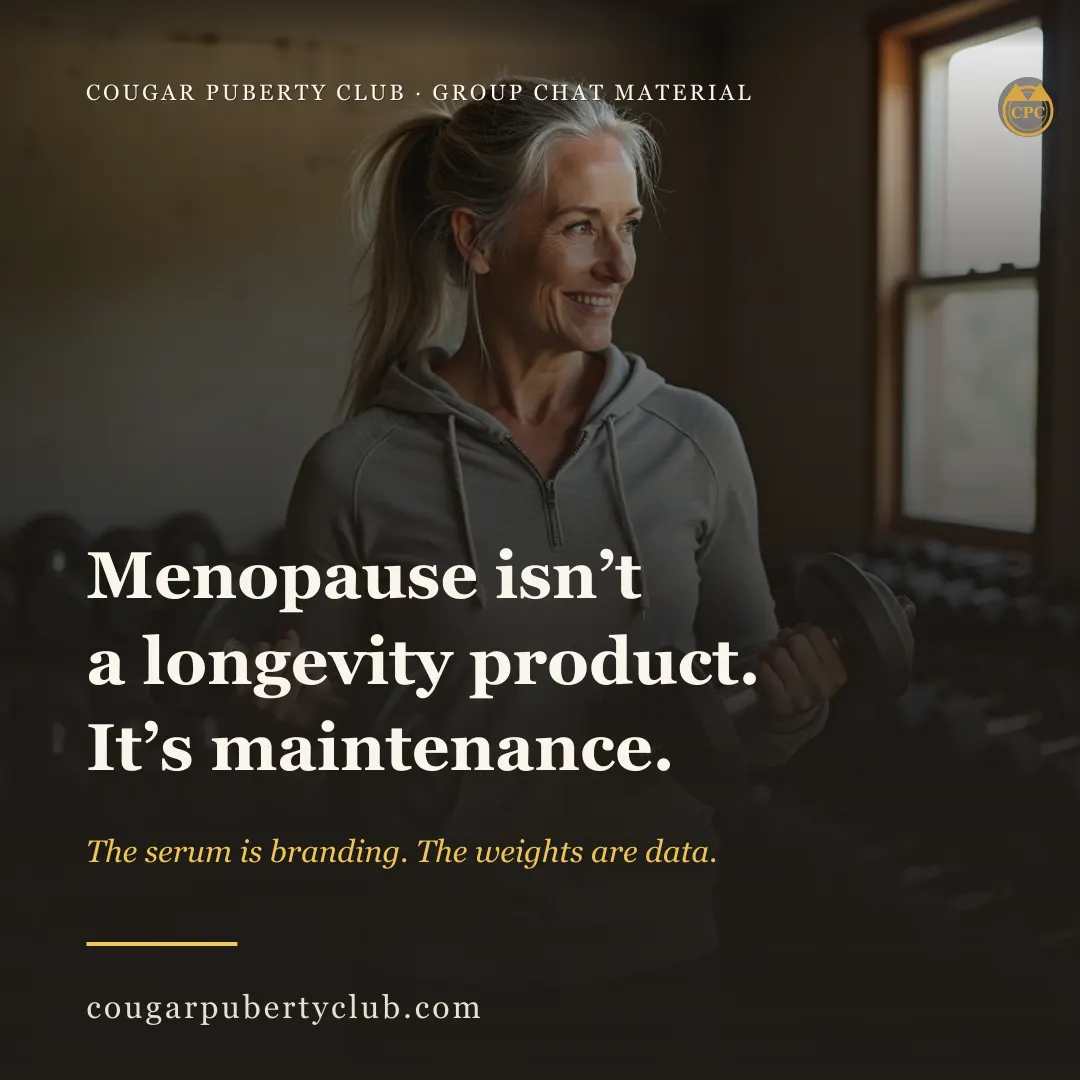
Somewhere between your last regular period and your first "healthspan protocol," the market quietly decided menopause was a longevity product.
You can watch the pitch change if you've been paying attention for a few years. The 2010s version was manage your symptoms - hot flashes, sleep, mood, the practical stuff. The 2026 version is extend your healthspan - a much bigger promise attached to much the same shelf. The trade press spent this year writing about menopause being absorbed into the longevity and beauty market, and if you've opened a supplement ad lately, you've felt it: the same industry that sells you a hot-flash patch now sells you a hormone story and a serum to go with it.
Here's the problem. The reframe is not wrong. That's what makes it dangerous.
The part where the longevity shelf is right
Menopause is a genuine inflection point, and pretending otherwise is its own kind of dishonest. The NHS is blunt about the reason: women lose bone rapidly in the first few years after menopause, and women are at higher risk of osteoporosis than men, particularly if menopause begins before 45 or the ovaries have been removed Established: NHS.
That's not nothing. It's the thing your 70s will be built on.
Symptoms - hot flushes, night sweats, sleep problems, mood changes, brain fog, weight changes, vaginal symptoms - can run for years, with the NHS putting the average at 7 to 9 years Established: NHS. A decade is a long time to be told you're being dramatic.
So the longevity framing is attached to something true: there really is a window around the transition when what you do (and what you know) changes the curve. The industry didn't invent the concern. It inherited it, then upgraded the promise.
Where the promise gets upgraded without the evidence
"Manage your symptoms" and "extend your healthspan" are different claims, and they don't carry the same burden of proof. Symptom relief: did the flush stop? Healthspan: how many good years did you buy, defined how, measured where?
That second question is the one the shelf would prefer you not ask. And there's a structural reason it can get away with not answering it.
In the US, dietary supplements do not need FDA approval before they are marketed. Under DSHEA, the manufacturer - not the FDA - is responsible for ensuring the label claims are truthful and not misleading Established: FDA. The FDA can act against unsafe products or false claims after they're on the shelf, but nothing clears the evidence before your money moves.
Which means "clinically studied," "supports healthy aging," and "healthspan" on a bottle are marketing positions, not regulatory findings. That's not a loophole anyone is hiding - it's the law, printed in plain sight. It's just not printed on the bottle.
What actually has evidence behind it after 50
Let's do the boring list. It's short, and almost none of it is for sale.
1. Strength training, and it's not a vibe
There is randomized evidence here, which already puts it ahead of most of the shelf. A 2026 systematic review and meta-analysis pooled 17 randomized controlled trials with 744 postmenopausal women and found structured exercise improved skeletal muscle mass index, grip strength, knee-extension strength, gait speed, the Timed Up and Go test, and single-leg stance Emerging: Frontiers in Public Health.
Read the scope, though, because it matters: that pooled population was postmenopausal women with sarcopenia, and the outcomes are muscle mass, strength and function - not lifespan, not fracture rates. Anyone who tells you strength training will "add years" is going past the data. Anyone who tells you it won't make your legs work better is ignoring it.
For bone specifically, load is the lever, and the NHS lists regular exercise alongside calcium and vitamin D in its prevention guidance Established: NHS. If you want the starting protocol, we've written it: The Peri Strength Starter and Does a Weighted Vest Actually Protect Your Bones?.
2. The HRT timing window - the one big claim that's earned
This is the place where the longevity language has real data under it, and it's also the place where honesty matters most.
A September 2026 analysis of 20 years of SWAN data found that hormone therapy started in peri- or early postmenopause was linked to 22% fewer cardiovascular disease events in women with hot flashes and night sweats. The association was strongest in Black women and in women who started within 10 years of menopause onset Established: JAMA Internal Medicine via VCU Health.
Now the fine print, which we've written about at length: it's observational, the authors state plainly that it does not support using hormone therapy to prevent cardiovascular disease, and breast cancer risk rises with longer use. This is a timing story, not a longevity product - and it's a conversation, not a checkout.
3. Bone density is a number you can actually get
The longevity shelf will sell you calcium and "bone support" forever. Almost nobody sells you the scan.
A DEXA scan is a short, painless 10-20 minute procedure, and the T-score tells you which bucket you're in: above -1 SD is normal, between -1 and -2.5 is osteopenia, below -2.5 is osteoporosis Established: NHS. Knowing your number is worth more than any subscription, because it converts "I should probably do something about my bones" into a fact you can act on. The full explainer is here.
4. Sleep, the least sellable lever
Sleep problems are one of the core menopause symptoms, and with symptoms running 7 to 9 years on average, "I'll sleep when this is over" is a decade-long plan Established: NHS. Sleep is under-monetized precisely because it's mostly a set of habits and a conversation, not a product - which should tell you something about how the market decides what matters.
The protein footnote
Protein matters for the muscle side of this, and the women discovering that the hard way are often the ones on GLP-1s who lost weight and strength together. But the honest move is to have a clinician look at your intake and your training, not to buy a "longevity protein" at three times the price of food. Ask the question. Skip the rebrand.
Five tells of longevity-product theater
- The promise is a timeframe, not an outcome. "Add 10 good years" is not a measurement. "Improve grip strength in postmenopausal women over 12 weeks" is.
- The evidence is a mechanism, not a result. "Raises NAD+," "supports cellular repair." A mechanism going up in a lab or a mouse is not an outcome in a woman in her fifties.
- The word "clinical" arrives without a trial. Clinical-grade, clinically studied, clinically inspired - ask which trial, in whom, measuring what.
- The claim ships with a monthly subscription. Anything that must be taken forever to work is a business model first.
- It's the estrogen story with a new price tag. The industry learned that midlife women will pay for a narrative. Make sure you're paying for an outcome.
What to ask for instead of what to buy
- A bone density conversation. "Given my age and history, should I have a DEXA now?" (Thresholds above; the "am I losing bone density" piece has the full list of who should ask.)
- Your actual lipid numbers. A standard panel reports LDL, HDL, triglycerides and total cholesterol; the CDC's optimal reference figures sit around 150 mg/dL total, about 100 mg/dL LDL, at least 50 mg/dL HDL in women, and under 150 mg/dL triglycerides, with total above 200 mg/dL potentially high Established: CDC. Numbers you can trend beat a marketing claim you can't.
- A strength baseline you can track. If your care team isn't measuring function, ask how they'd like to. Muscle is one of the few things here you can watch improve in real time.
- Sleep treated as an input, not a symptom. Bring the actual pattern - wake-ups, timing, duration - to the appointment.
- The question underneath all of it: "What am I preventing, and when does the window close?" A good clinician will answer it. A good shelf won't.
The unglamorous headline
The real longevity play after menopause is a barbell, a DEXA scan you asked for, a lipid panel you can read, a sleep pattern you take seriously, and a clinician who knows your history. Total cost: mostly time.
The serum is the subscription. The levers are the point.
If you want the evidence-first version of menopause planning rather than the marketing version, you're in the right place - and if this is the article that talks you out of a $180 "healthspan" purchase, send it to the friend who's about to make one.
This is not medical advice. It's a reading of what the evidence currently supports, so you can ask better questions. Follow your clinician on anything clinical - they know your history and this page doesn't.