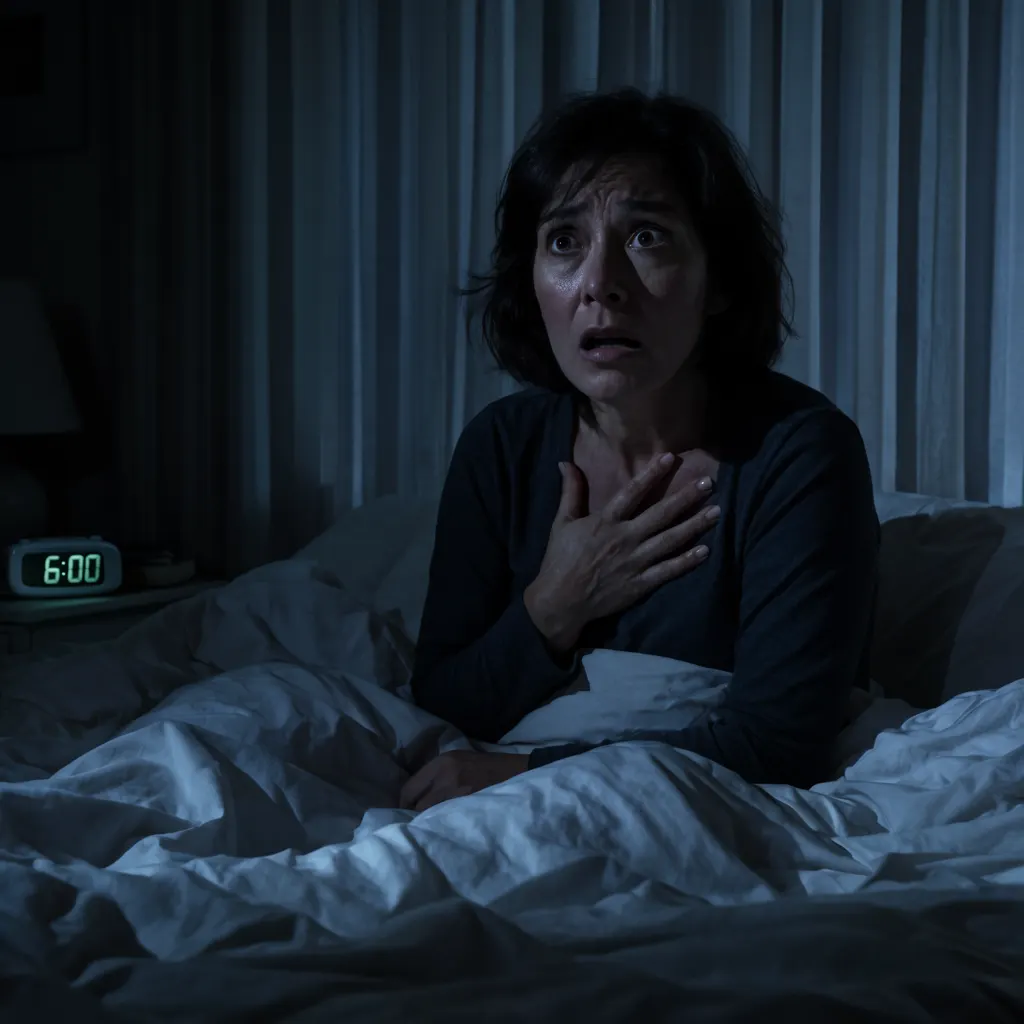
There is a specific perimenopause experience that doesn't have a proper name yet, so women describe it the way you'd describe a haunting: I open my eyes and I'm terrified, and I don't know what of. By 10am it's gone and I feel stupid.
Not sad. Not angry. Not worried about anything in particular. Terrified – heart pounding, palms cold, a voice in your chest insisting something terrible is about to happen, while the actual evidence of the morning is: the dog is asleep, the house is quiet, the worst thing in your immediate future is a meeting about the Q3 numbers.
You check the news. Nothing. You check your kids. Fine. You check your marriage, your money, your health – all quiet. And yet the alarm is going off INSIDE you, not from anything outside. Then, somewhere between the shower and the second coffee, it just... lifts. And you're left feeling like you manufactured the whole thing, which makes it worse, because now you're anxious and embarrassed.
It's not a premonition. It's not a spiritual warning. It's a cortisol spike wearing a trench coat – and perimenopause makes you more sensitive to it Reported: Patient.info.
What morning dread actually is
Every morning, your body wakes you up with a pulse of cortisol – the stress hormone doing its normal job as a biological alarm clock. Cortisol naturally peaks in the morning to get you out of bed and pointed at the day. That's true for everyone, at every age.
Here's the peri twist: when estrogen and progesterone shift during perimenopause, your body can become more sensitive to cortisol – so the same morning pulse that used to feel like "time to get up" now feels like "time to flee" Reported: Patient.info.
The NHS describes the stress response's signature plainly: it changes how you feel physically and mentally, and how you behave – and when that system is running hot, its symptoms include a faster heartbeat and the sense of being on edge Established: NHS. Meanwhile the NHS lists anxiety and mood changes among the recognized symptoms of menopause and perimenopause, noting they can feel worse when sleep is disrupted Established: NHS.
So the 6 AM dread is a stack, not a failure: a normal morning cortisol pulse + a hormone system that's amplifying it + (usually) a body that didn't sleep great = waking up already convinced the other shoe is dropping. It's a state your body is in, not a message about your life.
That's the reframe that matters: the dread is not information. It's weather.
How it's different from the 3 AM wake-up
If you've read our night-sweats explainer, you know the 3 AM wake-up – eyes open at 2:47, brain immediately queueing up every mildly embarrassing thing you've said since 2007. The 3 AM version is thought-driven: it's your brain at its most unguarded, reviewing the tape.
The 6 AM dread is different. It's not about thoughts at all. It's the alarm going off with your nervous system already screaming – heart pounding before a single thought arrives. It's the difference between waking up and starting to worry, and waking up already in the middle of the worry, with no memory of how you got there.
This matters for one practical reason: the 3 AM wake-up responds to thought-management techniques (don't engage the tape, get up, reset). The 6 AM dread doesn't respond to reasoning, because it isn't a thought – it's a physiological state. You can't argue with a cortisol pulse. You can only manage it.
Peri, anxiety disorder, or burnout?
The uncomfortable question every woman asks at 6:15 AM: is this perimenopause, or is this actually me falling apart? Here's the honest framework.
The peri signature. The dread arrives on waking, peaks fast, and burns off by mid-morning. It's physical – pounding heart, tight chest, cold hands – more than it is a story. It doesn't have a "reason" you can find, because there isn't one. It comes and goes with your cycle. This is the hormone-amplified cortisol response, and it's miserable but survivable.
The anxiety-disorder signature. The dread stops burning off. It starts attaching to things – your health, your kids, the drive, the meeting – and generating scenarios that keep it alive all day. It starts avoiding: you decline the thing, you check the thing, you re-check the thing. If anxiety is building a case against your day rather than evaporating by 10am, that deserves a proper conversation with a clinician, not a shrug.
The burnout signature. The dread is there, but so is the flatness. Waking up dreading the day because the day is genuinely, structurally too much – the caregiving, the job, the mental load – with exhaustion underneath. Burnout dread has a cause you can point at, and the fix is partly in the life, not just in the body. (Our caregiving piece and the fatigue files cover this lane properly.)
The three overlap, and peri can absolutely ride on top of anxiety disorder or burnout – the hormone amplification makes a hard thing harder. That's why the differentiation isn't "which one is it" so much as "what does this need."
The red flags: when it's more than morning dread
Here's the boundary, and it matters. The NHS is specific: a low mood – or loss of interest or pleasure – that lasts two weeks or more, most of the day, most days is the threshold for checking in about depression Established: NHS. Morning dread is not depression. But morning dread that is:
- joined by panic attacks during the day (sudden surges of intense fear with physical symptoms – racing heart, chest tightness, dizziness, feeling you're losing control),
- or accompanied by a low mood that hasn't lifted in two weeks,
- or stopping you from doing things – calling in sick, avoiding the drive, canceling plans,
...deserves a conversation with a clinician, full stop. The same conversation should include the question of whether anything else is going on – because perimenopause shares a symptom list with other things. The sleep-apnea explainer covers the one that masquerades as everything, and if the dread comes with your heart actually racing, the heart-palpitations piece has the questions to separate a surge from something cardiac.
Take the clinician questions at the top of this page to your appointment. They're written for exactly this conversation.
What helps the 6 AM dread
The manual is short and it works at the level the dread lives at – the body, not the story.
Morning light, first. Light is the strongest timing signal for the cortisol rhythm. Getting outside or by a bright window within the first hour anchors the pulse properly, so it peaks and falls instead of staying jacked. Open the curtains before you check the phone. Yes, before.
Protein before caffeine. Coffee on an empty stomach is a cortisol amplifier wearing a friendly face. Eat something with protein first – an egg, Greek yogurt, even last night's chicken – and the caffeine hits a calmer system. This is the single cheapest intervention on the list and the one women report working fastest.
The 6am grounding rule. When the dread arrives, do not do the thing your nervous system is screaming for: don't check the news, don't replay the tape, don't scan your life for the disaster. Say out loud: "Nothing has happened. This is a cortisol spike. It will be gone by 10." Then get up, get light, get protein, and let the wave break. Naming it as a mechanism – not a message – is what breaks the loop.
Sleep hygiene, honestly. The NHS notes mood symptoms feel worse with sleep disruption Established: NHS. If the 6 AM dread is riding on a 3 AM wake-up habit, the sleep troubleshooting guide is your next stop – because you're not fixing the dread, you're fixing the fuel.
The HRT conversation. This is where it gets real: anxiety and mood changes are recognized perimenopause symptoms, which means they're on the table for the hormone therapy conversation – not just hot flashes and night sweats. If the morning dread is a regular feature of your life, that belongs in the questions to bring to your clinician. The menopause-society-aligned position is simple: hormone therapy is the most effective treatment for menopause symptoms, and mood symptoms count. It's not "just" anxiety. It's a symptom with a mechanism – and mechanisms have treatments.
What never helps: being told to calm down (there is no calm to return to – you were never not calm), being asked "what's wrong" before the wave breaks (there is no answer yet; the answer hasn't been generated), and googling "impending doom" at 6 AM (the internet will happily confirm every worst case). The dread is not information. Do not feed it sources.
The bottom line
You are not having a breakdown, and you are not being haunted. You are waking up in a body whose alarm system is temporarily set to "everything is a threat," and the reason it's set that way is a documented, nameable, physiological process: the morning cortisol pulse meeting shifting hormones Reported: Patient.info Established: NHS.
The dread is not a premonition. It's a spike. It has a half-life. It will be gone by 10 – and knowing that, in the moment, is the whole trick.
Send the card to the friend who texted you at 6:14 AM asking if she should be worried. Then send her this page. The 6 AM dread has a name now, and named things are manageable.
If you're in crisis or the dread is joined by panic attacks or a low mood lasting more than two weeks, talk to a clinician – and if you're in immediate danger, call 911 or go to an emergency room.