A song did what a thousand infographics couldn't.
When the Holderness Family – Penn and Kim, the ~4M-follower family content brand – released their "Merry Perimenopause" Christmas medley, the comments section crowned it "the new Gen X female anthem." "I have never felt more seen." "I am so grateful to be going through this hell in a time where we are free to talk/sing about it." An OB-GYN office worker requested it for the waiting room playlist Upworthy.
That's the mechanic: recognizable tune + symptom lyric-swap = instant sing-along share. A meme scrolls past; a song gets sung. It gets forwarded to the group chat with the caption "this is us." It becomes a thing you do together.
We're not going to copy their lyrics – theirs are theirs. But the format is public property, and the tunes are even more so. So here's our annual franchise: The Peri-Carols. One new original carol every December, set to a public-domain tune, written for the women who live these symptoms. Vol. 1 is below. Vol. 2 drops next December.
Why a song – not a meme – is the format
Three reasons, in order of importance:
1. Sing-along beats scroll-by. A meme is a hit of recognition you swipe past. A song with a familiar tune is a loop – you sing the hook, you remember it, you sing it to someone else. That's the difference between a like and a forwarding spree.
2. An anthem names the group. "The new Gen X female anthem" is not a compliment about a song. It's a flag-planting: this is ours, this names us. Songs are how communities claim their shared experience – from protest songs to school fight songs to "we're all in this together." Perimenopause, famously, has been suffered alone in silence. An anthem is the opposite of silence.
3. The tune does the heavy lifting. Public-domain carols are pre-loaded emotional shortcuts. Everyone knows Jingle Bells. You don't have to learn a new melody to access a new truth – you just have to swap the words. That's why parody songs hit harder than original comedy songs: the nostalgia opens the door, and the truth walks in.
The Peri-Carols, Vol. 1: "3 a.m., 3 a.m."
(To the tune of "Jingle Bells," James Lord Pierpont, 1857 – public domain.)
Verse 1: Wide awake at 3 a.m., staring at the ceiling, running through the list of things I said without the feeling. Brain is fully charged, body's half asleep, I could quote you every word from that fight in 2003.
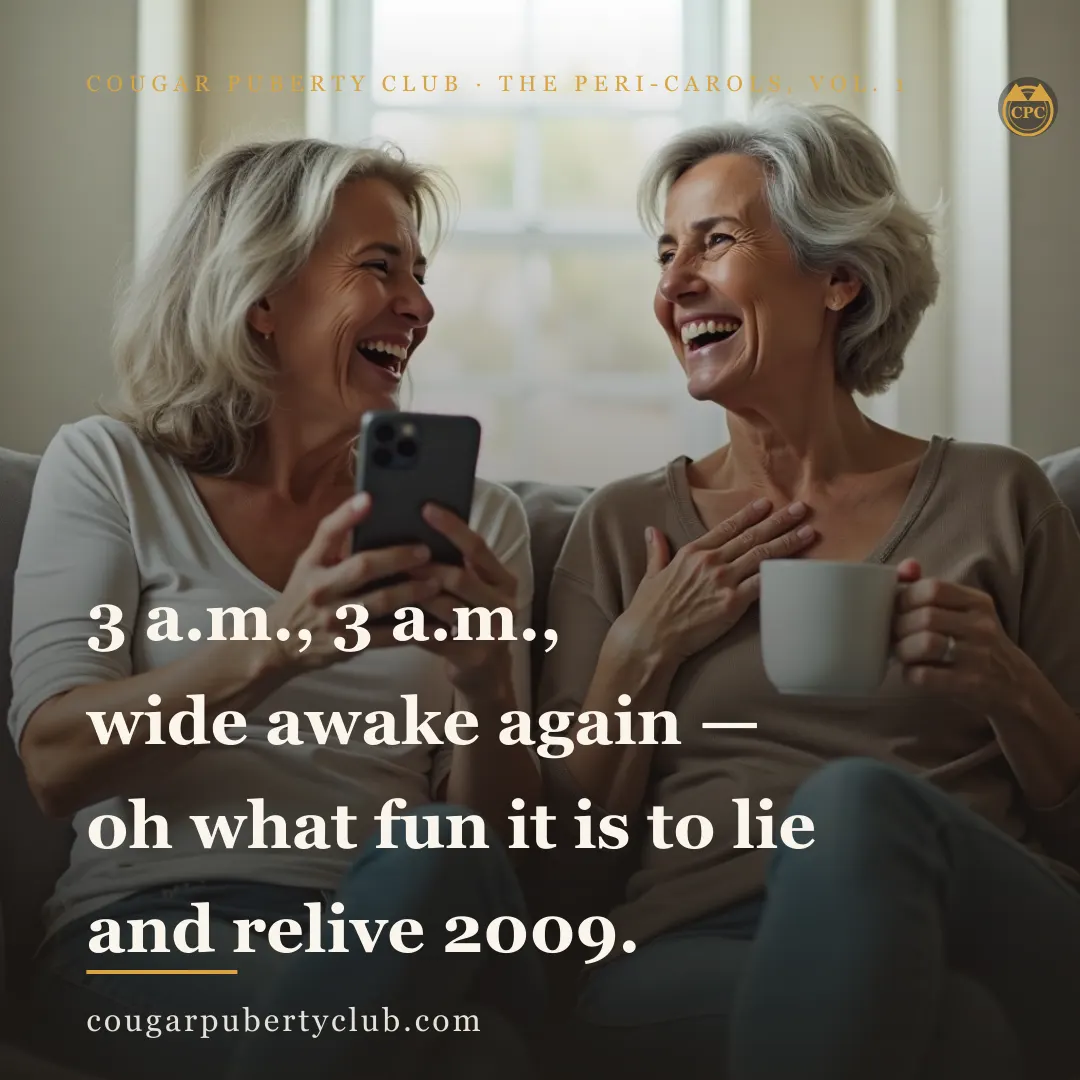
Chorus: 3 a.m., 3 a.m., wide awake again – oh what fun it is to lie and relive 2009! 3 a.m., 3 a.m., brain won't shut it down – oh what fun it is to sweat when the room is 68 around!
Verse 2: Patches on the nightstand, fan across the bed, estrogen is on vacation but my anxiety's well-fed. Calendar says July, thermostat says war, and I've been hot since 2020 – it's the gift that keeps on pouring.
Chorus.
Why this carol: the 3 a.m. wake-up is the most shared peri experience we cover – the witching hour, the night sweats, the brain that treats 3 a.m. as peak productivity hour for regret. Sleep problems are on the NHS's official perimenopause symptom list NHS. The song makes it singable.
Bonus verses for the rest of the year
One carol a year is the franchise promise – but the beats are all here, so here are three bonus verses you can hum now, on tunes you already know:
The Thermostat Carol (to "O Christmas Tree," traditional – public domain)
O thermostat, o thermostat, you are a war, not a setting. O thermostat, o thermostat, he wears a parka, I'm just sweating. The house is 64 and I'm on fire, it's not the heat, it's the hormone choir. O thermostat, o thermostat, you are a war, not a setting.
The thermostat war is one of the most recognized peri experiences there is – we have a whole explainer on why the temperature is a negotiation, not a setting. Heat intolerance isn't a hot flash; it's a state of being heat intolerance, not hot flashes.
The HRT Carol (to "We Wish You a Merry Christmas," traditional – public domain)
We wish you a cool, dry night, we wish you a cool, dry night, we wish you a cool, dry night, and a patch that stays on right. Good tidings we bring – of the word that you lost, good tidings of sleep, and a body that's not always hot.
The Word-Finding Carol (to "Deck the Halls," traditional – public domain)
Deck the halls with words I'm losing, fa la la la la, la la la la. 'Tis the season for the whatchamacallit, fa la la la la, la la la la. See the list I brought, then left at home, fa la la la la, la la la la. Sing we now of brain fog season, fa la la la la, la la la la.
Word-finding – the word that was right there – is one of the most specific and isolating peri symptoms there is, and it's on the NHS list: brain fog, poor memory, trouble concentrating NHS. The brain fog explainer covers why it looks like early dementia but usually isn't.
The franchise rules
Because someone will ask:
- Original lyrics only. We write our own words. The tunes are public domain (Jingle Bells 1857, O Christmas Tree and Deck the Halls and We Wish You a Merry Christmas are traditional). No copyrighted melodies, no copied hooks.
- One carol a year, every December. Annual franchises run on anticipation. Vol. 2 is already on the whiteboard.
- Recognition, not ridicule. The jokes are about the symptoms, the thermostat, the 3 a.m. brain – never about the woman having them. The humor is the recognition that we're all in this song together.
- Send us your lyrics. The best reader verses become Vol. 2 material, with credit (first name only unless you say otherwise).
The serious half
A song can make you feel seen, but it's not a diagnosis. If the 3 a.m. wake-ups are wrecking your weeks, or the word-finding is scaring you, the NHS says the bar for a GP conversation is deliberately low: contact a GP if you think you're experiencing menopause or perimenopause symptoms NHS. The song is the doorway. The appointment prep guide is what to bring through it.
And if you want to send Vol. 1 to the group chat right now – that's what it's for.
- The Peri-Carols, Vol. 1 lyric card is the image at the top of this page – screenshot it, send it to the group chat
- The 3 AM Club: night sweats and the witching hour
- Brain Fog: the word that was right there
- The Thermostat War: a negotiation, not a setting
- HRT Is Back: what actually changed